Meet the Vanguard ETF That’s Crushing the S&P 500 and Nasdaq-100 Despite Not Owning Micron, Sandisk, or Any of the “Magnificent Seven” Stocks
Sandisk (SNDK +8.88%) has been by far the best-performing S&P 500 (^GSPC -0.52%) stock in 2026 with a 544% year to date gain as of the market close on Aug. 13. Sandisk is followed by Dell Technologies, Seagate Technology, Micron Technology (MU +4.13%) — which now has a market cap of more than $1 trillion — Intel, Western Digital, Marvell Technology, Hewlett Packard Enterprise, Lumentum, and Advanced Micro Devices. So the 10 best-performing S&P 500 stocks are all tech stocks with significant exposure to the boom in artificial intelligence (AI) spending.
Given that concentration, you may think that large-cap tech stocks are driving the market to new heights. But surprisingly, small-cap stocks are outperforming mid-, large-, and mega-cap stocks in 2026 — as well as the S&P 500 and Nasdaq-100 — which is the largest non-financial companies by market cap in the Nasdaq Composite (^IXIC -0.32%)
Here’s why the Vanguard Morningstar Small-Cap ETF (VB -0.43%) presents one of the best ways to invest in small-cap stocks, and why the exchange-traded fund could be a buy now.

Image source: Getty Images.
An AI-driven rally
In 2022, the S&P 500 fell 19%, and the Nasdaq-100 fell 33%, as investors questioned valuations and digested inflationary pressures. But on Nov. 30, 2022, OpenAI released ChatGPT for free. What has followed has been nothing short of paradigm-shifting momentum in the U.S. stock market — driven largely by artificial intelligence (AI), the technology sector, and mega-cap growth stocks.
The gains were so large that Bank of America analyst Michael Hartnett popularized the term “Magnificent Seven” in 2023 to describe seven tech-fueled mega-cap growth stocks — Nvidia (NVDA -0.07%), Apple, Alphabet, Microsoft, Amazon, Meta Platforms, and Tesla. The AI-driven rally has expanded significantly beyond the Magnificent Seven, with the biggest winners in 2026 largely companies benefiting from record AI capital spending — from memory chip stocks to networking companies to semiconductor equipment makers.

Vanguard Morningstar Small-Cap ETF
Today’s Change
(-0.43%) $-1.32
Current Price
$307.97
Key Data Points
AUM
$183B
Dividend Yield
1.17%
Expense Ratio
0.03%
Top Holdings
RVMD
0.47%
NTRA
0.45%
EME
0.44%
Changing of the guard
Despite the rallies in tech stocks like Sandisk and Micron, there has been a slowdown in the mega-cap dominance. In fact, Nvidia and Amazon are the only Magnificent Seven stocks that are outperforming the S&P 500 year to date — and Meta Platforms and Tesla have declined.
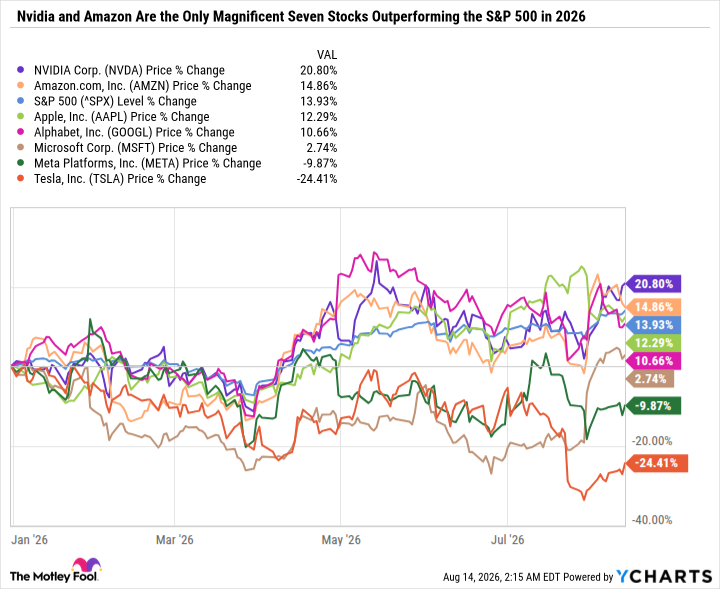
Big gains in semiconductor stocks have certainly contributed to strong 2026 performances in the S&P 500 and Nasdaq-100. But dig deeper, and there’s an equally interesting force at play — which is the rebound in mid- and small-cap stocks.
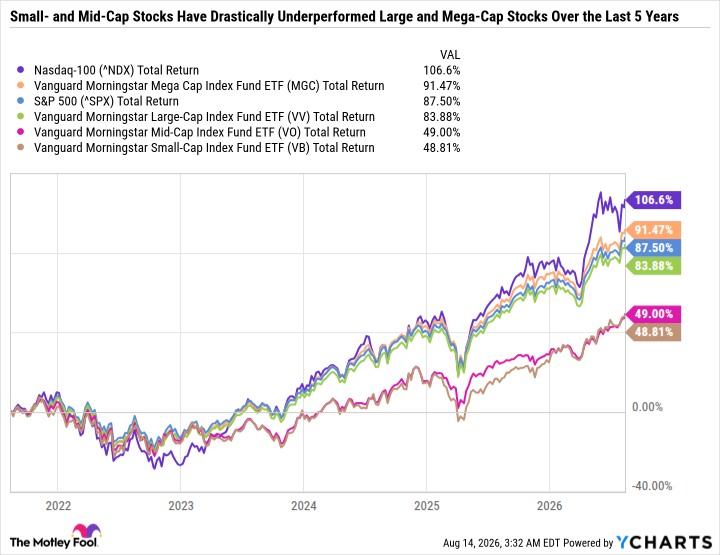
The boom in AI growth stocks coincided with the Nasdaq-100 more than doubling during the past five years, which is particularly impressive considering that period includes the 2022 sell-off. At the same time, small-cap stocks were drastically underperforming their large-cap peers. But in 2026, small caps are doing better than other large and mega-caps, as well as the major indexes.
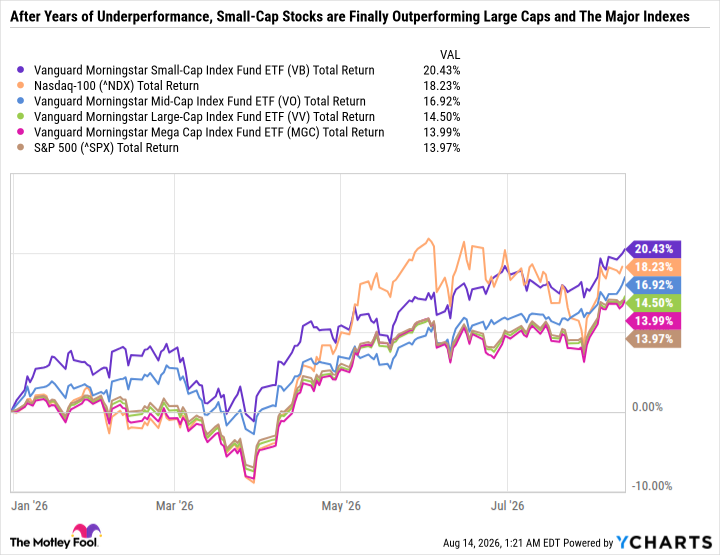
VB Total Return Level data by YCharts
Small-cap stocks remain a good value
Funds like the Vanguard Morningstar Small-Cap ETF tend to perform well when investors question mega-cap growth stock valuations and shift toward value stocks. Even after its strong performance in 2026, the Small-Cap ETF features a mere 22.3 price-to-earnings (P/E) ratio, which is noticeably lower than the Vanguard S&P 500 ETF‘s (VOO -0.47%) 27.5 P/E ratio.
Unlike the S&P 500, which has more than half of its weighting in just 5% of its holdings, the Vanguard Small-Call ETF has 1,311 holdings, and the largest holding makes up just 0.54% of the fund. Top holdings in the Vanguard S&P 500 ETF include well-known companies like Nvidia, Alphabet, and Apple — which make up a combined 20.5% of the ETF. The top holdings in the Vanguard Morningstar Small-Cap ETF are companies you may have never heard of, like Credo Technology, Jabil, Revolution Medicines, and Astera Labs.
The easiest way to visualize the difference between the Small-Cap ETF and the S&P 500 ETF is to look at their sector components.
|
Sector |
Vanguard Morningstar Small-Cap ETF |
Vanguard S&P 500 ETF |
|---|---|---|
|
Industrials |
22.4% |
8.8% |
|
Technology and Communications |
16.8% |
47.7% |
|
Consumer Discretionary |
12.8% |
9.3% |
|
Financials |
12.3% |
11.8% |
|
Healthcare |
12.3% |
8.9% |
|
Real Estate |
7.4% |
1.8% |
|
Basic Materials |
4.7% |
1.8% |
|
Energy |
4.4% |
3% |
|
Utilities |
3.6% |
2.2% |
|
Consumer Staples |
3.3% |
4.6% |
|
Other |
0% |
0.1% |
Data source: Vanguard.
As you can see in the table, the Vanguard S&P 500 ETF has a far higher weighting in technology and communications than the Small-Cap ETF, which is highly concentrated in value and cyclically focused sectors. In addition to having a lower valuation, the Small-Cap ETF also has a higher dividend yield of 1.3%, compared to just 1% for the Vanguard S&P 500 ETF. And both ETFs have identical 0.03% expense ratios — which is just $0.30 for every $1,000 invested.
A good ETF for value investors
The best reason to invest in an ETF is if it fills a particular need in your portfolio — especially one that is hard to replicate through buying individual stocks. If your portfolio is already built around mega- and large-cap S&P 500 stocks, then buying the Vanguard S&P 500 ETF can be redundant and duplicate existing holdings. Whereas the Vanguard Small-Cap ETF would provide significant diversification, as many of its holdings are stocks you may be less familiar with.
In sum, the Vanguard Small-Cap ETF is a good buy for investors looking for an ultra-low-cost way to get exposure to a basket of more than 1,000 stocks — most of which they probably don’t already own.