Atlas Shrugged and Interventionism – Econlib
I. Atlas Shrugged in Brazil
In 1988, when I was 27 years old, I read Ayn Rand for the first time. It was her novel Atlas Shrugged, in its just-released Portuguese edition. At that time, I already considered myself a sort of classical liberal, but my superficial knowledge of political philosophy, among many other gaps in my education, made my convictions not very convincing. It was only after reading her that I gained the libertarian worldview I more or less hold to this day. Mind you, I was already in business and volunteering in the classical liberal movement in Brazil, but that was more of an irreflective reaction to being raised under a military dictatorship and then being governed by a left-leaning populist than the result of any deep thought.
Brazil was enduring at that time the consequences of the 1986 “Cruzado” economic plan under which price controls were imposed on everything, which resulted in immense economic discoordination, forcing the government to intervene more and more on business decisions. In other words, economic chaos.
Reading Atlas Shrugged, it was impossible not to identify the similitude between what I was living and the policies adopted in that fictional United States in which the novel was set, with seizures of steel mills and patents, and with price, wages, and rent controls, among other interventions in the economy.
Not long after that, in early 1990, under the “Collor” plan, the Brazilian government froze all the bank assets in the country: checking accounts, savings accounts, everything. All citizens were left with the equivalent of 50 USD each to restart their lives.
Again, that immediately reminded me of the freeze of railroad debentures in Atlas Shrugged.
If there is a lesson to learn from those years it is that the politically induced economic discoordination that seems unimaginable in a prosperous society like the United States becomes conceivable once interventionism acquires its own momentum.
Worth mentioning also is that Rand understood something that many of her critics missed: the villains in Atlas Shrugged are rarely ideological socialists. They are pragmatists. They intervene not because they seek collective ownership of everything but because they regard every problem as requiring another discretionary exercise of power. The enemy is not merely socialism. The enemy is the belief that no sphere of social life should remain beyond political management.
The Brazilian government overreached into social life so far that when they finally reached rock bottom in terms of economic mismanagement, they were forced into a wave of privatizations, deregulation, fiscal discipline, and monetary prudence that created the conditions for business conditions to recover and endure even when faced by bouts of populism, corruption, and increased interventionism. The strike of wealth creators described in Atlas Shrugged worked in real-life Brazil!
II. What I Didn’t Know About Atlas Shrugged
It was much later that I learned that during the early 1950s years, when Ayn Rand was writing that novel about a “dystopian future,” the United States had an Office of Price Stabilization (OPS) enacting price controls, and a Wage Stabilization Board (WSB) limiting wage increases for workers. That culminated with the 1952 seizure of the steel mills by the Truman administration, and the 1958 Transportation Act which federalized the regulation of rail and led in 1971 to the de facto nationalization of most of it with the creation of Amtrak.
For me, reading the novel in the late 1980s in Brazil and without knowledge of the circumstances in which Ayn Rand was writing, it all seemed futuristic, but in fact, she was writing about the United States of her time.
Americans made many sacrifices to win World War II. Aside from the obvious sacrifices of life, limb, and treasure, they accepted changes to their way of life that originated during the Progressive era, accelerated with the Great War and the Great Depression, truly consolidated during WWII, and were mostly still in force in the 1950s. Many are still with us today.
Federally mandated rent controls in New York started in 1943, employment-linked health care started in 1942, the current iteration of withholding income tax started in 1943, and the subordination of monetary policy to the fiscal needs of the Federal Government started in 1942 and only formally ended with the 1951 accord. I leave it to you to judge whether we ever overcame that.
III. The Real Puzzle
The United States started to move away from limited and representative government as enshrined in the American Constitution, arguably, during the Civil War. The costs of keeping the Union and solving the contradiction between the principles of the American Republic and slavery were tremendous. However, adherence to the same principles established at the Founding reversed most, if not all, of the encroachments on freedom of contract and private property that were required to fund that war. The same cannot be said about the institutional changes introduced with the creation of the Fed in 1913, all the way to the fiscal fiasco we are currently experiencing and socialist legislation being imposed by state and local government around the country. Glaring examples of that are progressive income taxes (in Massachusetts), expropriatory rent freezes (in New York City), and “wealth” taxes (in California and Washington).
That invites us not to question why governments intervene during crises, but why interventions survive the crises that created them.
IV. The Ratchet
It is true, once the existential threats of Nazi-fascism and international Communism were defeated during WWII and the Cold War, some of the most intrusive government regulation of economic activities was paired down and private enterprise was allowed to flourish.
A case in point was the reduction of public spending and the federal debt as a percentage of GDP early in the post-war period, opening room for private investment to happen.
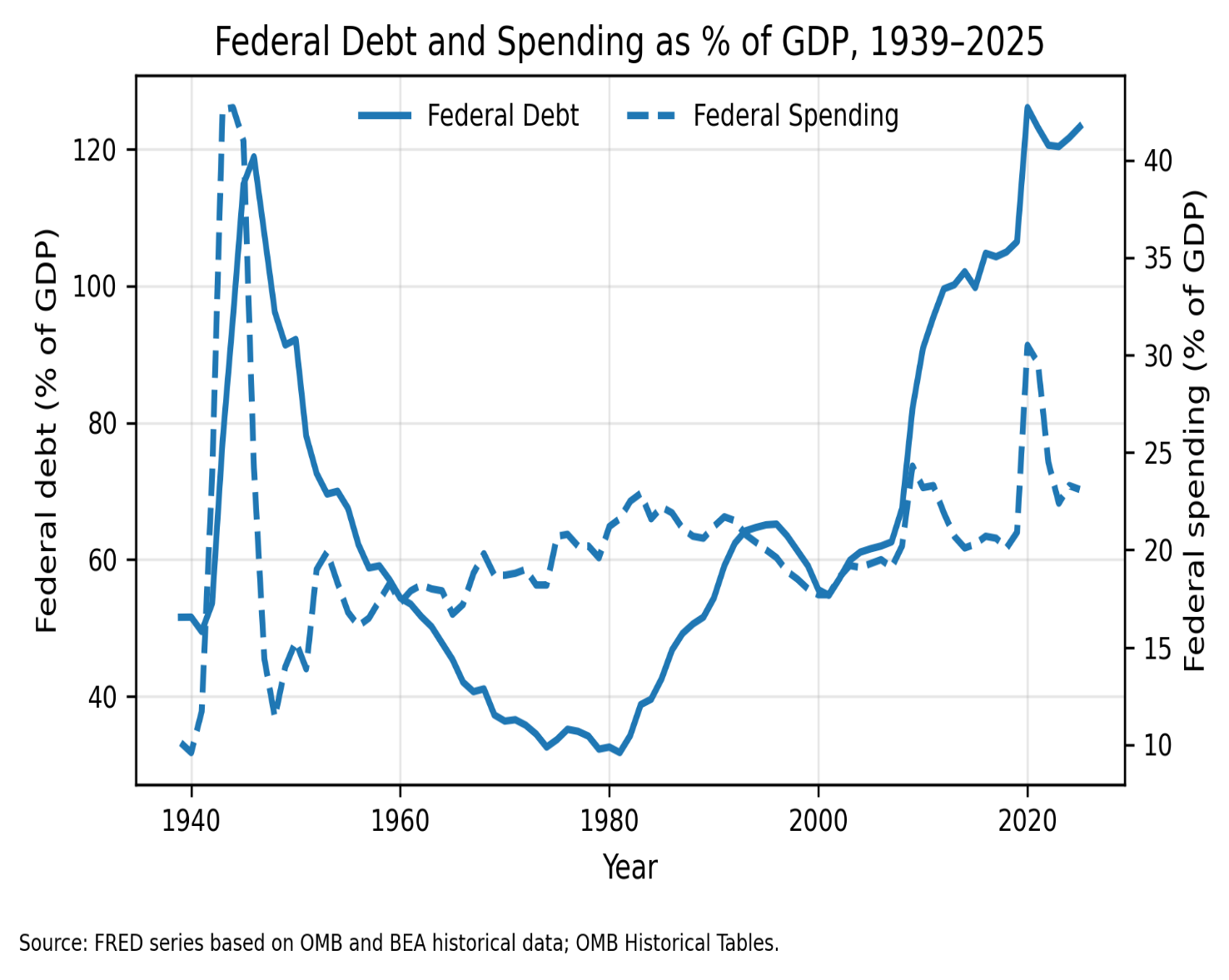
However, confirming Robert Higgs’ thesis, as can be seen from the chart above, once temporarily drastically reduced to about 12% of GDP in the late 1940s, federal spending “ratchet up” and gradually doubled to today’s levels, while the federal debt, after the WWII surge (1941–1946), and a long postwar decline (1946–1980), began a sustained rise in the 1980s and accelerated after 2008 and 2020.
That, of course, describes only the share of everything that is produced in the country (the GDP), that is directly controlled by the Federal Government. If you want to measure how much the state controls economic life in America, we need to add the state and local government expenditures, which average about 10.8% of the GDP since the 1970s.
On top of that, obviously, we need to consider how much of our economic life the state controls indirectly. For instance, think about sectors of the economy that are heavily regulated, where freedom of contract is almost nonexistent, such as health care. The country’s total expenditure on health care represents about 18% of GDP and the private portion of that is about half, that is, 9% of the GDP. Think about other heavily regulated sectors, such as real estate development, car manufacturing, etcetera. Along with this increased politicization of our economic life, a reduction of our protected sphere of personal autonomy took effect. That is, private property rights have been proportionally reduced.
Of course, in the limited space of this essay, I cannot report on all the evolution of interventionism in the United States since the end of WWII. It suffices to highlight that the same pattern has operated since then. The first stage is an “Emergency,” such as a war, depression, financial crisis, or pandemic. As a result, an intervention is introduced as temporary. The next stage is “Institutionalization.” Agencies, regulations, subsidies, monetary arrangements, entitlement programs become permanent. After that, we experience a third and final stage, “Normalization.” A generation grows up assuming these arrangements are natural. At that point the debate is no longer about whether government should intervene. The debate becomes only about how the intervention should happen.
I hope with this essay not just to point out the partial retreats after the Civil War, the Progressive Era, the New Deal, World War II, or, more recently, the Financial crises and the COVID pandemic. That the baseline of state intervention keeps rising was already well attested by Higgs in Crisis and Leviathan.
V. Why the Ratchet Works
The fact is that America in the postwar suffered a cultural transformation. That sapped the popular support for limited government. The ideals of individual freedom and responsibility started to be perceived as less important than other values by a significant part of the population. Specifically, they longed for the impossible to achieve ideal of equality of results and the requirements of equity. Equity, or isonomy, means, originally, equality under the law. That, however, was abandoned by the left side of the political spectrum in order to mobilize political support.
That brings us today to a political environment in which from the right, we see initiatives, by carrots and sticks, to acquire shares in private enterprises.
From the left, we see all sorts of infringement on private property rights, a case in point, rent controls.
At the same time that interventionism has, with ebbs and flows, gradually increased amid apathetic opposition or open support by large swathes of American voters, it has suffered a push back from different perspectives.
The law and economics critique about the lack of alignment between personal incentives and results in the public sector offers one explanation for the permanence of inefficient arrangements. The public choice critique about the unitary nature of economic agents, that is, we should not expect politicians, bureaucrats, and corporate interests to be less selfish than people who have chosen to work in the private sector. The only difference between them is that the set of incentives motivate them to maximize their personal benefit in different ways. It is not realistic to expect them to have a strong interest in the common good. That is a second possible explanation for the continuation of bureaucratic structures once their raison d’être has passed. The Austrian economics critique of the limits of knowledge of public planners is perhaps one of the most damning. The information about the most efficient allocation of resources is not one that can be reduced to statistics for the simple reason that such information does not exist until the economic agents operating under free market arrangements are allowed to interact. People arriving at the farmer’s market on Sunday morning don’t know what they may find, and therefore, they don’t know in advance what will be the best use of their resources. Multiply that to the entire economy and you realize that this is not a problem that computing power or good intentions or socialist doctrinaire rigidity can overcome. The information simply does not exist and will not be created until and unless free markets are allowed to operate. Lack of understanding about this “epistemological” problem so thoroughly explained by Hayek is one of the most important reasons, in my judgment, why people ignorant of its implications, in the left and the right still advocate, in some cases, with sincerity, for interventionism.
Finally, there is the political and moral critique offered both by Christian doctrine and by Neo-Aristotelian philosophy such as the philosophy of Ayn Rand. Human beings are required by their nature to provide for themselves and their loved ones. In order to obtain what they require, they can loot or produce. Looting is a zero-sum game. You can only loot, or tax, which is, in some cases, the same thing, if someone has previously produced. Whether you depart from Imago Dei conceptions about mankind, or a pure naturalistic one, the ultimate justification for state coercion is to protect people in their right to provide themselves and their loved ones with their material needs, and for that, protection against violence and fraud are established collectively with the creation of a political society. Marxists, and many others who claim to know better what is good for others and find in such claims justifications to try to impose their will on others, don’t like those moral arguments, and have tried to create, over the ages, collectivist rationales for their desire to grab power.
In this sense, the arguments in favor of a classical liberal order as they can be derived from public choice, law & economics, Austrian economics, and perfectionist moral defenses of individual autonomy offered by both Christian and Neo-Aristotelian philosophy, are not separate but complementary explanations for why liberty is the best organizing principle for society.
VI. Why It Now Comes from Both Left and Right
Coming to the close of this essay, we can now realize that the defining political tendency of the last century has been the gradual transformation of temporary emergency measures into permanent institutions. Because political power may legitimately direct economic life whenever sufficiently important goals are at stake, both the left and the right find justifications to reduce the sphere of individual autonomy and continue to reduce it. Their disagreement concerns goals, not methods. That seems to me to explain the persistence of emergency measures after emergencies end and why interventionism now comes from both sides.
VII. Conclusion
Let us return to Brazil for a moment. Growing up in Brazil allowed me to see what many Americans no longer notice. Policies that appear normal in one generation were extraordinary innovations in another. From that historical perspective, we can ask whether these institutions serve a free society or merely persist because they have become familiar.
The danger to liberty is not merely intervention during crises. It is society’s tendency to forget that the intervention was ever extraordinary in the first place.
I came to America because it remained the country most committed to liberty and private initiative. The challenge today is not merely resisting new interventions, it is to start questioning old ones. The United States, despite the gradual abandonment of the ideals of a free society by a significant part of its population, reflects in the institutional arrangements developed in the last 80 years, the last best hope for individual human flourishing, and I hope that in the year of its 250th anniversary, the trend against the civic ideals of its Founding could be reversed. I came here from Brazil to enjoy freedom. If the United States fails in providing that, there is nowhere else to go.
Leonidas Zelmanovitz is a Senior Fellow at Liberty Fund, and teaches part-time at Hilldale College.