President Trump Pivots to Asia | American Enterprise Institute
Unable to win the war against Iran, President Trump is unrolling a new strategy: pretending to win. The U.S.-Iran cease fire, honored mostly in the breach for its sixty day term, has lapsed with no negotiations to extend it. President Trump has declared “the Hormuz Strait is open and operating. All water mines have been removed or detonated,” and even boasted it will become U.S. territory.
Responding, Iranian Speaker Ghalibaf said “The United States is in a state of desperation. If it leaves the war, it will lose credibility, and if it continues, it will create dozens of problems for itself.” And Iran has increased the strain on U.S. operations, attacking the U.S. military logistics hub in Bahrain and forcing reliance on facilities in Diego Garcia, five days’ transit from the operating theater.
Fifteen million barrels of oil transited the Strait daily before the war; five million a day transit now. But Iran sporadically attacks shipping under U.S. protection and many carriers remain unwilling to run the risk.
Iran’s terms for ending the war haven’t changed. They include an end to the U.S. blockade and its economic sanctions, removal of U.S. forces from the region, acceptance of Iranian control of the Strait of Hormuz, and payment of reparations. AEI’s Critical Threats Project concludes “Accepting a deal that concedes to these demands would represent a strategic failure for the United States.”
The Administration also hasn’t done itself any favors, further alienating regional allies by failing to adequately protect them from Iranian attacks and even threating to attack Oman, evidently in response to Oman negotiating terms of passage through the Strait with Iran.
What the Trump Administration has done is down-play the importance of a negotiated agreement with Iran (it had previously, fictitiously, claimed negotiations were ongoing only to have that repudiated by Iran), shift focus from military to economic pressure on Iran, and create a news sensation in another geographic theater.
Treasury Secretary Bessent stated the economic measures would be unprecedented. Unsurprisingly, President Trump went further, claiming “This will be an ECONOMIC D-DAY, and we need all of our Allies to stand with the United States of America to isolate, and defeat, the Iran threat.” But allies are unlikely to join in, the President is unlikely to mortgage his desire for a summit with China’s Xi Jin Ping over Iran, and it’s difficult to imagine either economic levers that have not yet been pulled since the U.S. has had sanctions on Iran since 1979 or that an Iranian regime willing to kill 40,000 of its citizens in January to put down protests is likely susceptible to economic pressure.
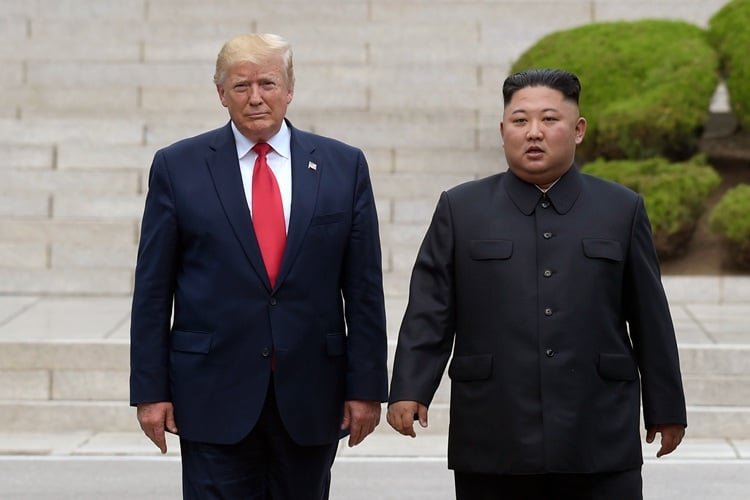
Which is why the President is trying to deflect attention from Iran. He appears to have settled on North Korea as the diversion: “Based on my very good relationship with Kim Jong Un, of North Korea, I am not happy with the fact that the United States has, long ago, agreed to participate in Joint Military Exercises with South Korea.” He further characterized North Korea as “unthreatening and respectful,” while condemning South Korea for not joining the war against Iran or investing enough in the U.S.
Midstream on the most valuable joint training the U.S. and South Korea have to rehearse defending against North Korean aggression, President Trump announced the U.S. would “substantially reduce” U.S.-South Korean military training. The announcement came as a surprise to both the U.S. and South Korean militaries.
North Korea responded with a yawn followed by a slap. The yawn was DPRK Kim Yo Jong saying the cancellation was meaningless. The slap was North Korea launching ten ballistic missiles – a nuclear-capable system — to remind America’s Asian allies of the threat they pose and the limited ability and willingness of the U.S. to protect them. China promptly advised South Korea not to “take sides” between the U.S. and China.
President Trump’s pivot to Asia signals a willingness to lose the war against Iran, corrode alliances that provide the U.S.’ central advantage in dealing with threats from China and North Korea, and embark on a yet another quixotic and poorly thought through foreign policy adventure. It is foreign policy malpractice.