Raising Capital: How Baker Street Advisors Grew to $21B AUM
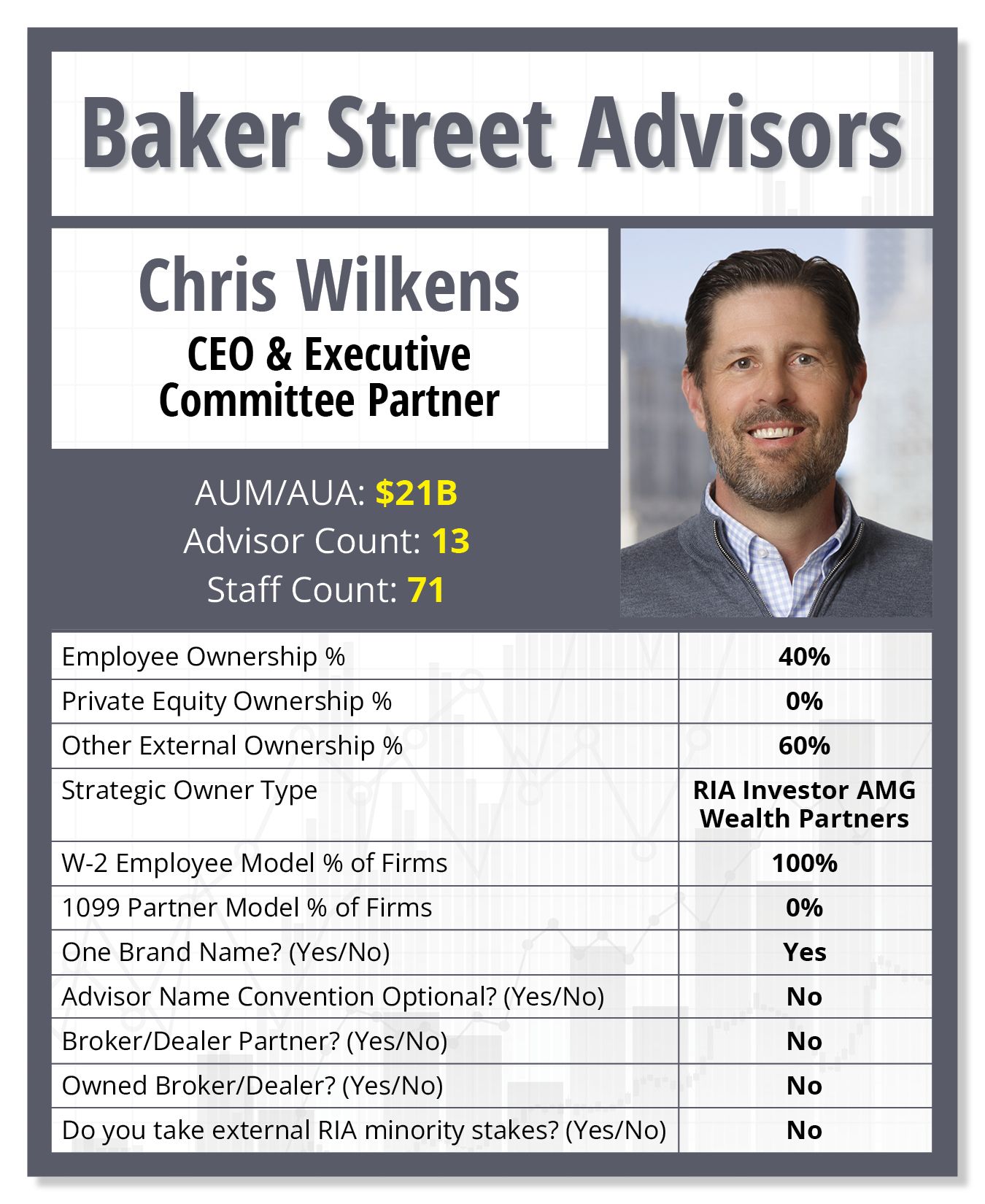
San Francisco-based Baker Street Advisors has grown to $21 billion in assets under management, not through acquisitions, but an organic growth rate that has averaged about 12% over the past 15 years.
Some of that growth was due to being in the right place, at the right time, according to CEO Chris Wilkens, who was among the firm’s first partners when it launched in the geographic heart of the tech boom.
But there is more to the firm’s growth story. Founded by Jeff Colin in the early 2000s, Baker Street has held on to the philosophy that it would grow through new client relationships, expanded wallet share, and hiring and training successor advisors. Even after selling a majority stake to AMG Wealth Partners in 2015, the firm has shunned acquisitions.
Instead, according to relatively new CEO Wilkens, Baker Street stays focused on serving high-net-worth clients with a minimum of $10 million, low fees and long-term relationships, with many clients now on their second or even third advisor at Baker Street.
Could the same strategy work in a less dynamic location? It’s a question Wilkens doesn’t think the team will have to answer any time soon. As he recently discussed with Wealth Management, he sees AI-driven wealth creation surpassing anything he’s experienced in over two decades advising tech workers.
The following has been edited for length and clarity.
Wealth Management: Can you start by explaining your ownership structure and how the AMG stake came about?
Chris Wilkens: Probably by 2013, there were three of us who owned the business: my partner Mike van den Akker, my partner Jeff Colin, who was the founder and employee one, and me. We were each about eight years apart in age, and we sort of understood, looking ahead, that we would ultimately need to do something. We wanted to find a way where we could maintain our fiduciary obligation for our clients, which we think that our independence and objectivity are core to, and then we wanted to find a way where we could sort of pre-negotiate our future retirements while maintaining our independence.
Back in 2013, the choices available to firms were either to sell to a bank or to borrow money from a bank. Neither one of those sounded amazing to us because selling to a bank would conflict with what made us special to our clients, and borrowing money from a bank might not be the advice we would give a client.
The model that AMG presented was really attractive: we could get some value for what we’d created—definitely not profit-maximizing—and have a partner with some experience and wisdom who could give us guidance, but didn’t have control over what we did. We maintain our independence. They don’t have a seat on our board, they don’t have any operational authority in how we run, and that was really appealing. We sold about 60% of the business, retained 40%, and we’ve been recycling the other 40% over the last seven or eight years.
WM: How has your thinking about growth evolved over the years?
CW: I would say it’s evolved, and it’s gotten clearer. Go back 15, 20 years, I think we were a little sheepish about our desire to grow because we kind of felt like the only reason we wanted to grow was that we wanted to have a more prosperous business. That’s not something that you put on a bumper sticker.
As time evolved and we were managing teams and hiring new employees, it became clear to us that we needed to grow to fulfill our fiduciary obligation to our clients. Our clients tend to hire us for decades at a time. We tend to be their second, third or last advisor. When I was getting a new client in my early 40s, I recognized that this client would need us in ways that would persist beyond my career. The only way we can do that is by building a next generation [of advisors].
You’re either growing sustainably, or you’re getting closer to death professionally, because if we don’t grow, the younger, talented people look up and say, “Oh wow, I’d love to have Chris’s job, but I see that we’re not creating any more room at the top because we’re not growing. I’m going to go over and work for [somebody else].” And then, when you start losing your people, you start fraying your client relationships, and ultimately, it’s an illusion to think you’re treading water. You’re really not. You’re sinking a little bit, and it happens slowly, and then all at once.
WM: You also mentioned that scale has become more important. Can you elaborate on that?
CW: The other thing that’s crystallized for us in the last, call it five years: when we started the business with $50,000, maybe even less—I can’t remember—you could have a license and have reporting that was better than any of the broker/dealers. Today, the tech stack has gotten more complicated. The tools have gotten more expensive, and you’ve seen from these other firms that are sort of hyper scaling, scale matters.
I wouldn’t want to be in this business and represent to a client that I could serve their needs for decades or even generations, with a couple of billion dollars under management. In order to be competitive, you need scale to charge market-leading prices, which means not the highest. And you also need revenue and revenue growth so you can afford the expensive tools we need to serve [clients] and have leverage with the sub-managers, too. Our beta costs for clients have fallen by more than 40% over the last 15 or 20 years. One of our values, the value of any advisor, is to act as a bulk purchaser on behalf of our clients and drive costs lower. And so, you need scale.
WM: Many firms are pursuing acquisitions to achieve that scale. Why aren’t you?
CW: If I actually put on my future goggles here, I think there is going to be a point in time where the pendulum swings back because what I’m seeing when I look out at these firms that are on acquisition binges, they’re always talking about how they’re a great home for advisors. And I find that so curious because it’s a great business, but these firms have become broker/dealers in an RIA wrapper. They want to be a place where entrepreneurial advisors can build businesses.
We want to be a place that does things the Baker Street way, with centralized processing around an investment philosophy. Because when one of our clients hires my partner Jordan, well, when Jordan one day retires, they don’t want to be wondering, “Well, what’s the advice I’m going to get then?” They hired us because of our commitment to the principles of simplicity, transparency, low fees and tax efficiency.
We’re not interested in advisors coming in here to build businesses. We’re interested in developing advisors to do things in the way that our clients have hired us to do them.
WM: What are the engines that have worked for you in terms of organic growth?
CW: Well, the first step is having the wisdom to have moved to Northern California from Buffalo, N.Y., in the late ’90s. That’s step one—right place, right time. When I go to national forums, conferences or similar events and meet people from other places, I realize just how tremendous a privilege it is to be in this market. There’s just so much new wealth being created.
Then, you have to deliver for your clients. We don’t do anything unsolicited, and it’s not because of principle. It’s just because we don’t think it’s a good yield on effort. Wealth management is about serving your clients, building relationships, demonstrating to their other professional service providers that you’re serving those clients and making their lives easier, and that you’re open for business, and you cultivate your clients and their providers into referral sources.
WM: And that engine has gotten you to $21 billion?
CW: Exactly. We’ve grown at around 12% compound annual growth for 15-plus years, and we want to grow fast enough to have all the tools we need to be a stable, durable organization, but not so fast that we threaten that durability. I look at firms that might be experiencing a sugar rush from growing really, really fast. Now you can do that at low AUM levels, but the idea that a big firm like ours could—the only way you could do that would be inorganically. You’d have to do that through acquisition if you want to try to achieve a 20% growth rate. And it isn’t really a 20% growth rate for equity owners because you’d be diluting over time.
WM: Finally, you mentioned you’re seeing unprecedented wealth creation in tech right now. Can you talk about that?
I have never seen what’s going on right now. Go back to the first dotcom [boom], go back to the mobile wave, social media wave. I’ve never seen wealth like what is being created today. [We’re seeing] clients who are signing up on the precipice of liquidity of a magnitude that’s unprecedented for us. We feel great about that.
The tools our advisors use to help these clients are familiar—ISOs, non-qualified options and RSUs. It’s just the numbers that are different; there are more commas. There are more commas, and there are fewer years. It’s astonishing.