Brunswick CFO sets course in a changing boating market
Ryan Gwillim spent the first seven years of his career practicing law, work he said he loved, before a series of roles at Brunswick Corporation eventually put him in the CFO seat.
Gwillim joined Brunswick’s legal department in 2011 and worked his way through corporate securities and M&A roles before moving into investor relations in 2017. He became treasurer two years later and CFO in 2020. Brunswick added chief strategy officer to his title in 2024.
Today, he oversees finance for the $5 billion marine business whose portfolio includes prominent boat brands like Sea Ray, Boston Whaler, Bayliner, Lund, and Harris, along with Mercury Marine engines and Freedom Boat Club (Brunswick’s subscription boat service). The company’s footprint also extends to advanced marine technology brands like Lowrance and Simrad.
Brunswick’s history is equally notable; founded in 1845 as a carriage maker, it successfully evolved from a traditional billiards and bowling giant into the world’s largest manufacturer of recreational boats and marine engines.
In the cabin of a 2027 Sea Ray SLX 360 at Brunswick’s media day at Brooklyn Marina last week, Gwillim sat down with CFO.com to talk about his role, the economics of the boating business and how Brunswick evaluates technology investments that don’t come with an easy-to-calculate return. He also explained why developing an interest in boating has become a crucial part of doing his job as CFO.
Ryan Gwillim
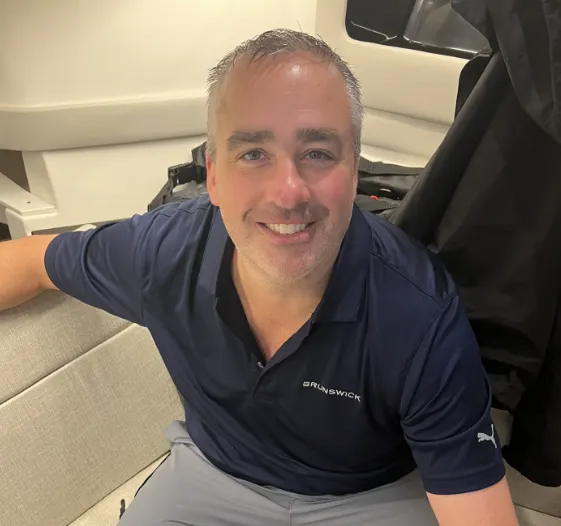
PHOTO: Adam Zaki/CFO.com
CFO and chief strategy officer, Brunswick
First CFO Position: 2020
Notable previous employers:
- CPA Global
- Baker & McKenzie
This interview has been edited for brevity and clarity.
ADAM ZAKI: Brunswick participates in nearly the entire boating ecosystem. What are the advantages of having all those different pieces of the industry under one company?
RYAN GWILLIM: I always say we do better as one Brunswick. It’s very clear we have unique synergies that really go across the entire ecosystem.
We’re sitting on one of the best examples. This is a Sea Ray boat, so from our boat group, it has AutoCaptain, which is an autonomous solution that puts Navico, Mercury and the boat group together. It’s powered by Mercury outboard engines, and it has a ton of engine parts and accessories that’s Mercury. This is a perfect example of why we’re just better for the consumer to be able to do all this at once.
And it’s not only our product. We’re able to walk to another boat [original equipment manufacturer] and say, “What you’re good at is building the hull, the structure. Let us come in and do everything else. Let us do the electronics, the systems, the propulsion.” That’s a pretty powerful message.
Brunswick has the resources to do that ourselves. A lot of the smaller boat OEMs don’t have fleets of software engineers and fleets of mechanical engineers, so we can actually do a system from bow to stern for them because we know our stuff works together.
Now, it doesn’t mean we don’t look outside. There are times when we look outside and say, “We’d really like that skill set,” or, “We’d really like that product.” We can just buy it, we could buy the company, or we can go do it ourselves. That’s how we got Navico Group.
Mercury is quite good at this. There may be a technical component that’s hard to get, or we’re getting less supply because the supplier is focused on other things. A lot of times we share supply with auto companies or other vehicles, and if their volume is 100 times our volume, sometimes our componentry gets less attention.
It really is having an entire enterprise focused on various pieces of the ecosystem, but then combining them for the benefit of the customer. All of this is done so we have the best product for the customer. None of it is done just to say we can do it.
Boats are some of the largest discretionary purchases available to consumers. Beyond interest rates and consumer confidence, what do you track to get a sense of where demand is headed?
Obviously, sentiment is big, just because it seems to feed a lot of the other metrics. Interest rates are something that we watch, and certainly on the value end of our product line, that consumer is a little bit more interest-rate sensitive.
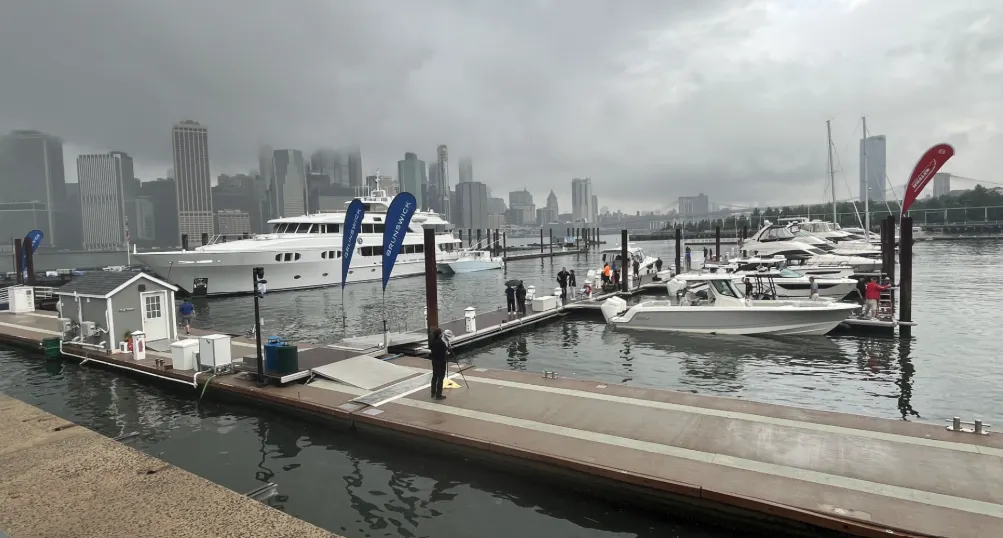
The pre-show setup of Brunswicks’ media day in Brooklyn, New York on August 18th, 2026.
PHOTO: Adam Zaki/CFO.com
We do watch fuel, but believe it or not, fuel prices, unless they really skyrocket, don’t prevent people from getting on their boat. The average boat owner uses about 25% of the gas in a year that their comparable auto would. It’s generally a couple of bucks more expensive at the marina, but we don’t see anybody boating less just because the gas is $6 or $7 versus $5 or $6.
We obviously track participation stats, and that is boat registrations. In almost every state now, you have to register your product. So we know there are about 10 million boats in the boat park just in the U.S., and we want to make sure that stays either going up in the areas that we play or certainly static, and it is.
Then new boat sales. This is one where we have to caution everybody because new boat retail sales are something a lot of our investors follow. But you noticed I mentioned it fifth or sixth. Yes, it is a metric that shows the health of new sales, but it’s very much geared toward the value side because of the number of units in value versus core and premium.
In our business, 90% of our boat earnings come from core and premium, and on a unit basis, that’s a heck of a lot smaller than the value side. This year, the market in the U.S. is going to be flat to slightly down on units. The core and premium, though, is flat to slightly up. That’s really what drives all of our sales and our earnings.
When investors say, “Boats are down 4%. What’s wrong?” Sure, they are, but focus on everything else that we do. The dollar value continues to rise. So you just can’t get too bogged down in a retail boat metric.
Companies like Harley-Davidson are dealing with an aging customer base and a huge supply of used motorcycles that is driving down sales of their new bikes. How do you prevent the Brunswick brands from ending up in a similar position?
The interesting thing is our used park is actually shrinking. Our last biggest year of new boat sales in the U.S. over 300,000 was 2004, right before the start of the great financial crisis That hit and it went down from there.
“So many times in the past, the team would design a boat and the design specification would say it would have a 25% gross margin. Then the first one would come off the line and it would have a 23% gross margin, and then by the time it’s in production, it’s 18% and the IRR doesn’t look like what it did before.”

– Ryan Gwillim
CFO and chief strategy officer, Brunswick
It’s the new boat park that seeds the used park. You used to have 300,000 boats that would be gently used, then more used, and today, that last year of 300,000 would be 21 years old. They’re still out there in good condition, but you can imagine the boat park in the used market is a lot smaller.
From 2007 to today, the average is 170,000 to 180,000 units. So the number of used products getting seeded in is actually almost half, maybe a little more, maybe 60%.
What we’re actually hearing from dealers is that if people want a gently-used product, there’s not a whole lot out there. Combined with the fact that those 10 million boats in the boat park are staying pretty steady, we actually believe that is going to be an impetus for new boat sales because people are going to start seeing there’s not a whole lot of gently used. So let’s go see what the new option is.
It also helps Freedom Boat Club. If you want to get into boating and you don’t want to go buy your own boat, Freedom is a perfect way to get in. It’s a one-time down payment of about $5,000, and then it’s a monthly payment of $300 to $500 to join the club, have access to all of the product and have access to their product at reciprocal clubs.
If $5,000 down and $300 to $500 a month sounds familiar, it should, because that sounds like the payment terms to a loan for a boat. It just so happens that the economics work out this way. The economics of that consumer joining Freedom, using the club, paying their dues, using the product, generating parts and accessories and generating the need for engines and everything else, are actually greater for us and them than a one-time sale.
We bought Freedom in 2019, and it’s been one of the best acquisitions we’ve made.
Where have you seen recent technology investments pay off across the brands?
Let’s separate technology into two different buckets. If you want to talk about boating technology, you could run an [internal rate of return] on how much sales are going to come from that, the earnings associated with it and the free cash flow. You can decide if you should invest. It’s pretty straightforward.
Look at the engines out here. Look at the boat we’re sitting on. All of these had product development plans and a high-performance product development system to go through and develop it, with a backstop and an IRR and an approval to proceed to spend money. It’s either above our hurdle rate or it’s not. If it’s not above our hurdle rate, it’s going to get killed or declined in the process.
“Keeping people on the water is the magic sauce for us. It drives all of our recurring revenue and earnings. It enables us to have the cash flow to reinvest in technology.”
– Ryan Gwillim
CFO and chief strategy officer, Brunswick
We do such a better job now designing our products to not only be what consumers want, but to make money as well. So many times in the past, the team would design a boat and the design specification would say it would have a 25% gross margin. Then the first one would come off the line and it would have a 23% gross margin, and then by the time it’s in production, it’s 18% and the IRR doesn’t look like what it did before.
Where it’s less tangible is AI investments and investments in ERP systems. It’s a little more challenging because some of it is investment in making the boat easier, making the engine more compatible, more connected to the captain, and so those you can’t really match with an IRR. You have to do some real work. Is this something consumers want? Is this something that will make boating easier?
We’re getting our heads around AI and all the investment there, but I think we have our best foot forward. AutoCaptain is a great example of just the technology on a boat that’s really ahead of anything else we have. We have AI agents coming that we’re going to put on boats that will help make the captain a better boater.
Can I measure that in an IRR? Probably not. But I can certainly say if we have systems to make boating easier for consumers, that drives all the other things. Keeping people on the water is the magic sauce for us. It drives all of our recurring revenue and earnings. It enables us to have the cash flow to reinvest in technology.
That is really a flywheel that has elevated our earnings flow over time from just being really focused on being a boat company 20 years ago to today, focused on technology, products and innovation.
How much do you have to know the business and the products to be an effective CFO? Are you a boater yourself?
First of all, to do my job successfully, I have to admit that we are a product, technology and innovation company, full stop. I would not be able to do my job if I didn’t know the answers about all of our products.
To [CEO David Foulkes’] credit, anytime there is a product review, we are encouraged to join and be a part of it. I travel and go to all the product development meetings, the quarterly ones and little stuff in between, because you have to have firsthand knowledge about how our product works and, more importantly, what separates our product from the competition. That starts to become a real value driver for investors.
I’m in front of investors very frequently. Knowing what separates our engines from Yamaha engines, for instance, or what the benefit of AutoCaptain is, it’s crucial. Without it, I don’t think anybody can be a successful CFO.
I love boating. I would love to do it more. We live in the Midwest so my boating season starts May 1 and generally ends a little bit after Labor Day, just because things are busy with travel. I’m also fortunate that I get to test our products whenever we go to one of our manufacturing facilities, so I’m definitely on the product even more often because of that.
But having a youngish family, with all their activities and work, makes it hard to be out every weekend. But when we’re out on the water my family really enjoys it.