The Dark SaaSpocalypse Cloud We Could See Through
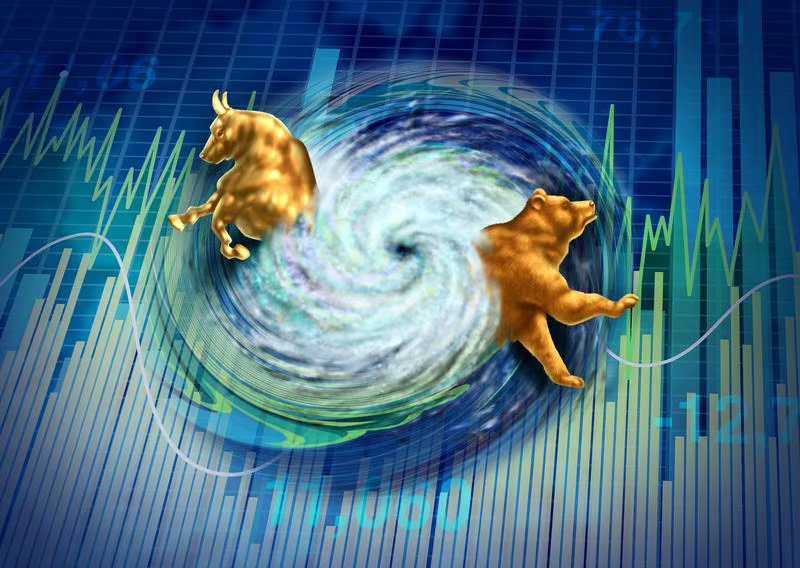
Some of the best opportunities of an investing lifetime arrive disguised as disasters. A frightening headline breaks, the crowd bolts, and a stock sinks under a storm of pessimism. Most investors see only the storm. A few see through it – and the crucial word is see. This isn’t about hunting for whatever has fallen furthest and hoping. It’s about knowing a business well enough that when the crowd panics, you can tell a broken thesis from one merely being tested. Conviction comes first; the cloud just offers a better price to act on it.
TMF co-founder and Chief Rule Breaker David Gardner has a name for this. In Rule Breaker Investing, he writes: “Detecting competitive advantage where others see vulnerability or weakness sets up the most lucrative investing opportunities. I call these situations ‘dark clouds I can see through.'” His image is pure Peanuts: “Picture a storm cloud bursting with lightning and rain directly over Charlie Brown’s head.”
The catch, he cautions, is real: “You have to show humility in the face of so much confidence on the other side. You may very well be wrong.” But when you’re right and you hold, skeptics turn into converts and the stock “climbs the proverbial wall of worry.” Two recent storms show the idea in action.
CrowdStrike, July 2024
When a faulty CrowdStrike (CRWD -1.09%) update crippled millions of Windows machines, the damage looked like it might last for years. The stock, near $85 beforehand, plunged more than a third to $54.50 within weeks. (Those 2024 figures are split-adjusted; CrowdStrike executed its first-ever stock split, 4-for-1, on July 1, 2026.)
In our Rule Breakers service, we put it in the Penalty Box – but we did not sell. We moved it to Hold, watched two quarters of growing customers and deepening usage, and moved it to buy again that December, by which point it had already passed its pre-outage price. The cloud was real but temporary: CrowdStrike has since nearly quadrupled off that low, touching $216 this month.
The SaaSpocalypse of 2026
The bigger, darker cloud came this year. Software had spent two decades selling by the seat: 500 employees meant 500 licenses, billed monthly like clockwork. Then artificial intelligence (AI) agents started doing work that used to require a human with a login – and if the work no longer needs the human, the reasoning went, it no longer needs the seat.
Investors decided the model was breaking and named the panic the “SaaSpocalypse.” Software fell below the S&P 500 for the first time ever, and the software exchange-traded fund (ETF) logged its worst quarter since 2008.
We saw a dark cloud we could see through. Agents can’t route around software that sits on a control point – to do anything useful, an agent must read and write the records and permissions living inside those platforms – and ripping out a system of record means rewiring workflows and reproving compliance, so customers stay put.
The fear also confused how software gets paid with whether it gets paid; the best platforms were already shifting toward charging for what agents actually do. In cybersecurity, the fear was backward entirely: Every new AI agent is one more identity to verify and one more door to guard, which means more security spending, not less.
So, rather than sell into the panic, Team Rule Breakers held its software leaders – names like Salesforce (CRM -0.84%), Datadog (DDOG +0.72%), and Palo Alto Networks (PANW -1.22%) – and, most tellingly, recommended Veeva Systems (VEEV -0.87%) as a fresh buy right into the storm on April 21 at $167.79.
This was not a stock we met in the wreckage: Veeva had been a Rule Breakers recommendation since 2014, studied for over a decade before the cloud rolled in. That’s what made the call possible. For members already holding, April was a chance to add to a winner at a discount; for everyone else, an invitation into a business we’d long understood, at a price the panic handed us.
By mid-2026, the clouds had thinned. Earnings proved the theses intact: The most defensible software names comfortably outran the recovering software ETF, security leaders beat estimates and raised guidance as demand rose, and Salesforce’s AI-agent product alone reached $1.2 billion in recurring revenue. Veeva trades near $248 today, up roughly 48% from that April recommendation (and beating the market by nearly 39% to boot).

None of this felt obvious at the time. That’s the point. Dark clouds never feel comfortable; they feel like everyone else knows something you don’t. Sometimes they do – which is why the work has to come before the storm, not during it. But when you already know why a company wins, and your research says the hurdle is temporary, these are the moments that build Rule Breaker fortunes.