Vistra Stock Sits 37% Below Its High While Power Demand Keeps Climbing. Should You Buy It?
Electricity demand is doing something it hasn’t done in decades in the United States: growing fast. Vistra (VST -1.95%), one of the country’s largest competitive power producers, told investors in its latest quarterly filing that data centers, the electrification of oil field operations, and electric vehicles are contributing to projected “fast-paced load growth” in the markets it serves.
You wouldn’t know it from the stock. Shares have dropped about 37% from a 52-week high of $219.82, to about $139 as of this writing. And Vistra has company, as the whole independent power group has sold off this year. Nuclear operator Constellation Energy, for instance, is down about 32% from its own high.
With demand for Vistra’s product climbing while its share price falls, is this a buying opportunity?

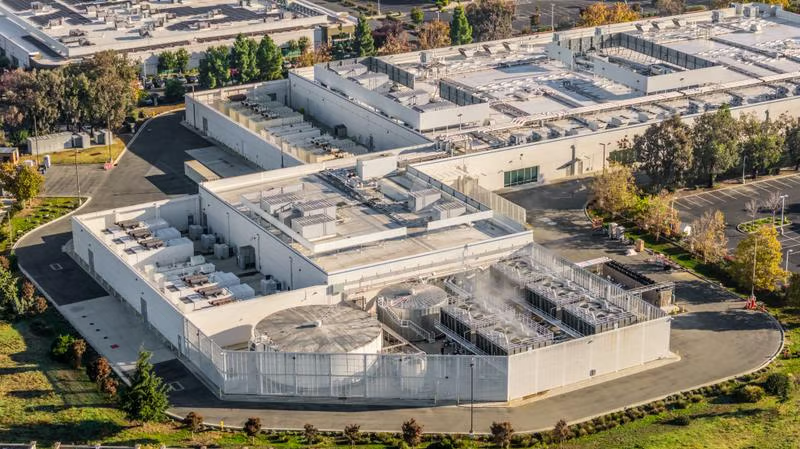
Image source: Getty Images.
A strong year, mostly locked in
Vistra’s latest results, reported earlier this month, showed a business moving in the opposite direction from its share price. Adjusted earnings before interest, taxes, depreciation, and amortization (EBITDA) from ongoing operations rose about 31% year over year in the second quarter, to $1.77 billion from $1.35 billion a year earlier, helped by higher realized power and capacity prices and contributions from recently acquired plants.
Management also reaffirmed its 2026 adjusted EBITDA guidance of $6.8 billion to $7.6 billion. Even more, it said it expects to land at or above the midpoint of that range.
The cash generation behind those earnings is substantial. The company guides to adjusted free cash flow before growth investments of about $3.9 billion to $4.7 billion this year. Against a market capitalization of about $47 billion, the midpoint works out to a roughly 9% free-cash-flow yield.
And unusually for a business tied to commodity power prices, this year’s results are largely spoken for. Management says about 100% of its expected 2026 generation volumes are hedged. Topping it all off, the company has been shrinking its share count aggressively, repurchasing about $6.5 billion of stock since late 2021 and reducing shares outstanding by about 30%.
Amazon and Meta signed on for 20 years
The development I find more important for the long run, though, is who is signing up to buy Vistra’s power — and for how long.
In September 2025, the company struck a 20-year power purchase agreement with Amazon Web Services, the cloud computing arm of Amazon (AMZN +3.97%), to supply 1,200 megawatts of carbon-free power from its Comanche Peak nuclear plant in Texas. Deliveries are expected to begin in late 2027.
In January, Vistra followed with 20-year agreements with Meta Platforms (META +1.21%) covering 2,609 megawatts of nuclear power and capacity from its Perry, Davis-Besse, and Beaver Valley plants, including new capacity from planned upgrades to all three. Deliveries under the Meta deals start late this year.
Notably, those Meta agreements aren’t even in the company’s 2027 outlook yet. Management points to an adjusted EBITDA “midpoint opportunity” of $7.4 billion to $7.8 billion for 2027 excluding them (and excluding a pending acquisition of gas plants). Vistra has also committed up to $1.0 billion to Helix, a new data center infrastructure venture where it will serve as the preferred power partner.
In short, nearly 4,000 megawatts of the company’s nuclear output is now contracted to two of the world’s largest technology companies for two decades each. That’s revenue visibility competitive power producers rarely get.

Today’s Change
(-1.95%) $-2.72
Current Price
$137.09
Key Data Points
Market Cap
Day’s Range
$136.61 – $141.10
52wk Range
$132.66 – $219.82
Volume
3.1M
Avg Vol
4.3M
Gross Margin
20.18%
Dividend Yield
0.66%
Should you buy it?
Adjusted EBITDA is up 31%, guidance is intact, and decades-long contracts keep stacking up. Yet the stock trades at a forward price-to-earnings ratio of about 13. The drawdown looks less like a verdict on Vistra and more like the market cooling on the AI-power trade that got crowded in 2025.
Sure, there are risks. Vistra sells into competitive markets, so beyond its hedges and contracts, its results ride on power prices no one controls. A slowdown in data center construction could test the demand thesis. And second-quarter net income was just $305 million, weighed down by unrealized losses on hedging positions — lumpy accounting that comes with this business model.
But at a forward price-to-earnings ratio of about 13, with this much of the future under contract, I think the stock is attractive. And I’d be a buyer at today’s price. If power prices roll over or the data center deals stop coming, that would change my thinking. For now, I’d simply size the position with the volatility in mind.