Louis Vuitton x Singer Reimagines Two Porsche 911s
In the 17 years since Singer Vehicle Design was founded, the California-based company has become one of the most recognizable names in the world of restomods, restoring and modifying classic Porsche 911s through what it calls “reimagining.” At Monterey Car Week 2026, Singer took that approach somewhere new, revealing its first collaboration with Louis Vuitton.

Photography courtesy of Singer Vehicle Design
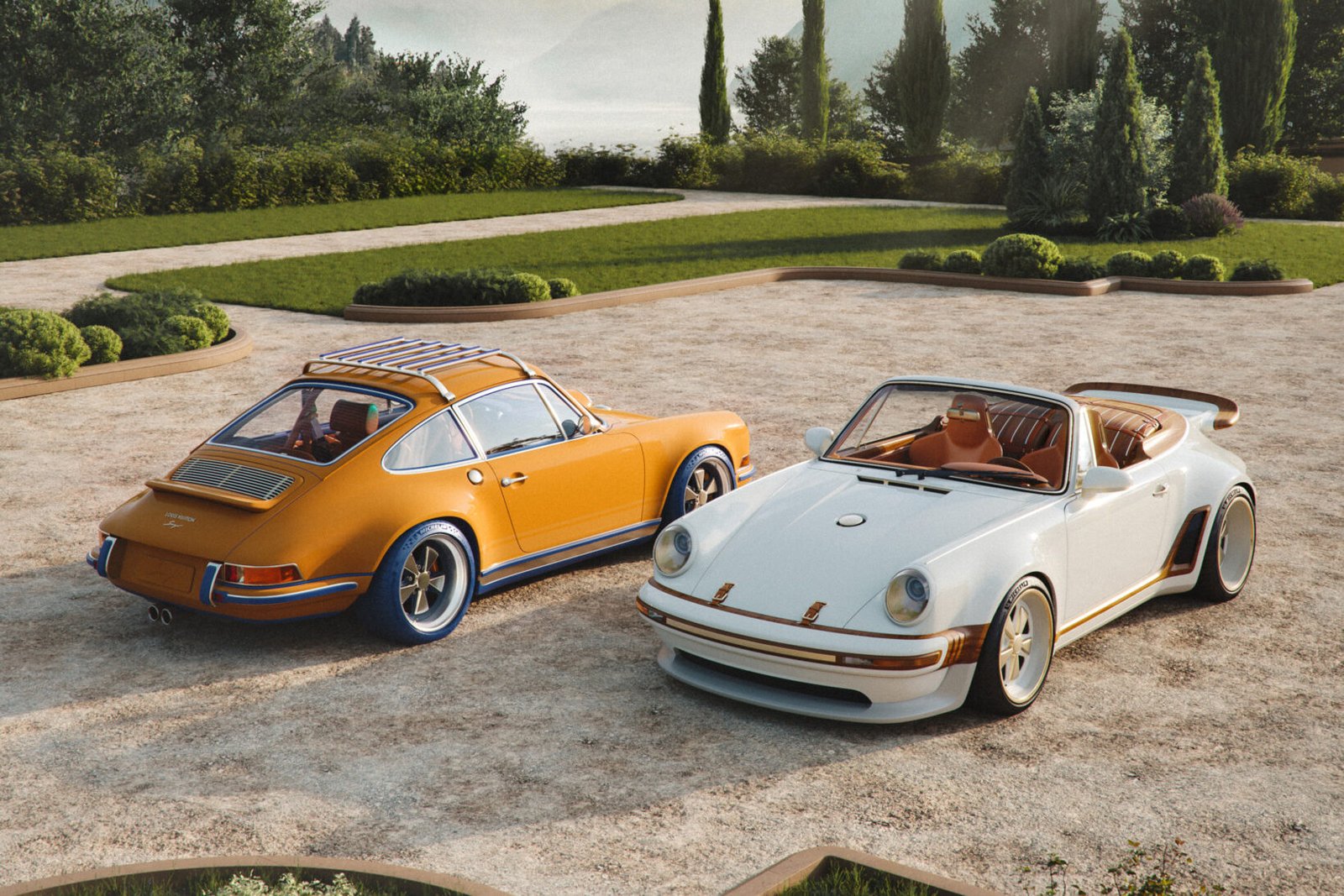
The partnership produced two distinctly different cars. The Porsche 911 Reimagined by Singer – Classic combines Louis Vuitton’s saffron, cobalt blue, and yellow with the fashion house’s long history of travel, luggage, and watchmaking. Its counterpart, the Porsche 911 Reimagined by Singer – Classic Turbo, was conceived with Louis Vuitton Artistic Director of Women’s Collections Nicolas Ghesquière and takes a more unexpected nautical turn.

The Porsche 911 Reimagined by Singer – Classic. Photography courtesy of Singer Vehicle Design.
According to Singer’s founder and executive chairman Rob Dickinson, the twin 911s were years in the making, with teams traveling between Paris, California, and England throughout the process.

Sketch courtesy of Singer Vehicle Design
“We were constantly exchanging ideas, with an enormous volume of renderings, digital design data, paint, and leather samples, and then photographs of the cars as they evolved,” he says. “Our two houses brought different expertise to the project, but we share the same standards and the same ambition. Every major decision was made together.”

Porsche 911 Reimagined by Singer – Classic Turbo. Photography courtesy of Singer Vehicle Design.
What became an unusually comprehensive collaboration began with something much smaller: a Singer client wanted a Louis Vuitton clock installed in their car. Louis Vuitton approached Singer about creating it, and Singer chief strategy officer Mazen Fawaz says the conversation quickly expanded until “the collaboration was extended to encompass every element of the car.”

Photography courtesy of Singer Vehicle Design
Word of the project also traveled within Louis Vuitton, eventually reaching Ghesquière. “This in turn led to a collaboration on a second car, which became the turbocharged cabriolet,” Fawaz explains.

Photography courtesy of Singer Vehicle Design
The original coupe shows just how far the project moved beyond a dashboard accessory. La Fabrique du Temps, Louis Vuitton’s watchmaking workshop in Switzerland, developed a removable mechanical clock inspired by the house’s signature Tambour watch, but integrating it convincingly meant Singer couldn’t simply drop the timepiece into the existing dashboard. The surrounding speedometer, tachometer, and gauges were ultimately redesigned to speak the same visual language, turning what began as one new component into a roughly year-long exercise in rethinking the instrument panel.

Photography courtesy of Singer Vehicle Design
That same level of attention extends throughout the cabin. Natural-toned leather references the cowhide associated with Louis Vuitton luggage, with yellow stitching and diamond embossing adding subtler connections to the house’s leatherwork. Even the hardware received attention: Plastic components that might normally go unnoticed gave way to metal switches, locks, vents, and controls, finished with techniques borrowed from watchmaking.

Photography courtesy of Singer Vehicle Design
Outside, the saffron bodywork is paired with cobalt blue accents and a specially designed roof rack that can carry luggage, skis, or a surfboard. That emphasis on packing for the road reaches surprisingly far back into Louis Vuitton’s history, as the house began making automobile-specific trunks in the late 19th century.

Photography courtesy of Singer Vehicle Design
The drop-top Classic Turbo takes the collaboration in an entirely different direction. Conceived with Ghesquière, the Calcaire Lutétien white cabriolet looks to classic motorboats for many of its cues. Wood becomes a defining material, appearing on the bumpers and throughout the storage areas, including a rear luggage deck whose varnished finish recalls the deck of a runabout. Even the lightweight white roof contributes to the nautical character, its stretched form evoking a sail.

Photography courtesy of Singer Vehicle Design
The clock is also handled differently, with the timepiece positioned in the center console. Gold-toned gauges and natural leather continue the material palette, while the varnished wood compartment behind the seats has been shaped around both the car’s luggage and removable roof. One of the more playful references appears at the gearshift, where a leather drawstring borrows the familiar closure of Louis Vuitton’s Noé bag.

Photography courtesy of Singer Vehicle Design
Both cars are accompanied by bespoke capsule collections that carry their individual design languages beyond the vehicles themselves. Clothing, helmets, driving accessories, and luggage were developed around each car, with some pieces designed specifically around how they would be transported. For the coupe, that means a Louis Vuitton surfboard and a pair of skis that can ride on the roof rack.

Photography courtesy of Singer Vehicle Design
“Witnessing the absolute confidence of an organization like Louis Vuitton at the peak of its powers, and channeling that focus through Singer’s own unique lens was pretty thrilling and also challenging,” Dickinson says. “This was an incredible joint effort from the team, which I think highlights the celebration not just of cars but of the human element—the craftsmanship, art, and engineering that lies at the heart of both companies.”

Photography courtesy of Singer Vehicle Design
The two cars mark the first collaboration between Singer and Louis Vuitton, but perhaps not the last. “If the opportunity arose to work with the team at Louis Vuitton again,” Fawaz says, “we’d be up for the challenge.”
For now, the brands are planning to take the cars—and elements of their accompanying collections—to additional locations around the world in the coming months.

Photography courtesy of Singer Vehicle Design