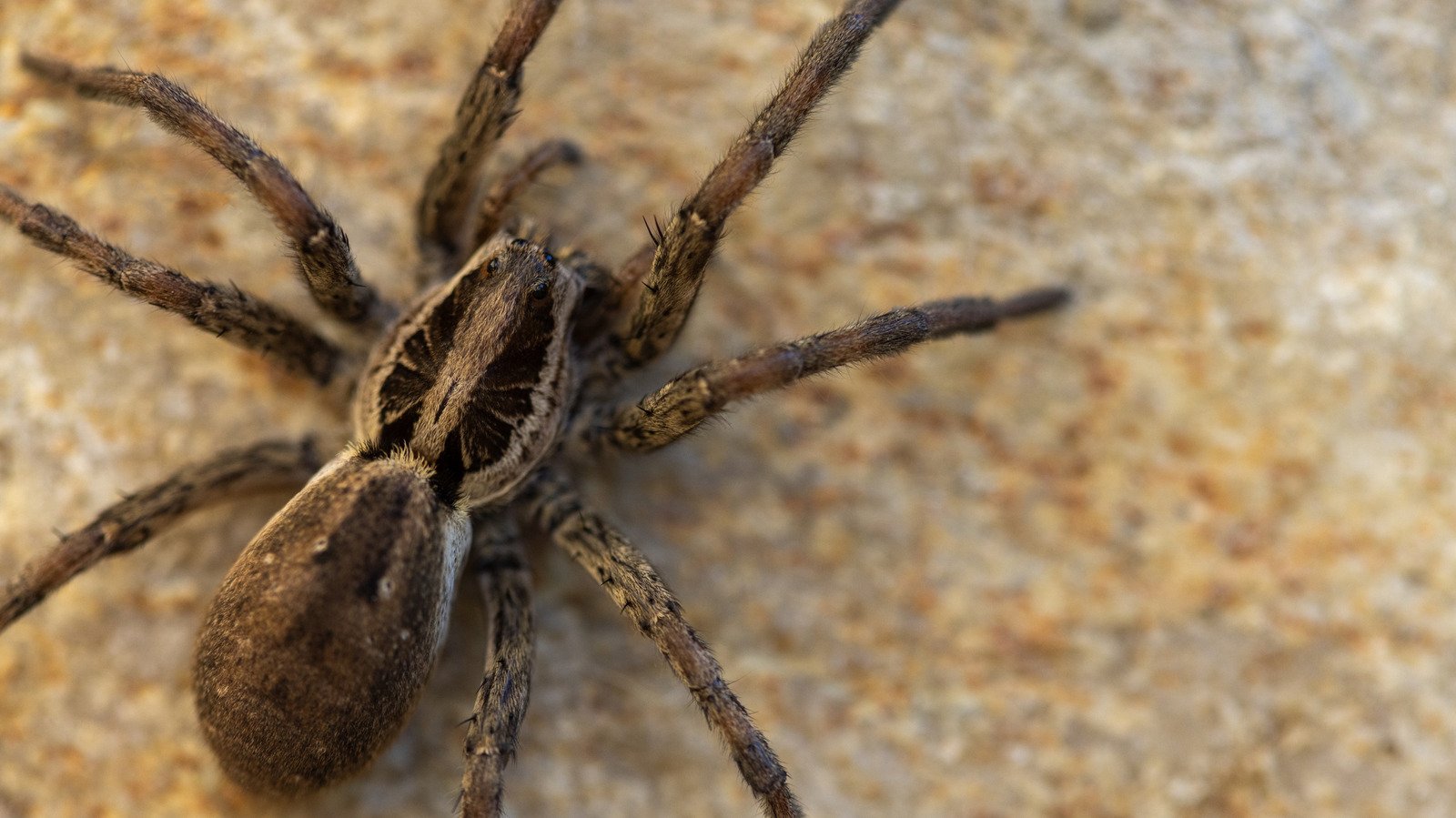
Fishing Spider Vs. Wolf Spider: How To Easily Tell The Difference
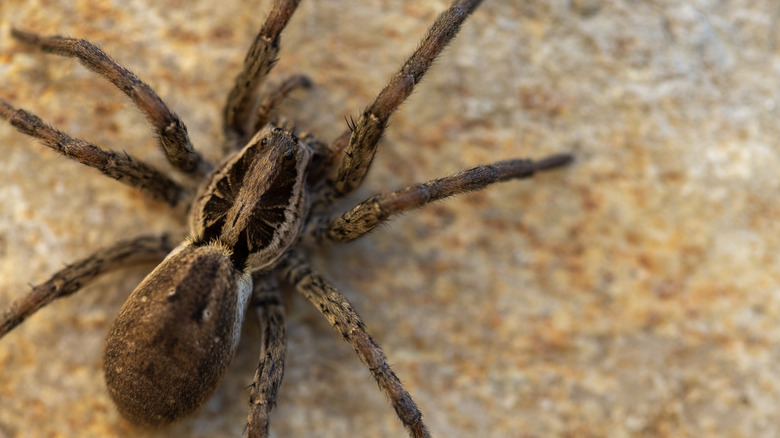
Fishing spiders and wolf spiders are easy to confuse at first glance. The hairy hunters are both large and brown, and they pursue their victims rather than building webs to trap them. Fear not — neither spider is considered dangerous to humans, even if their prey would probably disagree. Both arachnids’ habitats can offer a helpful clue for identification, as wolf spiders (part of the Lycosidae family) are commonly found in grassy or leaf-covered areas, while fishing spiders (Dolomedidae family) are more strongly associated with ponds or swamps. The latter are known to travel across land and may venture a considerable distance from water, so spotting this spider lurking in and around your home isn’t completely out of the question.
A few stronger clues can help you determine which spider has crossed your path. For one, fishing spiders generally have slimmer bodies and longer legs, whereas wolf spiders tend to look stockier with shorter legs. If you’re brave, a close-up look can provide further confirmation of their identification, as their eight eyes are arranged quite differently. To tell the difference, you’ll want to compare the spider’s build and eyes first, then use its location and movement to confirm your findings.
The body shape and the eyes are the easiest identifiers
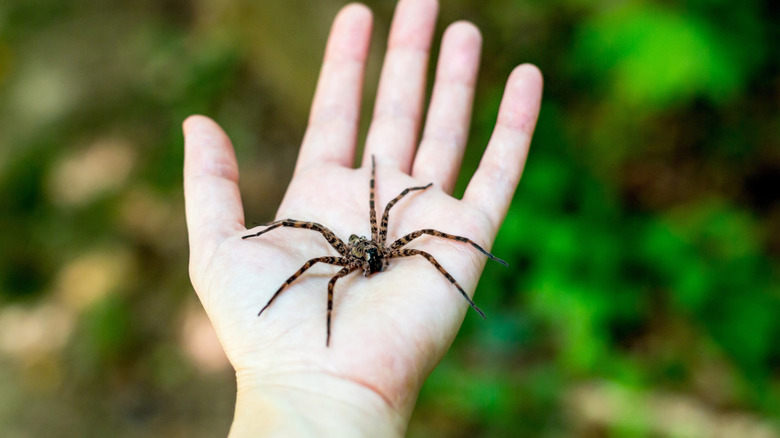
Some fishing spiders can cover nearly 4 inches with their legs extended, while wolf spiders are slightly smaller with leg spans around 3 inches. But that doesn’t automatically mean the largest spider is the fishing spider. Proportions are key here — pay attention to how long the legs appear in relation to the body, as the wolf spider will look thicker yet more compact.
Looking for specific patterns can also help with identification, although it can be a little tricky since both spiders sport similar earthy colors. Many fishing spider species have dark, W-shaped markings on their upper abdomens, along with banded legs. Conversely, wolf spiders usually have dark stripes on their bodies. Certain species of wolf spiders might be easier to identify, like the tiger wolf spider with orange and black stripes on its belly, or the rabid wolf spider, which has white marks behind its eyes.
And then there are the eyes themselves. A wolf spider’s eight eyes are divided among three rows, beginning with four small eyes across the bottom. Two large, forward-facing eyes dominate the middle, while the final pair sits higher on its head. On the other hand, a fishing spider’s eyes form two rows and lack the wolf spider’s conspicuous pair of oversized central eyes. Its front four are slightly curved, with the outer pair positioned higher than the inner pair.
Watch where it goes and how it carries its young
A fishing spider makes moves by dashing across the water on specialized, water-repellent feet. It can even slip beneath the surface to pursue aquatic prey. Wolf spiders use more of a stop-and-sprint strategy, waiting for prey before suddenly rushing forward to capture it and moving elsewhere when nothing comes along (wolf-like, as their common name suggests).
The real giveaway appears when mom is hauling precious cargo. A female fishing spider typically carries her egg sac in front, gripping it with her chelicerae (aka fang-bearing mouthparts). When hatching time approaches, she places the sac inside a silken nursery web and stays nearby to protect the spiderlings. A female wolf spider takes the opposite approach by attaching her egg sac to spinnerets at the rear of her abdomen. Once the eggs hatch, her babies will climb aboard and ride on her back for a week or two.
As we mentioned, both spiders are harmless to humans (with the exception of the occasional allergic reaction). If either spider finds its way indoors, gently relocate it outside, considering there are many reasons why you shouldn’t kill spiders, or contact a pest control company. If it’s a fishing spider, it might be best to call a plumber as well, since its presence could indicate excess moisture or a hidden burst pipe in your house.