75% of Nvidia’s $63 Billion Investment Portfolio Has Been Put to Work in Just 2 Game-Changing AI Stocks
When most investors hear the Nvidia (NVDA +3.21%) name, they think of Wall Street’s largest public company and the backbone of the artificial intelligence (AI) data center build-out. Nvidia’s graphics processing units (GPUs) hold a virtual monopoly in AI-accelerated data centers and sport compute advantages over external competitors.
But Nvidia is also a prominent investor, closing out the June-ended quarter with $63.4 billion in assets under management. Thanks to two very timely investments over the last year, AI titans Intel (INTC +1.21%) and Space Exploration Technologies (SpaceX) (SPCX -1.07%) collectively make up 75% of Nvidia’s investment portfolio.

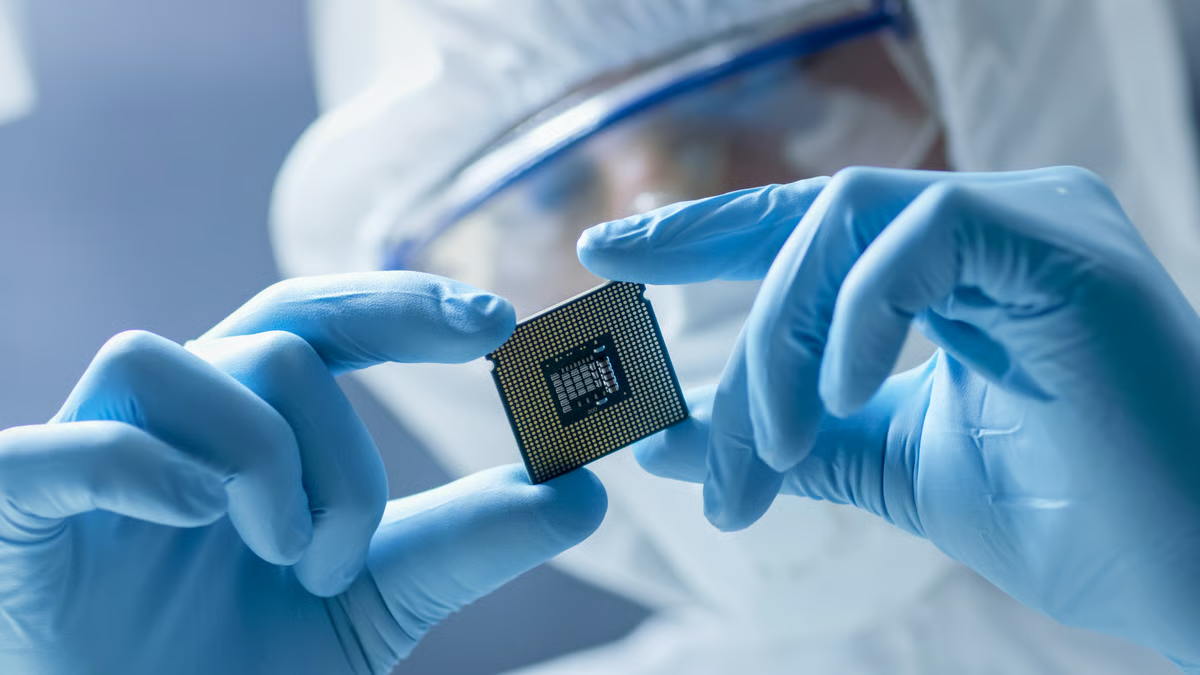
Image source: Getty Images.
Intel: 44.23% of invested assets (as of June 30)
Roughly four weeks after the Trump administration announced an investment in chipmaker Intel in August 2025, Nvidia unveiled a collaboration and investment package with Intel.
Nvidia agreed to purchase $5 billion of Intel’s common stock at a predetermined price of $23.28 per share. This purchase officially closed in December, giving the world’s largest public company a 214,776,632-share stake in the legacy chipmaker. As of the midpoint of 2026, this position was worth nearly $30 billion.
NVIDIA’s investment portfolio has grown to $63.4 billion, up 3.4x in just one quarter despite no new trades in Q2.
Intel remains its largest holding at $30 billion, while SpaceX has emerged as the second largest at $21 billion following its IPO.
Here’s how the portfolio breaks… pic.twitter.com/VTMYoBovLq
— Leverage Shares ETPs EU (@LeverageShares) August 28, 2026
The collaboration between the two companies focuses on integrating Nvidia’s superior accelerated computing hardware with Intel’s top-notch central processing units (CPUs) and x86 ecosystem. Whereas this collaboration is just one of several stepping stones for Nvidia, which grew its Data Center segment sales by 117% in its fiscal second quarter, it’s central to Intel’s ongoing turnaround efforts.
While Intel has plenty of runway to develop advanced AI chips and siphon away some of Nvidia’s overwhelming data center market share, it’s still the dominant player in personal computing CPUs. Even though personal computing is no longer a top-tier growth opportunity, the cash flow Intel generates from its x86 ecosystem can fund higher-growth initiatives.

Image source: Getty Images.
Space Exploration Technologies: 30.94% of invested assets (as of June 30)
The face of the AI revolution has also made bank thanks to an investment in AI start-up xAI in January 2026.
In February, Elon Musk’s SpaceX announced an all-stock deal to acquire xAI (which also owns social media platform X). The $10 billion Nvidia put to work in xAI in January translated into 122,764,805 shares of SpaceX following its record-shattering initial public offering on June 12. As of June 30, Nvidia’s SpaceX stake was worth close to $21 billion.
Although there are several moving parts to SpaceX, AI is central to its growth thesis. The company’s mile-long registration statement outlined a $28.5 trillion addressable market, $26.5 trillion of which is tied to AI. As of May 2026, xAI’s data centers were operating north of half a million Nvidia GPUs. In other words, it’s in Nvidia’s best interests that xAI (and other hyperscalers) succeed in their rapid data center expansion.
$SPCX
Q2 operating cash flow: $2.42 billion
Q2 capex: $18.37 billionQ2 free cash flow: ***negative $16 billion***
Thank you for your attention to this matter.
— Stanphyl Capital 🇺🇸 🇮🇱 🇺🇦 (@StanphylCap) August 4, 2026
However, Nvidia’s mega-investment in SpaceX is anything but secure. Whereas Intel has decades of history in its corner, SpaceX has yet to prove the sustainability of its operating model. Musk’s company is losing money and burning through quite a bit of capital as it ramps up Starship and expands its data center compute capacity.
While SpaceX’s prospectus infers that Musk’s company will be a long-term game changer, justifying its premium valuation amid significant losses and ongoing cash burn may prove challenging.