Estonia Deploys Drones And Dragon’s Teeth Against Russian Threat

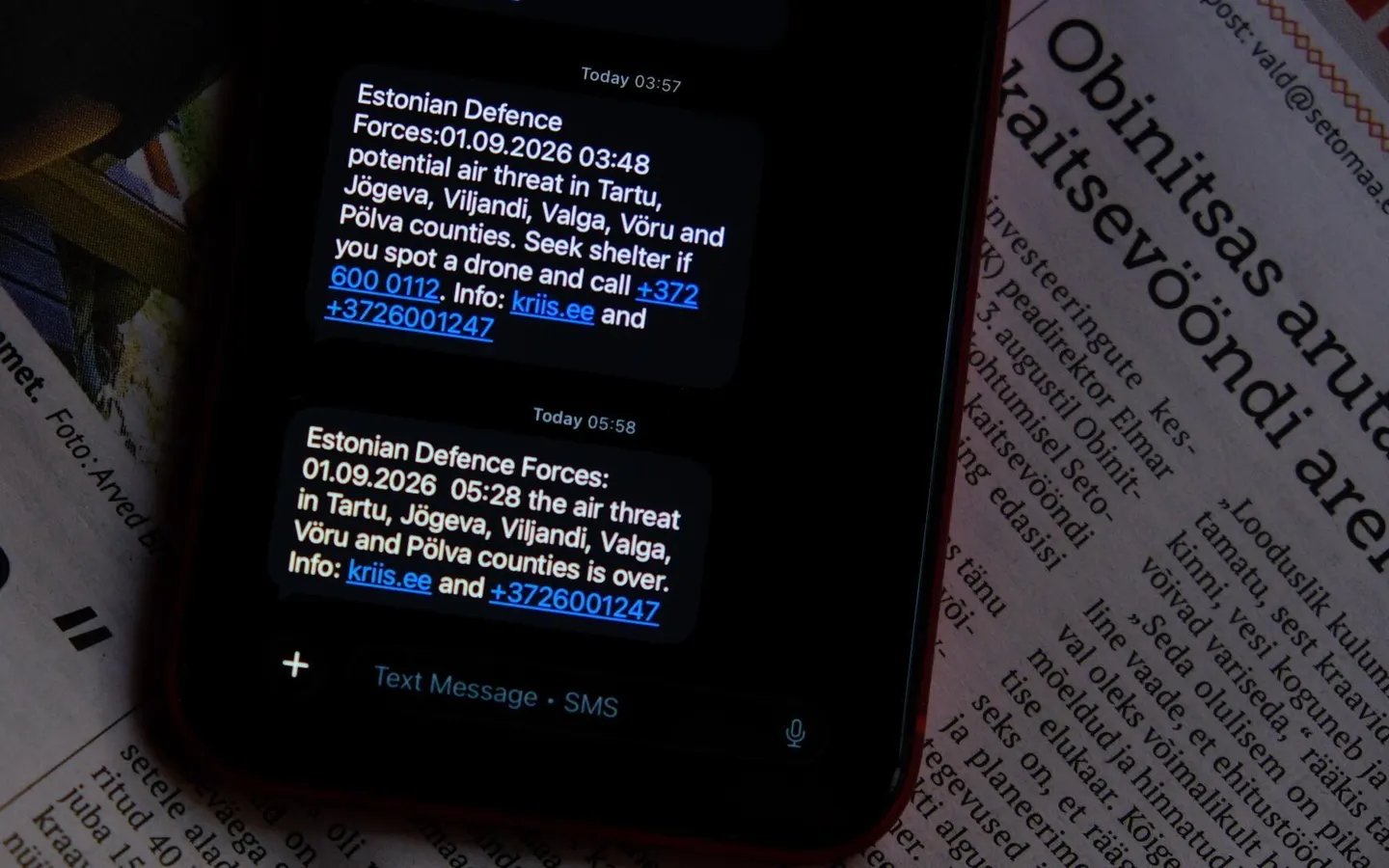
An alert issued on Tuesday morning in eastern Estonia warning of a drone threat
ERR news
On Tuesday morning, the Estonian Defence Forces issued a text alert to residents of eastern districts, warning them to “seek shelter if you spot a drone.” This was not a drill. NATO fighters scrambled to counter the threat and the all-clear was later given.
Estonia, somewhat smaller than West Virginia with a population under 1.4 million, has a 183-mile border with Russia. It will be very much in the front line in the event of any Russian aggression, which commentators warn may be imminent.
Estonia has been invaded from the East before. This time, preparation and investment in technology could produce a very different outcome.
Lessons From History
The submarine EML Lembit, which bears the honorary title of the navy’s “Vessel Number 1,” is the centerpiece in the Maritime Museum in Tallinn, housed in a former seaplane hangar. The sub represented the cutting edge of military technology and was built for Estonia in Britain in 1936.
EML Lembit, the Estonian Navy’s “Vessel Number 1”
David Hambling
Lembit has four torpedo tubes, but its main weapons were mines. Lembit could lay 24 sea mines in one mission, closing the narrow channels and shipping lanes of the Baltic Sea. Surface vessels might be sunk by the Soviet navy, but nothing could prevent submarines minelayers from blocking invasion forces. (In fact, sea mines were to dominate the naval war in the Baltic). The museum also devotes considerable space to the many coastal batteries built to defend the country from a threatened Soviet attack.
Unfortunately in 1939, Estonia agreed to allow the Soviet Union to operate naval and air bases on its territory to counter the Nazi threat. The Soviets based about 25,000 personnel on Estonian soil, while the Estonian military numbered about 14,000. In June 1940 Moscow massed over 100,000 troops on the border and issued an ultimatum demanding a new pro-USSR government and unlimited access for its troops.
Paris had just fallen. The British army had escaped at Dunkirk and was preparing to face the German Blitz. No allies could help Estonia, and the government capitulated, ordering the military not to resist Soviet occupation. Only a few guerrilla fighters, the Forest Brothers, fought a protracted war in remote wooded areas where they could take advantage of their local knowledge.
Estonia endured brutal Soviet occupation, followed by equally brutal German occupation, followed by a second Soviet occupation. The country finally regained independence more than 50 years later in 1991.
Estonia: This Time Is Different
In 1940 Estonia was isolated, outnumbered, and had thousands of Soviet troops inside its borders. Lessons have been learned.
Politically, as part of the NATO alliance, Estonia is no longer isolated. This should deter aggression, but in the current climate some question whether the U.S. has the political will to defend Europe.
How can a small country defend itself? Estonia learned lessons from Ukraine, moving away from a traditional defensive posture, which relies heavily on a NATO “tripwire” bringing international help, to a forward “deterrence by denial” posture with heavy investment in drones and deep strike systems.
A new defense plan introduced this year requires the country to fight 30 days of war self-sufficiently. Rapid mobilization will allow Estonia to start fighting the moment an attack is threatened. The government holds “snap drills” in which reservists receive an electronic notification to report to assembly points within hours to ensure readiness.
This mobilization expands the basic force of 8,000 personnel to more than 40,000. The same process reassigns tens of thousands of civilian workers to keep vital infrastructure running.
As in Ukraine, Russia will count on a rapid advance to seize the country. Estonia is smaller, but now far better prepared. Extensive lines of obstacles, including concrete dragons’ teeth and anti-tank ditches, will slow down any attack, along with hundreds of defensive bunkers.
Defense Tech Forward
Meanwhile the Estonian defense industry has grown by an estimated 350% since 2021. The focus is on technology which will be essential to counter a Russian attack, whether it is a ground invasion or long-range drone strikes.
Frankenburg’s miniature anti-drone Mark 1 missile
David Hambling
Frankenburg aims to build affordable missiles that can be mass produced at scale within Estonia. The first of these is the miniature Mark 1 missile to counter drones. The company describes this four-pound munition as “the smallest and lowest-cost guided interceptor missile ever live-fired”, noting that it was developed from concept to successful live-firing in just 13 months.
This comes just in time to counter the latest jet-powered Geran-3 and Geran-4 attack drones which are too fast for mobile fire groups and propeller-driven interceptor drones.
Meanwhile, Alatyr Group has developed another anti-drone weapon, the P4P high-speed interceptor which combines a multicopter with a rocket booster to intercept drones at more than 300 mph.
Other notable Estonian companies include Threod Systems, makers of fixed-wing reconnaissance drones and drone launchers, DefSec Intel Solutions who build AI-powered surveillance and counter-drone systems, and Rantelon which specializes in electronic warfare, notably drone detectors and jammers.
Future wars will be drone wars, and Estonia is taking a lead in this area.
Wolfram Europa seek to fill a more fundamental gap in European defence: explosives. These have been a fundamental limitation in Ukraine, with soldiers dismantling land mines and obsolete munitions to get material for drone bombs.
Many nations build missiles, artillery shells and other weapons, but they assume explosives can just be bought in from elsewhere, notes Wolfram Europa CEO Magnus-Valdemar Saar in an online post. That may be true in peacetime, but the rules change during a war when other factors come into play from prioritizing national needs to not wanting to be seen to support a conflict.
To other Western nations, the Russian threat may seem remote and abstract. In Estonia, they get drone alerts and can see smoke from Ukrainian strikes across the border. Just as importantly they have experienced invasion and its consequences before and are ready to resist it.
The high-speed technology development in Ukraine has been spurred by the pressures of war. Estonia does not have quite the same pressure, but technological development is much faster than in countries where the Russian threat appears more remote.