Government debt crisis in U.S.—and other countries—inevitable without fiscal reform
Government debt crisis in U.S.—and other countries—inevitable without fiscal reform
beng
Wed, 09/02/2026 – 12:41
EST. READ TIME 5 MIN.
Deficits and debt are not the main problems with United States government fiscal policy. The variable that really matters is government spending. Those expenditures divert resources from the productive sector of the economy, whether financed by taxes, borrowing or money printing.
In other words, excessive government spending is the problem and red ink is a symptom of the problem. But, as Greece painfully demonstrated back in 2009-2010, sometimes a symptom becomes so acute that it also becomes a problem.
A debt crisis occurs when the people who buy and trade government bonds decide that a government no longer can be trusted. At which point, they switch from being bond investors to being “bond vigilantes.”
When this happens, interest rates on bonds usually spike because buyers need to be compensated for perceived higher risk. This contributes to a downward spiral for the country since any new debt (and any debt rolling over) is much more expensive to service. Moreover, because the country’s bonds are less attractive (and therefore fall in value), that can hurt financial institutions that have substantial holdings.
This deterioration can happen quickly. As late economist Rudiger Dornbusch observed, “In economics, things take longer to happen than you think they will, and then they happen faster than you thought they could.” And that certainly describes how Greece went from stability to crisis in just a few months.
Is the U.S. at risk because of excessive spending?
There is growing discussion that the U.S. could become the next Greece. The concern is understandable. There are several very grim statistics.
- The national debt just hit $40 trillion, perhaps a psychological threshold.
- The national debt is more than 100 per cent of GDP, approaching Greek levels.
- Annual national deficits are approaching $2 trillion.
- Annual deficits are projected to exceed $3 trillion within 10 years.
- There’s no discussion in D.C. of controlling entitlement spending—essentially Social Security and Medicare/Medicaid.
- Trump, like every president this century, has been a big spender.
- The Social Security Trust Fund is running out of money.
- Unfunded liabilities make the official debt seem small by comparison.
These are all very unpleasant numbers. But perhaps the most troubling indicator is that interest rates on government bonds have jumped. Investors now require interest rates of five per cent or more on 30-year bonds, a significant increase compared to 2-3 per cent just a few years ago (and less than 2 per cent during the height of easy-money policy during the pandemic).
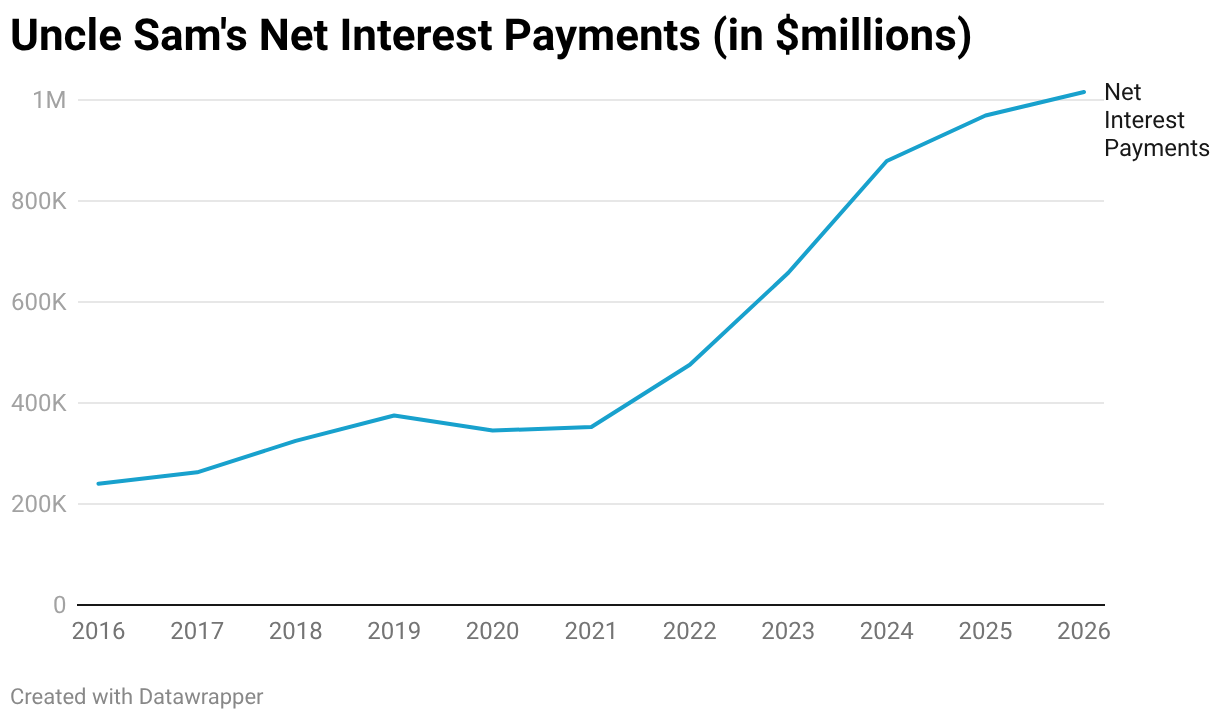
What are the consequences of rapidly rising debt combined with rising interest rates? The unfortunate answer is that the U.S. federal government now spends $1 trillion on net interest payments according to the Congressional Budget Office—and more than $2 trillion annually within a decade (see the chart below).
All of this sounds like the U.S. is vulnerable to bond vigilantes. Which is true, but that does not necessarily mean a crisis will happen this year. Or even next year. Here are two counterarguments. But not arguments to be complacent. Merely explanations for why there may be time to fix problems before a crisis occurs.
Higher interest rates may not be a sign of country risk. Interest rates reflect several factors. Yes, interest rates might rise because of a perceived risk of default for a specific borrower, in this case the U.S. federal government. But they also can rise because of a market expectation of higher long-run inflation. Interest rates also might climb if there are competing—and attractive—options for investors. Perhaps they prefer to invest in AI companies instead of government bonds.
Other governments are more vulnerable to crisis. While the government in Washington has been reckless, other countries may be even further down the road to fiscal chaos. France, Italy, Japan, Belgium, Canada and the United Kingdom are just a few of the countries with very high debt levels and weak economic fundamentals. It’s possible—perhaps likely—that bond vigilantes will first descend on some or all of those countries, particularly smaller countries such as Canada.
Moreover, there is a pattern of money flowing to the U.S. whenever there is economic instability. This “flight to safety” could give the U.S. some additional breathing room. As does the dollar’s role as the world’s reserve currency.
Let’s close with two additional observations.
First, Treasury Secretary Scott Bessent asserts that growth could solve the debt problem. Faster growth is a wonderful goal, of course, but his math is nonsensical. Debt in the U.S. is driven by excessive spending growth. And rising spending levels are driven by demographics and poorly designed entitlement programs. Faster growth will not solve those problems.
Second, there is a solution, albeit not one that will be popular in Washington. Excessive spending growth is the source of America’s fiscal woes, so spending restraint is the solution. The U.S. should copy Switzerland and adopt a spending cap. The goal should be to make sure government spending grows slower than the private sector. This approach works. It has led to smaller government and declining debt in Switzerland while neighbouring countries are spiralling in the other direction.
Since I’ve already quoted one deceased economist, let’s conclude by citing another. Herb Stein famously noted that, “If something cannot go on forever, it will stop.” That insight applies to U.S. debt. The crisis may not occur right away, but it’s inevitable at some point without fiscal reforms.

By: