The AI Bubble Is Built on a $1 Trillion Delusion
Just today, I cancelled my ChatGPT subscription — I don’t need it anymore. I’m not alone. It’s not as good as Claude. Paid subscriptions to ChatGPT have plateaued because there is so much more competition. Now you may think: does it matter if OpenAI fails to generate income of $300bn? If a company fails, does it matter for the wider economy? Well, unfortunately, it does.

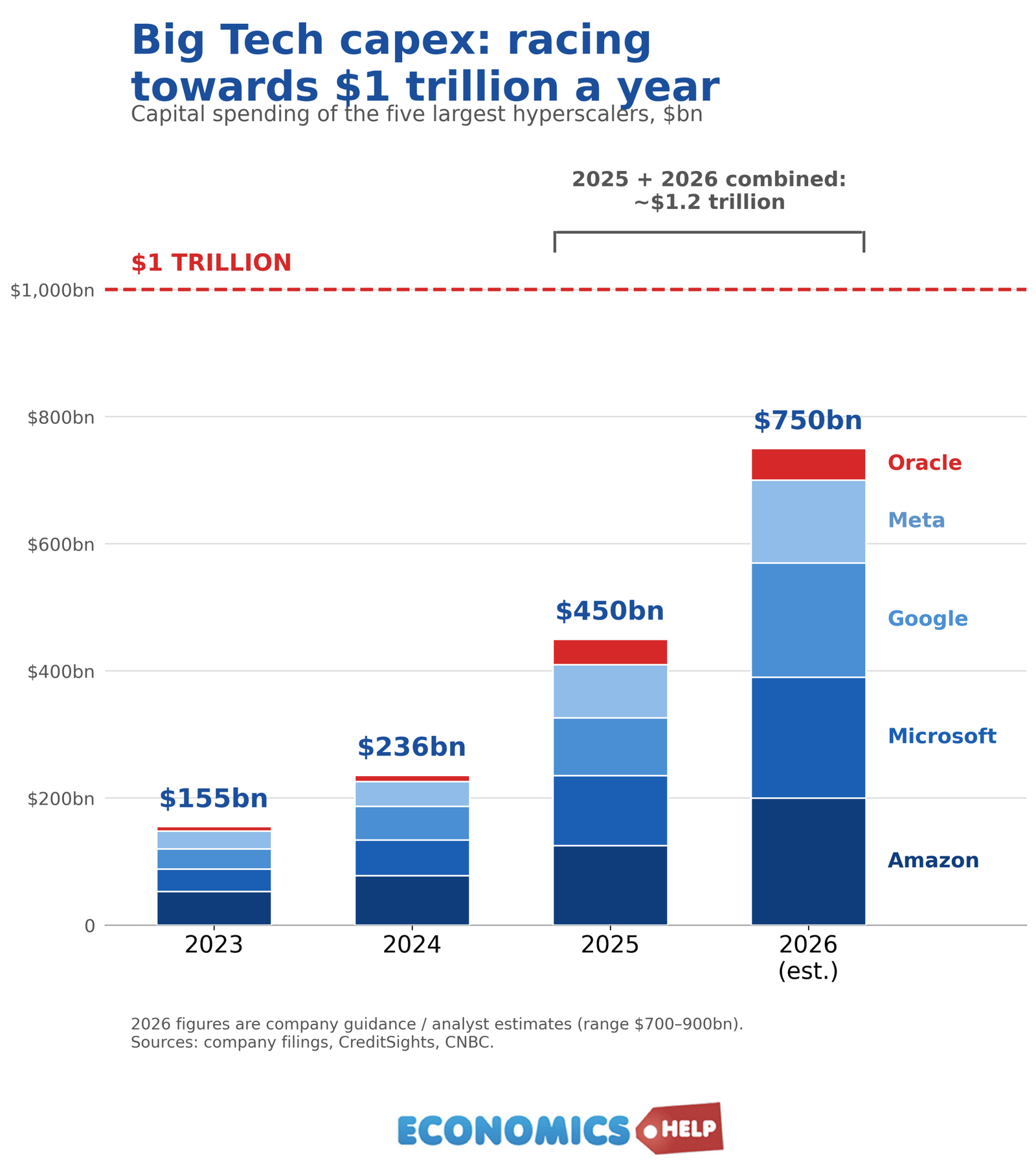
The five largest hyperscalers are spending $1 trillion on AI investment across this year. It dwarfs the investment of previous bubbles. That’s a lot of money for an industry with no track record of making significant profit.
There is also a circularity problem. Microsoft invests in OpenAI; OpenAI spends that money on Microsoft’s cloud; Microsoft books it as revenue.

OpenAI and Anthropic have $1.1 trillion in commitments to buying compute power. Oracle is borrowing approximately $100bn to build data centres for a company losing $20 billion a year. The risky investment rests on the assumption that OpenAI will generate huge growth in revenue. But if and when this fails to materialise, the demand for data centres and chips will fall, and the big data centres could prove to be white elephants. But it gets worse, because the data centre and AI boom is now being financed through increasing debt, not cashflow. Not only is debt rising, but the cost of financing is rising too.

So if revenues fall, it creates a systemic risk. This isn’t just speculation. The Bank for International Settlements warned of this risk in a recent study into the industry. And this mirrors what is happening more widely — a big rise in borrowing to buy shares. This boom in debt is often a precursor to the bust.

Another way of looking at the valuation of shares is to see earnings yields are as low as in 2000 and 1929. Anyone remember what happened in those years?
How excited are you?
In general, there was widespread exuberance and excitement when AI was released; managers and coders felt all-powerful as AI produced code that would take hours of human effort. I do relate to that enthusiasm of seeing the possibilities of AI, and this has stoked the exuberance of investors. But the idea AI will replace human jobs was exaggerated. There are quite a few cases of firms backtracking and realising AI couldn’t replace humans. AI bots making expensive mistakes, firms hiring more software engineers who struggle to keep up with the avalanche of AI code. AI is generative — it runs on probabilities. At some things, like coding, it is good, but it is a long way from being God yet.
Can Silicon Valley Titans be Wrong?
Now, at this point, a good question to ask is: surely the titans of Silicon Valley and magnates of Wall Street can’t be so wrong as to invest a trillion dollars without a realistic business plan to make money? How can clever people get it so wrong? The problem is that humans are very good at self-delusion. Firstly, AI is in some respects very good — demand is rising, firms are paying for it. But just because railways are a great business model which changed society doesn’t mean railroad companies didn’t go bust. I would actually argue railroads are far more revolutionary and beneficial than AI will ever be. But Silicon Valley titans can become isolated from reality.
The dream of being the next monopoly
How did we end up in the situation of a capex arms race? Everyone fears missing out on the chance to be a monopoly. The great idea of Silicon Valley is to spend so much on generating the best models and most capacity that you become the monopoly, like Google, with a licence to print money. There are three problems. Firstly, the technology is being so widely diffused, you won’t need to be beholden to a monopoly provider of AI. The problem for the AI industry is that the better AI becomes, the less you need to spend on it. This is the Catch-22 of AI. But the big hyperscalers are locked in an arms race they don’t want to drop out of. But cracks are already showing. Data centres are behind schedule, and there is growing opposition to them from locals. And by the time they are built, the technology risks being obsolete, overtaken by better chips. It is common for people to say, if the AI bubble bursts, at least we will have the infrastructure. But railways last for a hundred years. AI chips last just a few years. The dizzying pace of AI development is both a strength and a weakness for the AI industry.
Costs of AI
But the real canary in the coalmine is that in the dash for revenue, no one really stopped to think about the other side of the equation: costs. Anthropic’s latest model is really clever, but it burns through tokens at great expense. Goldman Sachs estimates token use will multiply 24 times. The latest coding models use exponentially more than simple chatbots. And this is a real problem. In a bid to gain market share, firms have subsidised the use of AI agents. Everyone is burning through tokens to create that loyal consumer. But AI is not like Google Search. Google never had to subsidise users to search — search was profitable per query. AI is the reverse: every query loses money. What will happen to demand when prices rise to cover costs? This is already happening in business, as some wake up to unexpected costs from Anthropic token use.
Now, some will say that despite doomerist talk, there has actually been a measurable rise in demand for AI tools. There is a measurable increase in revenue, and there is still scope for greater use as more conservative organisations, like local government, slowly come around to the possibilities. This is true up to a point; the problem is the unprecedented level of investment and costs that have been ignored. I think a good comparison is Amazon in 1999. They had the right technology and were innovative — it is just that valuations became wildly overvalued. However, the difference is that Amazon created a monopoly power that remains very profitable. I’m very doubtful any AI company will emerge with the so-called ‘moat’. The reality is most people who pay for AI also find it very easy to switch between models, even in the future, building their own and not relying on Big Tech at all. Also, it is worth bearing in mind that the benefits of AI may not be fully captured by GDP.
SpaceX Bubble
But going back to the theme of AI hyperbole: SpaceX, like OpenAI, assumes it will be able to generate fantastic returns in the future. You can see SpaceX is currently a moderately profitable satellite company, making a loss in space and AI, but its valuation stands at $2 trillion. A big selling point for its current valuation is the possibility of building gigantic data centres floating in space. It’s the stuff of science fiction. But in space, it’s actually much harder to run a data centre, because in a vacuum there’s no air to carry heat away, so cooling — the biggest challenge in any data centre — becomes far harder. There is a lot riding on the personality and promises of Elon Musk. Sometimes it is worth using boring valuations based on verifiable profit.
The $1 trillion bet is that something fundamentally different emerges from current AI, which is actually better described as large language models. The goal of OpenAI is to create AGI — artificial general intelligence. This is an evolutionary leap from current large language models; it means reasoning like a human across different sectors. Current LLMs can write a book, but they can’t be trusted to run a business. This vision of a superintelligence is used to justify the current levels of investment and borrowing.
Michael Burry, who successfully called the housing bubble, though he was wrong on others, has just expanded his bets against AI — this week shorting Nvidia, Tesla, and even Caterpillar, which has doubled simply by selling the diggers that build the data centres. It will be interesting to see what happens next.
About The Author