The Problem of Chinese Economic Dominance.
It’s not good for China, US or Europe

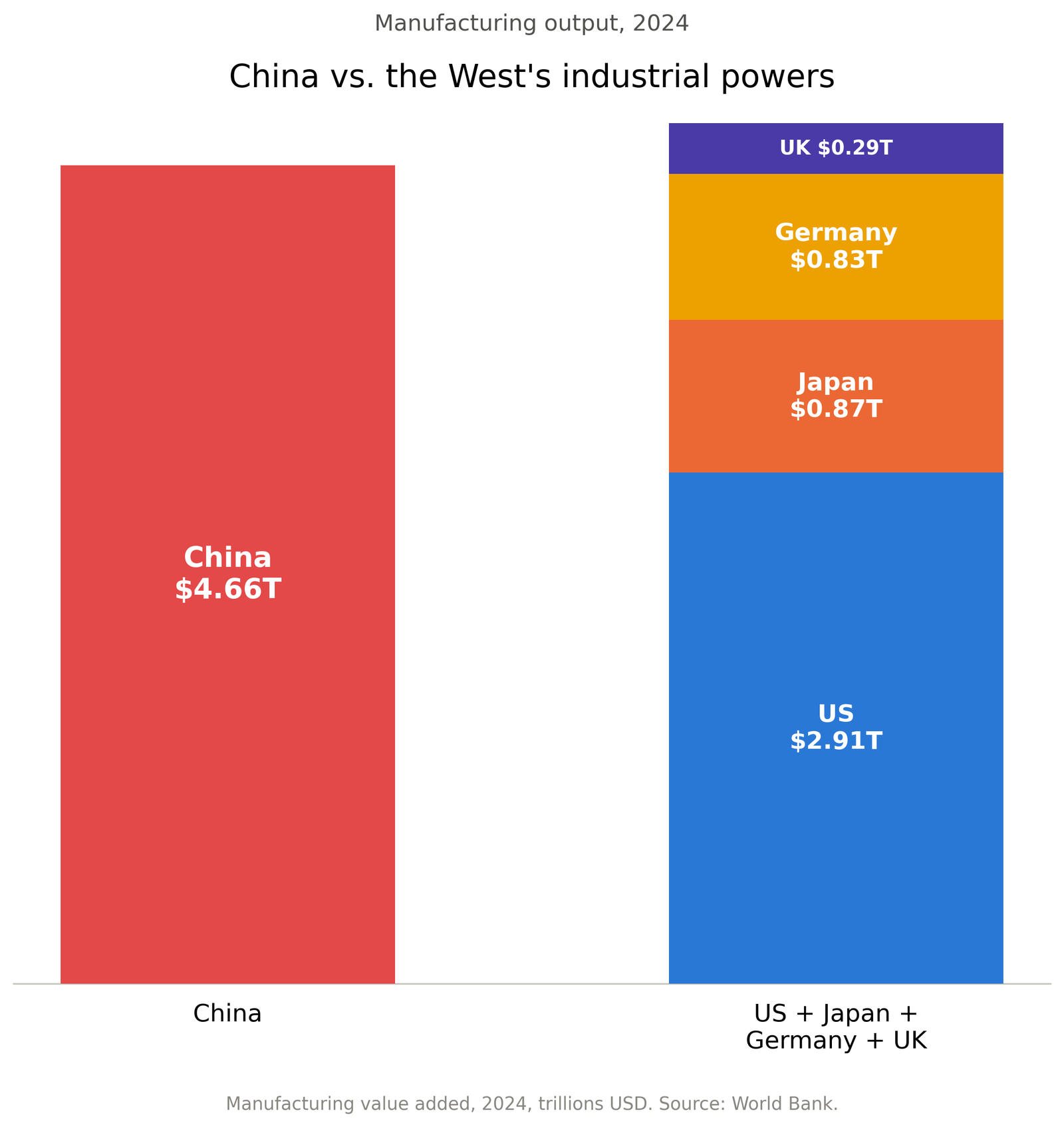
If everything seems to be made in China these days, it’s probably because it is. China manufacturers roughly the same amount of goods as the US, Japan, and Germany combined. European consumers are currently benefitting from cheap solar panels, electric cars and electronics. But, it comes at a cost, with the EU now running a trade deficit of €1 Billion a day. EU industry is in crisis with Volkswagen causing unprecedented job losses.

China’s surplus with the EU has more than doubled in just seven years and there is a growing sense of panic with EU comissioner von der Leyen saying the relationship is unsustainable. China has achieved this industrial dominance through high investment, economies of scale and technological development, but there is a darker side. Overcapacity, government subsidy, export dumping and aggressive price cutting. This is overcapacity in Chinese batteries, it is one reason why UK firms go bust. If you take solar panels, China dominates 80% of global supply and, according to the OECD is the most subsidised industry in the world. But there is so much oversupply, producers are making a loss and prices may have to rise soon. The prevaling Chinese economic culture is one of involution, forever cutting prices, gain market share. This gives us cheap goods in the short-term, but forces other countries out of business.

China has seen a dramatic growth in global car sales. Estimates suggest Chinese firms received $231bn of state support during their period of growth. The OCED say Chinese firm receive between three and nine times the rate of their rich-world counterparts. But the big loser is European car makers. This is the real risk for Europe a loss of good manufacturing jobs and regional decline – reminiscent of the rust belt decline in the US. There has been a real rise in protectionist sentiment, not just Trump but former free market economists who agree something needs to be done.
It’s not just state subsidies, a recent report by French government report claims 20% undervaluation in the Yuan which gives Chinese exports an unfair advantage. And its not just economics, ever since 2022, there is greater reluctance to rely on imports from one country, who may not align with European or US interests. It is worth bearing in mind, China has single-handedly kept the Russian economy afloat since the invasion of Ukraine.
According to the IEA China accounts for 61% of global mined rare earth supply and 91% of global refining and processing capacity. In April 2025, China imposed restricts on the exports of rare earths, creating a shock about how dependent Europe and the US are on Chinese magnets. After export controls were introduced the price Europe paid rose six fold. Supply chains slowed down.

The UK and Europe has made great efforts to reduce carbon emissions. It has phased out coal power, but the transition to renewable energy has given the UK higher electricity prices, and this is part of the reason for loss of competitiveness. However, China has been less worried about carbon emissions. Despite rise in renewable energy as a share of the total, coal power continues to be important.

The result is that whilst UK industry declines, we increasingly import from China, where CO2 emissions are significantly higher per capita. The real global warming source is now China. By the way, if you adjust for trade and show only consumption, by 2022, China was the same as the UK despite lower levels of national income.
Unbalanced China
For all the dominance of Chinese manufacturing, it hides an unbalanced economy with domestic failings. An important reason for Chinese dominance in all types of manufacturing from clothes to high end electronics is the low labour share. The share of China’s manufacturing output that is paid to workers is one of lowest in world. This study suggest more than 50% of the current boom in Chinese exports to Europe, is driven by weak Chinese demand and deflation in China.
Notably, China had a real boom in house prices that is now unwinding. Falling house prices and unsold properties have caused a property collapse with local governments becoming heavily indebted. This continues to worsen with falling house prices causing greater defaults.
Despite relatively high growth, China faces higher youth unemployment due to a weakness of domestic demand. In fact, there is such worry about youth unemployment the official statistic was abandoned as the government try to control the flow of news about the economy. But, removing statistics doesn’t solve the problem and it is worth bearing in mind, the new face of Chinese manufacturing is very much about mass automation, huge factories with low levels of human labour. GDP statistics mask a two tier economy with high levels of poverty in rural areas.
China’s own former premier once admitted 600 million people, live in effective poverty. The hukou residency system, locks rural migrants out of healthcare, education and pensions and this drives a urban-rural income gap that’s roughly two and a half times wider than it was three decades ago and accounts for three-quarters of all inequality in the country.
AI – Next Chinese Target
In recent weeks, China has made a splash with the arrival of cheaper AI models, which undercut the much more expensive American models. In terms of hardware, Chinese AI Chips lagged far behind the US, but in Jan of this year, the Trump administration reversed years of export bans, agreeing to sell China up to a million advanced Nvidia chips, enough to triple its AI computing power overnight. And China is now beginning to win the deployment race with China’s share of global usage rising from 1% in 2025 to roughly 30% in 2026. Yet, should we be concerned about Chinese dominance of AI given issues over data protection, censorship and surveillance?
Population pressures
In the longer-term, China’s one child policy was wildly successful, leading to a sharp fall in fertility rates, but it means, like many other Asian economies, it is facing a demographic crunch. Ageing population, falling working age population. Already it has been taken over by India in terms of raw population. The problem is that although China has experienced rapid growth, it is still not ready in terms of welfare support for an ageing population.
Benefits of Chinese manufacturing
It is important to present a balanced view of China’s manufacturing dominance. It does create lower inflationary pressure and a wider choice of goods at low price. One study suggests cheap Chinese exports could reduce consumer prices by 1% by 2028. Secondly, the involution and dominance of Chinese renewable energy may have drawbacks, but has led to unprecedented technological evolution, which has made renewable energy more cost-effective than ever before. This reduction in costs is critical to an effective energy transition. Without China, how long would it taken to have seen such technological imporvements China has led the way in expanding renewable energy production and the next decade will be different.

China is leading the rollout of electric lorries, this will massively reduce demand for oil. The issue of state subsidies, involution and mass economies of scale have led to the technological gains of learning by doing.
Poor decisions by Europe
Also, maybe the reason for relative decline of European car firms is not unfair competition, but poor decisions by European firms themselves. Even as Chinese electric cars were gaining traction, European car firms were paying themselves €31 billion in dividends rather than investment in the next generation of cars. You can’t blame China for Europe’s relatively high energy costs, another disadvantage.
Also, when Hormuz closed, many predicted oil prices would soar, if they didn’t it was because China acted as a massive buffer stock. Chinese imports of oil fell drastically, as they used up their oil inventories. China effectively implemented a maximum price on oil, equally, prices may not fall for a while as they build up their stocks again. For good or ill, China is having more influence on oil prices than OPEC restricting supply.
So overall, China is dominating manufacturing and there are good reasons to be concerned about the growing trade imbalances. Primarily Europe faces economic crisis and rising unemployment at a time of stagnating growth. But, the imbalance ironically hurts the Chinese economy too. For all China’s growth, exports and trade surpluses, living standards for ordinary Chinese could be higher than they are now. Rebalancing economy away from exports to domestic consumption helps dampen the investment boom, increases living standards and also helps the west. The economy is not a zero-sum game, we can benefit from Chinese manufacturing, but Europe should not allow it to gain monopoly, it will damage long-term interests.
https://chinapower.csis.org/tracker/china-manufacturing/
https://substack.com/home/post/p-203790353
https://substack.com/home/post/p-202951575
https://www.theguardian.com/business/2026/jun/15/eu-trade-deficit-with-china-record-1bn-a-day
https://www.cfr.org/articles/chinas-massive-surplus-everywhere-yet-imf-still-has-trouble-seeing-it-clearly
About The Author