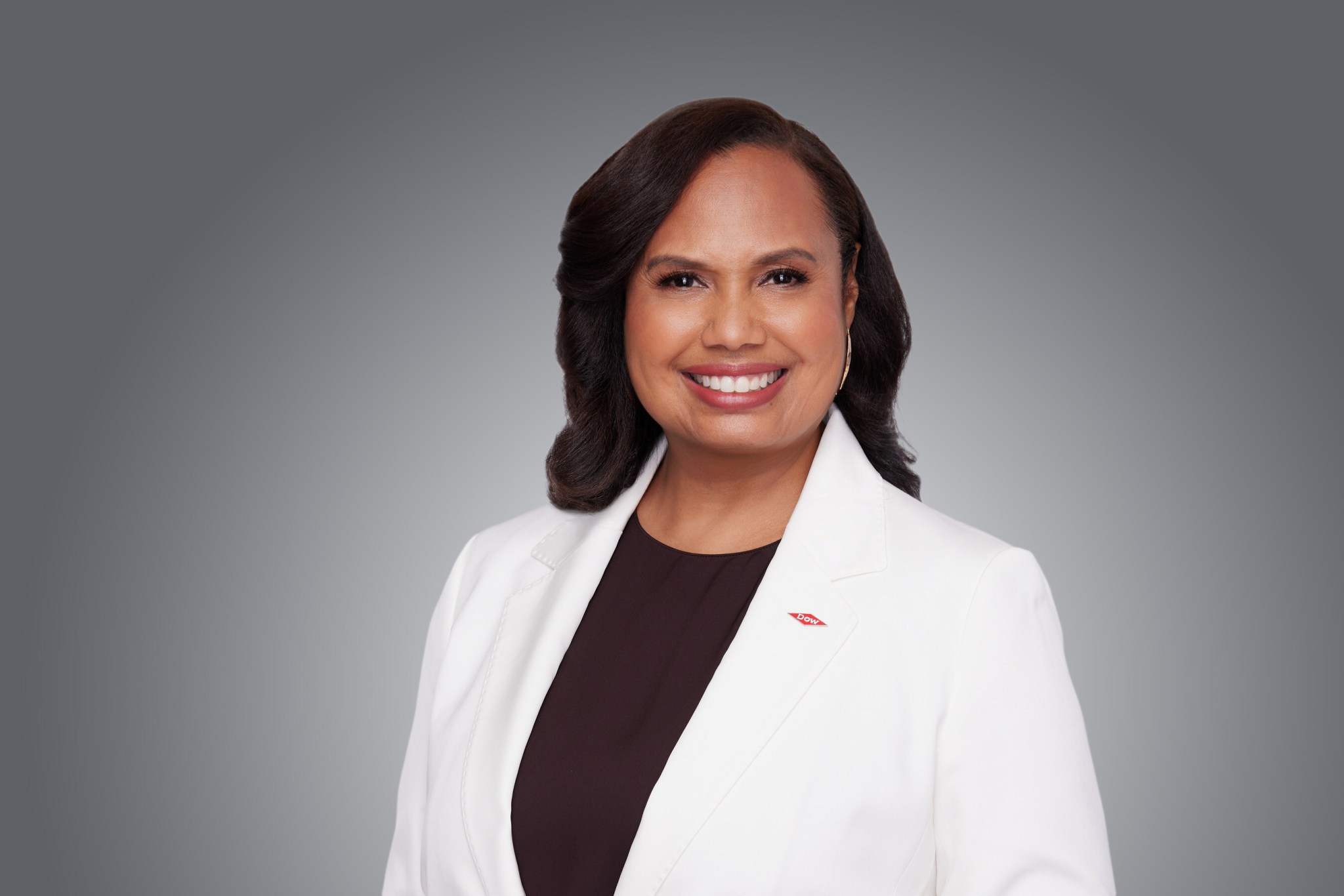
More than 30 years after joining Dow Inc. as an intern, Karen Carter became the CEO this year, taking the helm of a company grappling with financial losses, a corporate restructuring, thousands of layoffs, and the shuttering of some European plants.
Not that she hadn’t signed up for it. Carter took over the CEO role July 1 after helping create and implement the “transform to outperform” strategy announced in January.
“There’s a saying that it’s a blessing to be stressed by the thing you prayed for and hoped for,” Carter told Fortune. “This is really a privilege and an honor to be leading this company in such a time of change.”
That change includes Carter representing both the first woman and the first Black CEO for the nearly 130-year-old manufacturer, which is the largest chemicals company in the Americas. Last week, as Carter presided over her first earnings report as CEO, she delivered more change. Coupled with a boost to North American petrochemical profit margins from the Iran war and resulting high oil prices, Dow posted its most profitable quarter last week in four years, reporting a net income of $802 million and a 20% jump in net sales.
“It’s been a long time since we posted a quarter like this,” Carter said. “We anticipate that we’ll continue to be in a bit of a volatile environment. But we remain committed to what we said we were going to do, which is execute on our self-help and maximize the [third] quarter based on the market fundamentals.”
Despite the strong results, Dow’s stock value still dipped slightly because of its cautious guidance for the rest of the year, primarily because of the uncertainty in the Middle East and the supply chain ripple effects worldwide. The hope is to exceed the conservative guidance, she said, and satiate the shareholders and customers.
Carter, 55 and a native of Wichita, Kansas, has a lot of moving parts to take into account as she steers the Dow ship forward. Along with the emphasis on oil and gas in the now-infamous Strait of Hormuz, petrochemical supply chains also are dramatically impacted, affecting everything from plastics packaging to construction materials to data center and pharmaceutical components.
On the downside, Dow’s Saudi Arabia joint venture plant is still mothballed, and Dow is shuttering economically disadvantaged facilities in the United Kingdom and Germany.
On the larger upside, about 60% of Dow’s footprint is in the Americas where chemical plants are capturing much larger profit margins from the war. That’s because most Asian and European plants use crude oil-based naphtha as their primary feedstock, which has surged in cost. In North America, plants lean on cheap and abundant ethane and propane supplies that are domestically produced from the shale natural gas boom.
“Our footprint is advantaged on the ethylene and polyethylene side because it is based on ethane, where that price has remained pretty stable,” Carter said, referencing the world’s most common plastics. “For much of the rest of our portfolio, we continue to lean into those higher-value and higher-growth applications, like data centers.”
Most of Dow’s recent growth is in North America—from Freeport, Texas south of Houston up to the current construction for a $7.5 billion net-zero petrochemical project in Fort Saskatchewan, Alberta.
Big turnaround effort
While margins tell part of the story for Dow’s rapid financial improvement, Carter also credits the turnaround effort, which is continuing as planned even though profits improved faster than anticipated.
Both Dow and the broader industry faced a downturn in recent years, which potentially bottomed out in 2025, after a global overbuild of base chemicals and plastics. Dow posted an annual loss of about $1.5 billion last year and started 2026 off with a $445 million quarterly net income loss.
That’s why Dow pledged to cut 4,500 jobs—the effort is 55% complete—and reduce costs, increase efficiencies, and close some plants—while still growing strategically, such as in Canada.
“There are some things that we have to change,” Carter said. “We have to be more agile; we have to be more resilient; we need to be leaner as we go forward. That’s why the transformation work is so important. And it’s not just about cost cutting. It is two-thirds productivity and one-third growth, Fundamentally, this work is about making the company more competitive as we move forward.
“Job reductions are for sure part of it, but it’s about changing the work before we change the workforce,” she continued.
Former CEO Jim Fitterling stepped down, but remained executive chairman, elevating Carter to the chief executive role.
Data centers and laxatives
As part of its leaner workforce, Dow is leaning more on AI and automation. But Dow also is growing in the now-booming AI data center business. In May, Dow launched its Dow Coolant Care Network for helping data centers stay cool and energy efficient, utilizing the DowFrost thermal management product and more, Carter said.
On the pharmaceutical side of the business, Dow also is capitalizing on another economic boom—the surge in GLP-1 weight management medications. Dow is benefiting most on the—pun intended—downstream side of the boom. The GLP-1 surge has triggered much more resulting demand for laxatives, and Dow manufactures key laxative components that are showing big gains.
“One of the side effects—maybe you wouldn’t want to put this in an article—requires some people that are on GLP-1s to use MiraLAX as an example,” Carter said with a laugh, noting her optimism on continued growth.
The biggest profits though are still coming from the core of the business—plastics and packaging and the margin growth. While that may be contributing a little to inflation, including on grocery bills, Carter said demand remains strong globally.
“If you think about food packaging, it’s less than 10% of the total cost. So it’s hard to tell whether that package of cookies is going to be much more expensive. It’s not one-to-one like it is for gasoline,” Carter said. “The demand is relatively stable. Even if the economy is not that great, and people may be downshifting to private labels from branded labels, we sell into both.”
Previous predictions showed the industry downturn extending through 2026 and the global plastics glut not being fully solved until 2030, Carter said. But unprofitable plants in Europe and Asia are being shuttered faster than anticipated and planned Middle Eastern expansions may now see delays—as well as prolonged outages—so the potential upside is accelerating beyond the current profit spike, she said.
So, while she may be “blessed to be stressed,” that stress level could be minimized in the future. “I’m super excited about the possibilities of this company moving forward.”