Warren Buffett’s Successor, Greg Abel, Put Nearly $35 Billion of Cash to Work Last Quarter. Here’s What He Bought.
One thing that characterized Warren Buffett’s last few years as CEO of Berkshire Hathaway (BRKA -0.84%) (BRKB -0.57%) was the massive pile of cash he accumulated on the company’s balance sheet. Berkshire Hathaway is home to dozens of businesses that generate significant free cash flow every quarter.
On top of that, Buffett became a net seller of stocks from Berkshire’s equity portfolio for the last 13 quarters of his tenure. He even paused share repurchases for the last year and a half of his time as CEO.
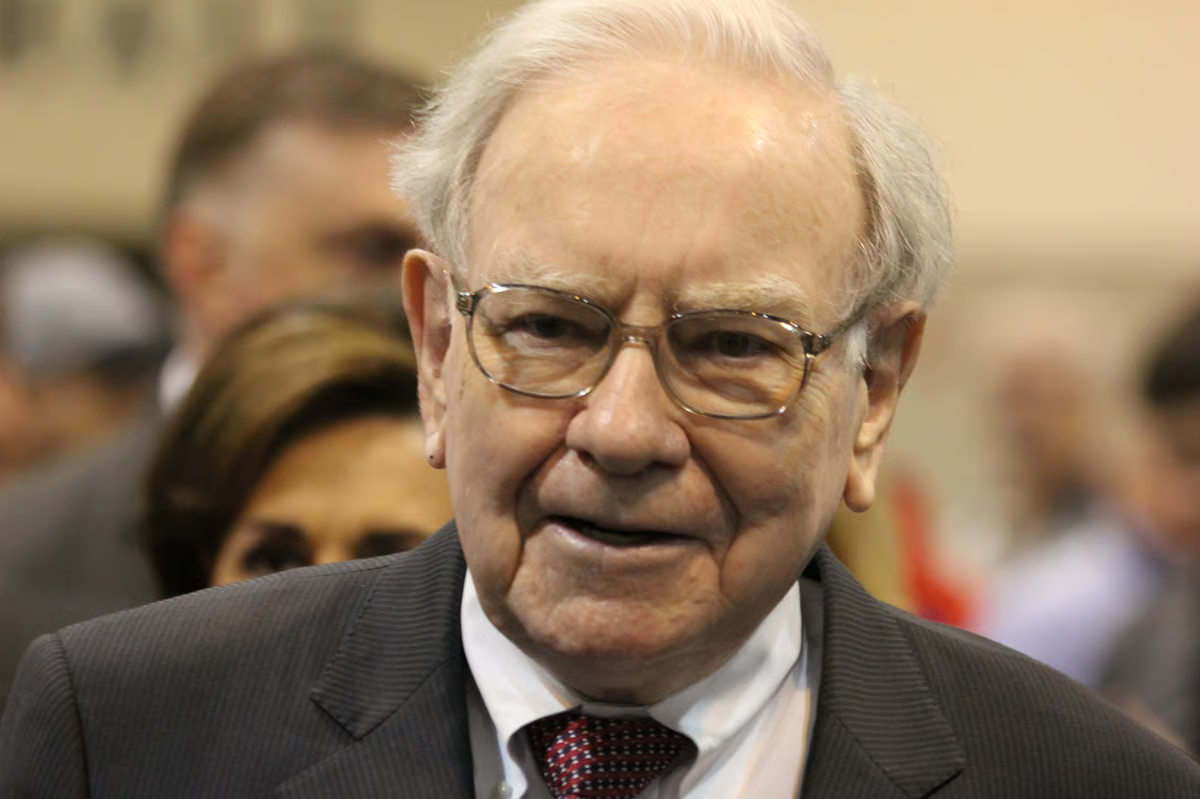
As a result, he handed over the reins of Berkshire Hathaway to Greg Abel with about $369 billion in investable cash and equivalents available to invest. Abel, known as more of an operator than a capital allocator, has gotten to work. After making several significant purchases in the first quarter, he deployed about $35 billion of cash for Berkshire Hathaway investors in the second quarter.
Here’s what he bought and what it means for shareholders.
Image source: The Motley Fool.
Abel’s biggest purchase of the second quarter
Abel spent $23.5 billion purchasing new equity positions for Berkshire’s portfolio last quarter.
Abel’s largest purchase was likely Alphabet (GOOG -0.12%) (GOOGL -0.13%) stock. He negotiated a $10 billion private placement for shares of the tech stock in June, part of an $85 billion capital raise for the Google parent company. It’s possible Abel bought more during the quarter as the stock eventually fell below the price negotiated in the private placement.

Today’s Change
(-0.12%) $-0.40
Current Price
$343.54
Key Data Points
Market Cap
Day’s Range
$342.07 – $348.06
52wk Range
$197.46 – $404.47
Volume
10.9M
Avg Vol
22.3M
Gross Margin
60.94%
Dividend Yield
0.25%
Buffett said he initiated the position in Alphabet in the third quarter last year. He sees Alphabet as capable of delivering very strong returns on invested capital in its cloud computing business. What’s more, he sees the chance to deploy hundreds of billions of dollars into high-return businesses as a tremendous opportunity.
Indeed, Alphabet’s cloud computing revenue climbed 82% year over year last quarter, and it has a massive backlog of unearned revenue. With excellent demand visibility, it can be built with confidence, and it should produce solid cash returns over time. The market is concerned with free cash flow, but as long as the cost of capital remains below Alphabet’s returns, it looks like a solid business.
Another business acquisition
Berkshire Hathaway agreed to acquire Taylor Morrison Home last quarter for $6.8 billion. Including the debt on the company’s balance sheet, the total enterprise value was $8.5 billion. While Abel didn’t close the deal until this quarter, that cash was earmarked for the homebuilder.
High mortgage rates and housing prices have weighed on homebuilder stocks. Despite those challenges, there’s still a massive opportunity for homebuilders over the long run. The U.S. faces a severe housing shortage. A White House report from this spring detailed a shortage of at least 10 million homes.
Abel may see an opportunity to take advantage of economies of scale. Berkshire already owns Clayton Homes, and the combination will make it the fourth-largest homebuilder in the United States. “The scale and reach we gain by unifying with Berkshire and Clayton’s regional site-built homebuilders is transformative,” Taylor Morrison CEO Sheryl Palmer said in a press release.
The homebuilding operation presents another opportunity for Berkshire to deploy capital with good cash returns on investment.
Buybacks resume
Abel reinitiated Berkshire’s share repurchase program in the first quarter but disappointed investors by buying only $234 million in stock. He made a huge step up in repurchases last quarter, with the total returned to shareholders reaching $4.5 billion. That’s the largest total since the first quarter of 2023.

Today’s Change
(-0.57%) $-2.90
Current Price
$504.03
Key Data Points
Market Cap
Day’s Range
$503.77 – $509.17
52wk Range
$464.01 – $537.74
Volume
4M
Avg Vol
4.8M
Gross Margin
23.52%
The repurchases are a sign that Abel and Buffett think Berkshire stock is cheap. The board only authorized share repurchases when the stock traded below its intrinsic value, conservatively determined by the CEO (Abel) after consulting with the chairman of the board (Buffett). To that end, the stock currently trades at around 1.46 times book value, slightly above its valuation over the last quarter but still within the range Buffett has found attractive in the past.
Abel spent billions buying back more shares in July based on the total share count reported in the company’s 10-Q.
Buying up Japanese trading houses
The last purchase worth highlighting is Berkshire’s continued purchases of Japanese trading houses through its subsidiary, National Indemnity. Last quarter, the companies reported that Berkshire increased its stakes in Marubeni, Mitsubishi, and Sumitomo. The exact total spent on the increased stakes in each business isn’t reported.
Each Japanese trading house runs a diversified portfolio of businesses and operates much as Berkshire Hathaway does in the United States. What’s more, Berkshire can borrow Japanese yen at a very low interest rate to hedge against exchange-rate headwinds. The dividends received on its investments in the sogo shosha, as they’re known, far exceed the cost of carrying the debt. With the weakness in the yen, the hedge has proved extremely valuable.
Abel also sees the opportunity to develop strategic relationships with the Japanese trading houses. He struck another strategic relationship with Japanese insurer Tokio Marine earlier this year.
Whether Abel’s capital deployment strategy proves itself in the long run remains to be seen. Despite the massive $35 billion total, the amount still represents a tiny fraction of Berkshire’s available cash. The company ended the quarter with over $359 billion in cash and equivalents available for investment.