Changing Engines, Different Cycles: Monetary Policy in China and Europe
Renewed tensions around the Strait of Hormuz have put energy shocks back at the center of macroeconomic policymaking. Yet the same shock is arriving in markedly different macroeconomic environments and triggered different policy reactions. China and Europe are cases in point.
On June 11, the European Central Bank raised its policy rates by 25 basis points, the first hike since September 2023. It also increased its projection for headline inflation in 2026 to 3%, reflecting higher energy costs, and upward price pressure on food, goods, and services.
Meanwhile, the People’s Bank of China (PBOC) has not tightened. Its governor, Pan Gongsheng, highlighted the inflationary effects of the recent oil supply shock, but also stressed that such imbalances should be viewed in a longer-term context, where market adjustments and technological change can help rebalance supply and demand.
The immediate policy responses to the Hormuz shock differ. The divergence itself, however, predates the latest geopolitical event. Inflation dynamics in China and Europe have diverged since 2020 as shown in chart 1.
What has driven these contrasting inflation environments? What are the implications for monetary policy in each economy?
At the aggregate level, China and Europe are in very different macroeconomic phases. China continues to face weak domestic demand and persistently low inflation, while Europe is confronting renewed inflationary pressure from an external supply shock.
Beneath these aggregate conditions, major industries in these two regions are at different stages of their own cycles. In China, the property sector is contracting while advanced manufacturing and new-energy industries are expanding. Europe faces a different configuration, with parts of its established industrial base under pressure while new sources of growth still need to be fostered and scaled. When an industry becomes large enough to drive a significant share of economic activity, it can act as a growth engine: its expansion or contraction can reshape aggregate demand and supply, and thereby the broader macroeconomic cycle. Inflation or deflation is one outcome of how these forces interact.
The underlying sectoral dynamics matter for monetary policy in distinct ways. In China, weak domestic demand calls for further easing alongside measures that address further constraints on household spending. In Europe, the challenge is to contain the effects of an external supply shock while preserving the investment needed to strengthen long-term supply capacity.
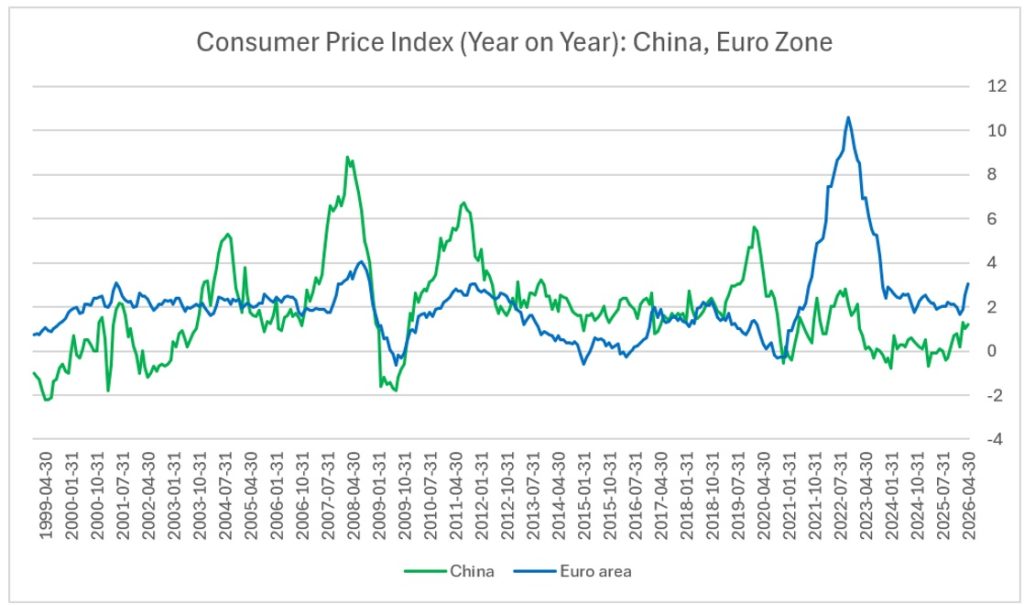
Source: Bank for International Settlements
Changing growth engines in China
China’s property sector downturn shows how the contraction of a major growth engine can reshape the aggregate macroeconomic cycle. As a largely domestic, non-tradable and credit-intensive sector, the contraction of the property sector affects aggregate demand through several channels. Its value chain, from construction and building materials to related goods and services, accounts for a substantial share of domestic economic activity. Housing has also been a major store of household wealth and vehicle for investment, while land sales and property-related revenues have been important sources of local government finance. A recent CF40 analysis of China’s manufacturing capacity cycle finds that property-related demand remained a drag on manufacturing demand through 2025, while the property sector’s close links to consumption, infrastructure and other domestic investments have propagated the contraction more broadly. The property sector is nonetheless likely to remain an important foundation of China’s economy even if it plays a smaller role in driving growth than in the past.
At the same time, China’s new growth engines, including advanced manufacturing and new energy industries, are expanding, but with a different macroeconomic footprint. Their contribution has so far been most visible on the production side of the economy. One way of tracing this shift is through a recent CF40 analysis of China’s “new economy”. The analysis identifies new-economy firms primarily based on R&D intensity. Among listed firms, the study finds a clear reallocation towards this new economy: between 2018 and 2025, its share of revenue rose by 4.2 percentage points to around 18%, its share of net profits by 14.1 percentage points to around 30%, and its employment share from 25% to 30%.
New energy, particularly solar photovoltaics, illustrates how the expansion of a new growth engine can reshape supply conditions beyond the sector itself. A stylized model of thermal and photovoltaic power generation by CF40 describes a reinforcing mechanism for the solar sector: as photovoltaic capacity expands, learning effects lower equipment costs, while a rising share of renewable energy lowers electricity costs. Cheaper electricity, in turn, reduces manufacturing costs, including the cost of producing renewable-energy equipment, encouraging further renewable-energy investment and deployment. This interaction is becoming increasingly relevant beyond manufacturing as electricity-intensive computing and AI expand, creating new sources of demand for power and stronger links between digital and energy infrastructure. New energy is therefore both a growth engine and an increasingly important input into the expansion of other sectors. The growing role of domestically produced renewable energy may also reduce exposure to external energy supply shocks and limit the pass-through of these shocks into broader inflationary pressures.
China’s External Dimension and Europe’s Trajectory
Against a backdrop of domestic demand weakened by the property downturn, external demand has become increasingly important for China’s manufacturing growth. The CF40 analysis of China’s manufacturing capacity cycle finds that exports have moved relatively independently of domestic demand, largely insulated from the property correction. As property-related demand contracted after 2021, exports continued to expand, increasing their relative importance in China’s manufacturing demand.
The expanding output of China’s advanced manufacturing and new energy industries increasingly intersects with Europe’s own industrial and energy priorities. Chinese firms have become important global suppliers of technologies ranging from solar equipment and batteries to electric vehicles, combining manufacturing scale with increasingly sophisticated technologies and supply-chain capabilities.
Europe faces a tension between deployment and production. On the one hand, access to Chinese technologies can accelerate the deployment of clean energy and electrification in Europe; on the other hand, concerns over competitiveness and strategic dependencies have strengthened the case for developing Europe’s own domestic production capacity. Restricting imports, however, does not by itself create competitive domestic capacity and may raise investment costs or slow technological diffusion. This tension sits within a broader fragmentation of global trade. As Christine Lagarde, the ECB president, highlighted in a 2025 speech in Beijing, geopolitical considerations are increasingly shaping trade and supply chains.
Sectoral dynamics shape, and possibly limit, monetary policy transmission
In China, a first limit concerns the transmission of lower interest rates to household demand. A recent CF40 monetary policy analysis argues that lower rates can support consumption and housing demand through lower debt-servicing costs, a lower opportunity cost of spending, higher asset values and improved inflation expectations. Yet household demand may still respond only weakly where other constraints remain binding. Younger households facing employment insecurity, limited wealth and weak expectations for future income may be reluctant to increase consumption or borrowing even when credit becomes cheaper. Stronger employment prospects and social security policies can complement monetary easing.
A second limit emerges as China’s new growth engines mature. Monetary and financial policy can support the financing and scaling of new growth engines, but sustaining them also requires that the surrounding markets, regulation, and infrastructure evolve with them. Targeted refinancing through the PBOC has helped channel bank lending towards priority sectors, including renewable energy, supporting investment and expansion. However, as China’s renewable-energy sector has reached considerable scale, financing is no longer the only constraint on further development. Continued expansion increasingly depends on electricity market reform, grid investment and system integration.
A related implication concerns how policymakers read economic momentum. Changing growth engines can weaken the link between bank credit growth and economic activity. The recent CF40 analysis of China’s financing slowdown points to this emerging divergence: new aggregate financing to the real economy fell below year-earlier levels from March 2026 even as indicators including industrial profits, exports, tax revenues and producer prices improved. The new-economy analysis provides one structural explanation, showing that new-economy firms generate more profits with relatively less reliance on interest-bearing debt. At the June 2026 Lujiazui Forum, Governor Pan Gongsheng made a similar point, noting that emerging, more asset-light industries require fewer bank loans per unit of output than traditional engines such as real estate and infrastructure. Slower credit growth can therefore coexist with improving economic activity, making credit aggregates a less informative indicator of economic momentum as the structure of growth changes.
In Europe, monetary policymakers also face stark tensions. Tighter monetary policy can dampen demand, reducing the risk that renewed inflationary pressures become embedded in broader price dynamics. But higher financing costs can also weigh on investment, hiring, innovation and technology adoption, with effects that may persist beyond the current tightening phase. This matters because Europe simultaneously needs substantial long-term investment to strengthen productivity and competitiveness and to foster and scale new growth engines. The renewed energy shock makes this tension particularly visible: monetary policy can limit its propagation, while tighter financing conditions may also slow the investment needed to strengthen Europe’s supply capacity and to reduce exposure to similar future shocks.
The effects of tightening also depend on how firms are financed. Recent ECB research finds heterogeneous transmission across firms: those with stronger balance sheets and access to market-based finance are better placed to sustain investment when rates rise, while more leveraged, smaller and bank-dependent firms are more exposed to higher interest rates. Monetary policy decisions also affect which firms are better able to continue investing, innovating, and expanding during a tightening cycle, and thus have implications that extend beyond aggregate investment alone.
China and Europe provide an interesting parallel in the ways their financial systems support shifting growth engines. China has demonstrated that emerging industries can be financed and scaled within a predominantly bank-based financial system, including through targeted central-bank refinancing and other policy support. At the same time, as its economy becomes more innovation-intensive, China is broadening its financing structure and strengthening the role of direct financing and capital markets. Europe approaches the challenge from a different direction. Its current policy debate increasingly emphasizes deeper capital markets, particularly equity financing, as a means of fostering innovation and scaling new sources of growth. The two cases suggest that there may be no single financial model for fostering new growth engines. What they share is the need for finance to be complemented by sector policies, market design and infrastructure that allow new industries to develop and operate at scale.