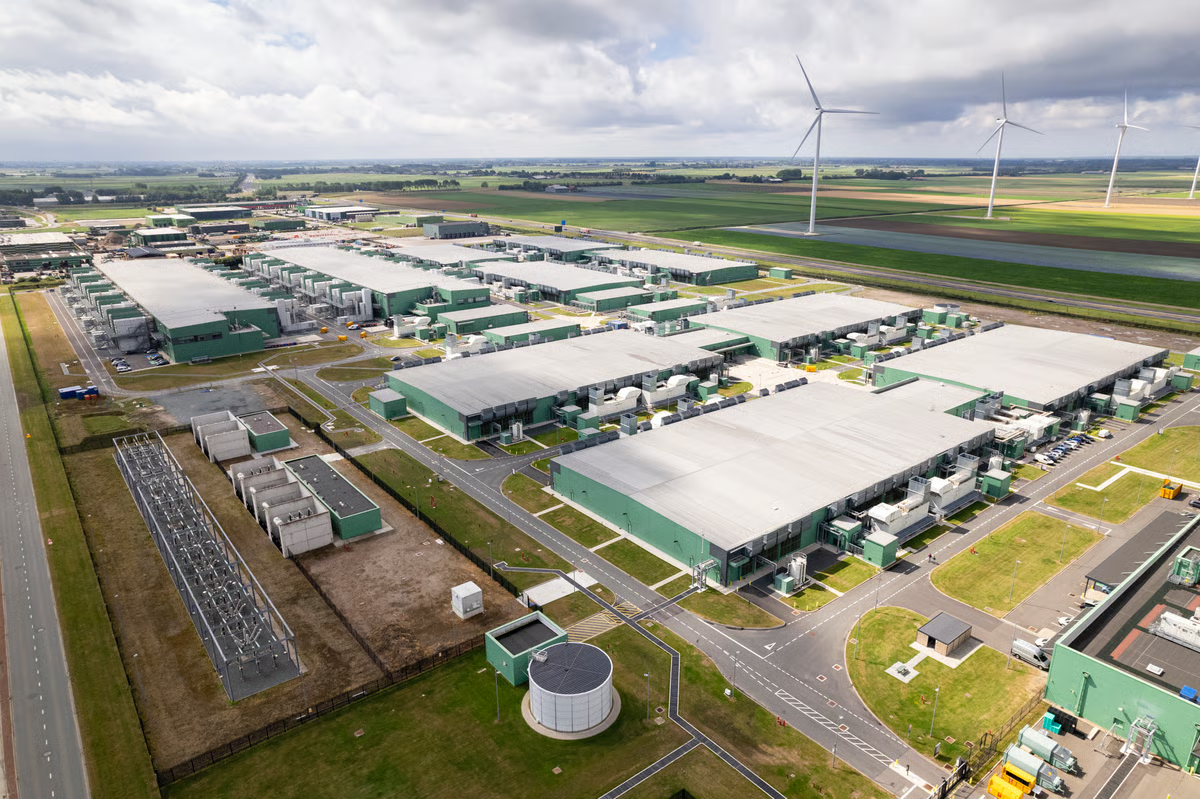
Morgan Stanley Says AI Data Centers Face a 38-Gigawatt Power Gap. These Industrial Stocks Fill It.
Morgan Stanley (MS -1.53%) estimates that U.S. data centers will need roughly 68 gigawatts of power between 2026 and 2028. About 15 gigawatts are tied to projects already under construction, while another 15 gigawatts can be supplied through available or contracted grid capacity. Do the math, and you’re left with a potential 38-gigawatt power gap. That’s not trivial.
In some parts of the country, getting a new connection to the electrical grid can now take five to seven years. Artificial intelligence (AI) companies won’t wait that long, and Morgan Stanley expects data center developers to increasingly look for ways to get power faster, including on-site, natural gas turbines, fuel cells, and other forms of behind-the-meter generation. And that’s where it gets interesting.
Generate it, move it, keep it cool
You can’t solve a 38 GW power shortage with another Nvidia chip. Somebody has to actually generate the electricity. Somebody has to move that electricity around the data center. And somebody has to keep thousands of power-hungry graphics processing units (GPUs) from overheating. That’s why I’m bullish on GE Vernova (GEV -1.70%), Eaton (ETN -1.54%), and Vertiv (VRT -4.23%).
GE Vernova sells the turbines that can help generate additional power. Eaton sells the transformers, switchgear, circuit breakers, and other equipment needed to distribute it. And Vertiv sells the power-management and cooling systems that keep AI data centers running.
To be sure, none of these companies is an AI stock in the traditional sense. But if Morgan Stanley is right about that 38 GW gap, they could be selling some of the most important equipment needed to close it.
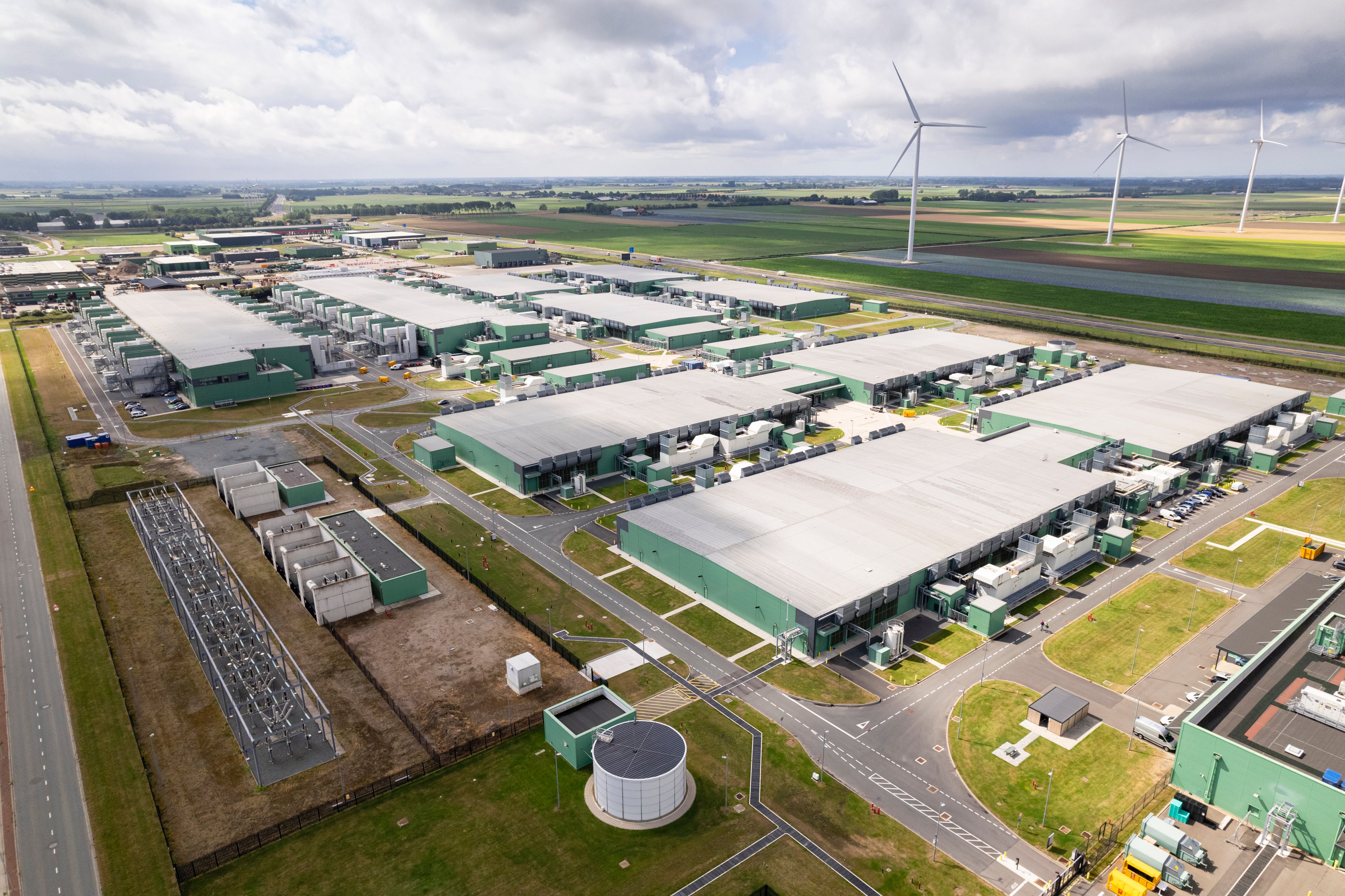
Image source: Getty Images.
GE Vernova: You can’t run AI without electricity
GE Vernova manufactures natural gas turbines that generate electricity for utilities and, increasingly, large data centers. That’s becoming particularly valuable because connecting a new data center to the grid can take years. Some developers are instead considering “behind-the-meter” power, essentially building their own power plants next to the data center.
Morgan Stanley specifically identifies natural gas turbines as one of the biggest potential solutions to the power shortage, estimating they could provide roughly 15 to 20 gigawatts of capacity through 2028. GE Vernova is already seeing that demand.

Today’s Change
(-1.70%) $-17.07
Current Price
$987.46
Key Data Points
Market Cap
Day’s Range
$963.76 – $1003.00
52wk Range
$530.16 – $1195.94
Volume
17.1K
Avg Vol
2.8M
Gross Margin
20.16%
Dividend Yield
0.18%
During the second quarter, its Gas Power equipment backlog and slot reservations reached 116 gigawatts, up from 100 gigawatts. Management now expects at least 125 gigawatts under contract by year end. Also worth noting: Data center orders in its Electrification business exceeded $5 billion in the first half of 2026, more than double what it booked in all of 2025.
Eaton: The picks and shovels of electricity
Generating electricity is only half the battle. Once you’ve got the power, you still need to get it safely into thousands of servers. That’s where Eaton comes in. Eaton manufactures switchgear, circuit breakers, transformers, busways, backup power systems, and other electrical equipment required inside data centers.
During Q2, Eaton’s Electrical Sector data center orders increased approximately 85% year over year, while revenue jumped roughly 65%. Its Electrical Americas segment’s backlog was also up 33% from a year earlier, providing considerable visibility into future demand.

Today’s Change
(-1.54%) $-6.66
Current Price
$424.67
Key Data Points
Market Cap
Day’s Range
$417.22 – $436.95
52wk Range
$311.92 – $478.00
Volume
2.3K
Avg Vol
2.4M
Gross Margin
35.90%
Dividend Yield
1.02%
Eaton is also spending heavily to expand its AI infrastructure exposure. In March, the company completed its $9.5 billion acquisition of Boyd Thermal, adding liquid-cooling technology designed for increasingly power-dense AI data centers. Boyd Thermal is expected to generate roughly $1.7 billion in 2026 sales, including about $1.5 billion from liquid cooling, giving Eaton another way to profit as AI servers consume more electricity and generate more heat.
Vertiv: Keeping AI from cooking itself
Vertiv sells power-management equipment, uninterruptible power supplies, thermal-management systems, and increasingly sophisticated liquid-cooling technology. And AI has been a gift for the company.
Vertiv’s Q2 revenue jumped 24% to $3.27 billion, while adjusted operating profit increased 51%. Adjusted earnings per share (EPS) surged 60% to $1.52, and adjusted free cash flow more than tripled to $925 million. Management now expects roughly $14 billion in 2026 revenue at the midpoint of guidance, with organic sales growth of approximately 31%.

Today’s Change
(-4.23%) $-11.54
Current Price
$261.00
Key Data Points
Market Cap
Day’s Range
$256.11 – $275.55
52wk Range
$118.70 – $379.94
Volume
40.5K
Avg Vol
6.2M
Gross Margin
35.73%
Dividend Yield
0.09%
The physical side of AI
Morgan Stanley expects nearly $2.9 trillion in global data center construction through 2028. And regardless of which company dominates AI, those facilities still need electricity, electrical equipment, and cooling.
GE Vernova helps generate the power. Eaton helps distribute it. Vertiv helps manage power and heat once they reach the servers. None of these stocks is cheap, and there’s always the possibility that data center construction slows as hyperscalers become more disciplined with capital spending.
But a roughly 40 GW power shortage isn’t something you solve with another software update. You solve it with turbines, transformers, switchgear, cooling systems, and billions of dollars worth of industrial equipment. And that’s exactly what these three companies sell.