Retirement Advice Ecosystems Eclipse Product Focus
Nearly 11,000 Americans turn 65 every day, marking one of the largest retirement transitions in U.S. history. For record keepers, advisors, asset managers and insurers, this is more than a demographic milestone. It represents a fundamental shift in what participants need from the retirement system.
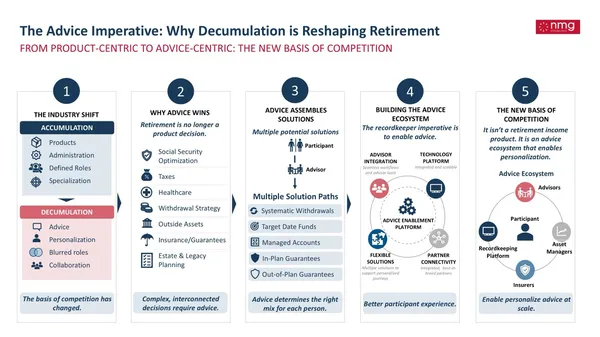
For decades, the defined contribution industry thrived on specialization. Record keepers administered plans. Advisors served employers. Asset managers manufactured investment products. Insurers provided guarantees. Accumulation rewarded specialization. Decumulation does not.
Creating income in retirement is not simply an investment decision. It requires coordinating Social Security, taxes, healthcare, outside assets, withdrawal strategies, estate planning, and, where appropriate, guaranteed income. No single product or provider can solve that challenge alone. Thus, the basis of competition shifts from product leadership to advice enablement.
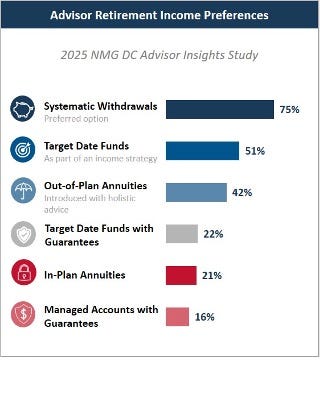
NMG Consulting’s 2025 DC Advisor Insights Study explains why. Based on interviews with 579 retirement advisors, we find no emerging consensus around a single retirement income solution. Instead, advisors assemble retirement strategies based on each participant’s needs. Systematic withdrawals remain the most common recommendation (75%), followed by target date funds (51%), out-of-plan annuities (42%), target date funds with guarantees (22%), in-plan annuities (21%), and managed accounts with guarantees (16%).
The takeaway is not that one solution is winning, but rather that advice assembles solutions.
Products have become components of an advice process rather than competing endpoints. That is reinforced by another finding: advisors are twice as likely to recommend out-of-plan annuities as in-plan annuities, reflecting their preference to evaluate guarantees within the context of a participant’s complete financial picture rather than the retirement plan alone. Hybrid advisory firms exemplify this participant-first philosophy by combining workplace retirement expertise with holistic wealth planning and employing the broadest range of retirement income solutions.
For record keepers, the implications are profound.
Being ‘advised’ does not necessarily mean having a financial advisor. Many participants will continue to rely on their workplace retirement plan as their primary source of retirement guidance. Others will benefit from technology-enabled guidance, while participants with greater financial complexity will increasingly engage a trusted advisor.
That means record keepers must support multiple advice pathways. Their platforms should deliver intuitive self-service experiences, enable digital guidance, integrate investment and insurance solutions, and, often, provide financial advisors when participants need more personalized support. Differentiation will not come from simply offering a new product. Instead, record keepers will differentiate themselves by enabling the ecosystem that brings those capabilities together.
The retirement industry spent decades optimizing products.
The next decade will be defined by optimizing advice.
The organizations that win will not necessarily manufacture the best retirement income products. They will build advice ecosystems that enable every participant to receive the right guidance through the right channel, at the right time. In decumulation, competitive advantage will come not from owning the participant relationship, but from enabling better retirement outcomes.