Living Room Seating Doesn’t Have to Start and End With a Sofa

Sofa often takes the largest share of a living room, but it does not need to provide every type of seat. Chaise lounges create space to stretch out, benches add seats without another tall back, ottomans extend armchairs, while paired lounge chairs can form a conversation area away from the main seating group.

Seat shape also changes how people use the room. Low pieces preserve views across open layouts, curved seats break from straight furniture lines, and chairs with footrests support a different posture from upright sofas. These rooms show how seating can change without adding another conventional couch.
Pair an armchair with its own ottoman

High-backed gray chair gets a square upholstered ottoman rather than an attached footrest. Both pieces share gray fabric and dark legs, so they read as one seating arrangement despite the gap between them.
Separate construction gives the ottoman another role when no one uses it as a footrest. It can move beside the chair as an extra seat or shift away when more floor space is needed. Two small tables fit beside the arrangement without blocking access.
Use a curved chaise to break from straight furniture lines

Pink chaise bends across the window wall instead of following its straight line. Wide curves create several sitting positions, while the low back keeps much of the black-framed window exposed.
Pillows gather at one end rather than covering the full seat. Green, cream, black, and pink patterns connect the chaise with other colors in the room without making it resemble a standard pillow-lined sofa.
Mixed seating can also change circulation. Emily Henderson’s team tested a living room with a sofa, open-backed chaise, and accent chairs, using the chaise to add seating without closing the passage between adjoining spaces. (1)
Put a backless bench against an unused wall

Slim upholstered bench occupies space beneath dark wood paneling without projecting far into the room. No back rises across the wall, leaving the panel details visible from end to end.
Three pillows provide support for anyone sitting against the wall, while the low seat can serve as a perch when extra places are needed. Its shallow form also suits a circulation area where another armchair would take up more floor space.
Give a chaise its own reading corner

Cream chaise fills the narrow area beside the French doors with one long seat instead of squeezing a chair and ottoman into the same spot. Raised support at one end provides a place to lean, while the open length leaves room to stretch out.
Round metallic table sits within reach and holds a lamp, books, glass, and framed photograph. Wall-mounted lighting adds another source above the chaise, giving the strip beside the doors a function beyond circulation.
Let an oversized chair hold a corner on its own

Tall winged chair fills much of the vertical space between the floor and window, giving this corner enough furniture mass without a second chair. Broad arms and a deep seat make its proportions closer to a lounge chair than a small accent seat.
Metal side table sits beside one arm, while a tall lamp rises behind the chair. Three pieces establish a complete seating spot without requiring a sofa to define the corner.
Use a leather chaise for another sitting position

Channel-tufted leather chaise supports the body from shoulders to feet in one continuous form. Curved metal supports lift it above the cowhide rug, leaving floor visible beneath a piece with enough length to replace a chair-and-ottoman combination.
Brown leather repeats tones found in the wood furniture around it, while the cowhide marks the chaise area on the floor. Reclined seating adds another posture to a room that might otherwise depend on upright chairs and sofas.
Face two lounge chairs toward each other

Matching cream lounge chairs turn toward a small brass drinks table instead of sitting side by side against a wall. Open wood arms preserve views toward the recessed bar behind them.
Space between the chairs leaves room for the pedestal table while keeping it within reach of both seats. Facing the chairs toward each other creates a conversation spot that can function apart from the main sofa.
Use a daybed where a sofa back would block the room

Long cream daybed provides sofa-length seating without a conventional back running across its full width. Wood structure supports one end, a bolster creates a place to lean, and the opposite side remains open.
Low construction suits placement away from a wall because sightlines continue across the seat. People can approach it from more than one side, giving the piece a different role from a sofa designed around one front and one back.
Studio McGee used an extra-long daybed outside the main seating group in its Mountainside Retreat, describing the arrangement as “separate while still connected.” (2) Daybeds can divide functions without creating the visual barrier of a full sofa back.
Mix several seating forms inside one rug

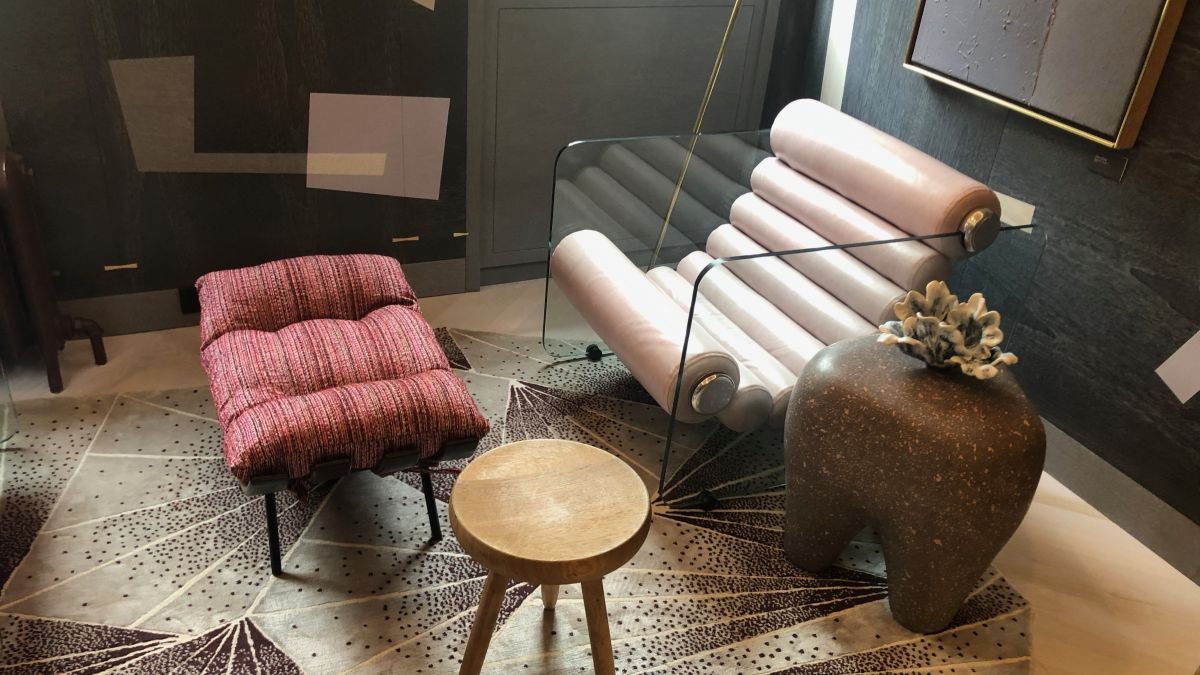
Pale tubular sofa, red lounge chair, and small wood stool share the same patterned rug despite having different shapes and construction. Sofa combines glass sides with cylindrical cushions, chair uses three thick horizontal pads, while the stool has no upholstery.
Rug provides the common boundary instead of matching furniture. Each seat keeps its own profile while the floor treatment places all three inside the same seating zone.
Repeat a chair without buying a matching furniture set

Two cream chairs repeat the same broad back, curved arms, and textured upholstery on opposite sides of the room. Tables between them change in height, shape, and finish, while mustard seating adds another upholstered form nearby.
Repetition does not need to extend across every seat. Emily Henderson’s design team uses layouts with a matching chair pair on one side and a different chair elsewhere in the group, allowing materials, upholstery, and furniture shapes to change without removing every repeated element. (3)
Add a bench when another full chair would take up too much space

Striped bench uses two pink cylindrical bolsters instead of a conventional back and arms. Crossed wood supports lift the upholstered seat above the floor, reducing the solid mass associated with another armchair.
Its form sits between an ottoman, bench, and small daybed. One person can stretch across it, two people can use it as a short bench, or the bolsters can provide support at either end.
Choose a chair with an open frame

Cream upholstery forms a continuous seat and back, while thin brass tubing traces the outer profile and continues into the base. No upholstered sides, skirt, or thick wood arms close off the structure.
Open construction leaves space visible beneath and around the seat, creating contrast beside heavier sofas, cabinets, or upholstered pieces. Wide seating does not have to produce the same visual mass as a fully upholstered armchair.
Sofa can anchor the room without dictating every seat around it. Chaise lounges support reclining, benches fit against walls or circulation zones, daybeds preserve sightlines, and paired chairs create a separate place for conversation. Choosing each seat for its position and use gives the room more options without filling every open section with another sofa.
Sources: (1) Emily Henderson, “The Farmhouse Living Room Layout Challenge: Playing With Real Furniture In A Demo’d Space” ,(2) Studio McGee, “Mountainside Retreat: The Entry & Great Room”,(3) Emily Henderson, “The 5 Go-To/No-Fail Living Room Layout Configuration Options”