The Best Cement Mixers of 2026, Picks from Our Editors
A cement mixer can make quick work of many DIY-friendly projects that require a bit of concrete work. From building decks to erecting a new mailbox, concrete helps to ensure everything stays securely anchored and safe. While you could mix concrete with a shovel in a wheelbarrow or mason’s tub, incorporating the water and cement mix can be a tedious, tiring process.
Using a quality cement mixer can make that process much quicker and easier so you still have energy for the rest of your project. To help you find the right tool for your needs, we researched a range of the top options available today. Our favorite, the Kushlan 350DD Cement Mixer, earned the top spot in our list of recommendations for its ample 3.5-cubic-foot capacity, durable rust-proof drum, and compact, collapsible design. This guide will help you understand how to pick a machine that suits your usage, as well as why the following are considered among the best cement mixers on the market.
- Top Pick: Kushlan 350DD. Offers 3.5-cubic-foot capacity, rust-proof drum, and collapsible design.
- Budget-Friendly Option: Central Machinery. Durable with a 3.5-cubic-foot capacity and safety-lock switch.
- Portable Choice: Ryobi 5.0 cu. ft. Features a tilting drum and integrated transport wheels.
- Heavy-Duty Use: Kushlan 600DD. Handles up to 300 pounds with a robust polyethylene drum.
Bottom line: Discover the best cement mixers of 2026, tailored for various needs and budgets, from portable to heavy-duty options.
- BEST OVERALL: Kushlan 350DD 3.5 cu. ft. 3/4 HP Cement Mixer
↓ Jump to Review - BEST BANG FOR THE BUCK: Central Machinery 3.5 cu. ft. ⅓ HP Cement Mixer
↓ Jump to Review - BEST PORTABLE: Ryobi 5.0 cu. ft. ½ HP Portable Cement Mixer
↓ Jump to Review - BEST FOR HEAVY USE: Kushlan 600DD 6.0 cu. ft. 3/4 HP Cement Mixer
↓ Jump to Review

Before You Buy a Cement Mixer
Most folks use the terms “cement” and “concrete” interchangeably, and to some degree, so will this guide. While it’s a common misconception, there is a difference between cement and concrete.
Cement is a binder that sets, hardens, and adheres to other materials, and as such, is a key ingredient in concrete, an aggregate of several different ingredients. Cement comes as a fine powder that hardens via a chemical reaction with the addition of water. In general, the cement referred to in concrete is Portland cement, which is usually derived from limestone.
Concrete is an aggregate made up of water, stone or gravel, and Portland cement; other bonding agents can also be added for repair scenarios. The addition of gravel and stone lessens the amount of Portland cement required, which is often more expensive and less readily available than gravel. Gravel also increases the strength of the cured concrete. And note that mortar, which is used between bricks and blocks to secure them in place, is a mixture of cement, water, and sand (no gravel).
By this definition, there are no cement sidewalks, cement slabs, or cement mixers. Each would actually be concrete, but the terms are so interchangeable that manufacturers use “cement” to describe their mixers.
Our Top Picks
Whether facing a large project or a quick patch, you’re likely to find the best cement mixer for your needs among the models below.
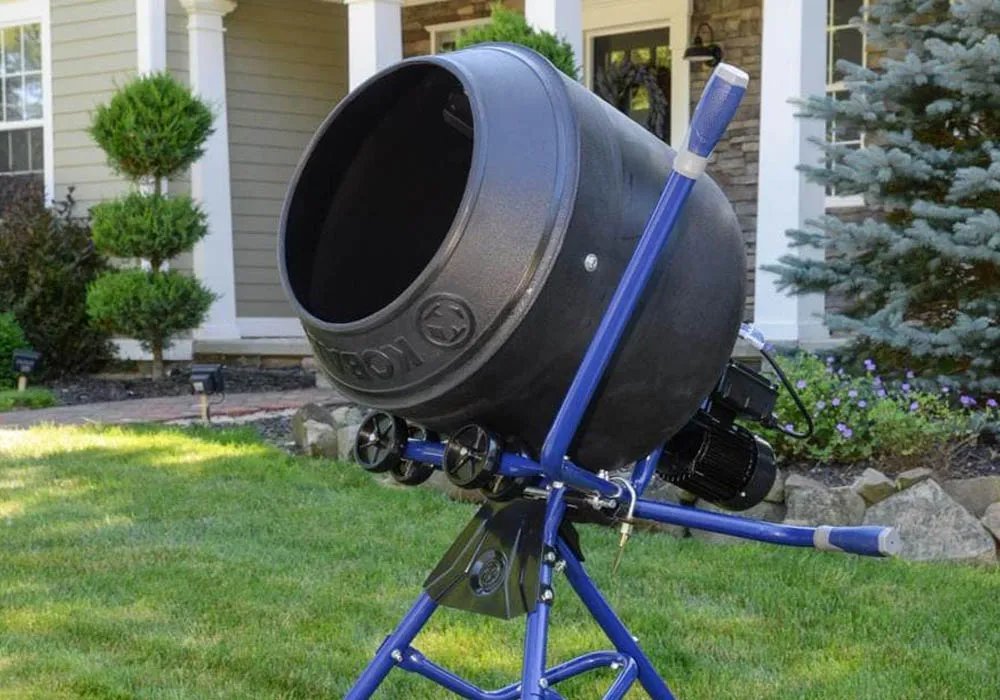
Those hunting for a medium-sized barrel cement mixer for a variety of concrete projects should check out Kushlan’s 3/4 Horsepower 120-volt Cement Mixer. This wheelbarrow-handled machine can handle up to 3.5 cubic feet of concrete mix, providing more than enough volume for most such small projects as fence posts and mailbox footings. Its 3/4-horsepower motor rotates the barrel 28 times per minute, so mixing a fresh batch of concrete won’t take long.
This Kushlan is all about durability. It features a 5/16-inch thick, dent- and crack-resistant, rust-proof polyethylene drum. Polyurethane, flat-free tires will hold up to 180 pounds of concrete mix, allowing you to roll a mixed load directly to your job. Yet the machine itself weighs just 75 pounds, and the handles collapse by pulling a pin, making it more compact for storage.
Get the Kushlan 350DD cement mixer at Lowe’s, Tractor Supply Co., or The Home Depot.
For a durable barrel mixer that won’t strain your budget, consider this options-packed model from Central Machinery. Featuring a 3.5-cubic-foot capacity, it offers plenty of volume for typical home concrete projects. The solid-steel unit delivers long-lasting durability on job sites, in yards, or around farms, where it can even mix livestock feed and seed.
Despite its steel construction, two large 9-inch wheels let you roll the mixer easily across rough terrain. A wide 15-inch drum opening simplifies dumping in dry bags and pouring out fresh batches, while the 1/3-horsepower motor spins the barrel at 36 RPM for quick blending. A safety-lock switch also prevents accidental start-ups, making this a reliable choice for residential tasks.
Get the Central Machinery cement mixer at Harbor Freight.
With a 5.0-cubic-foot drum capacity, this Ryobi model offers extra volume for DIYers needing to mix larger batches at once. A 1/2-horsepower motor drives the unit, delivering reliable power to blend dense batches thoroughly. Built with steel construction, it provides job-site durability while remaining easy to move around your workspace via its integrated transport wheels.
A tilting and pivoting drum mechanism helps users dump fresh concrete directly into a wheelbarrow or form without heavy lifting. The direct-drive gearbox ensures efficient power transfer to the mixing tines during operation. Weighing 110 pounds, this electric mixer balances capacity and mobility for midsize home improvements.
Get the Ryboi cement mixer at The Home Depot.
A dry bag of concrete mix is heavy by itself; add some water, and the weight can be backbreaking. That’s of no concern for Kushlan’s 6.0 Cubic Feet, 3/4-Horsepower Cement Mixer. This barrel-style mixer can hold up to 300 pounds of mixed concrete, rolling across the site with its 14-inch flat-free tires and wheelbarrow-style handles.
The Kushlan features a 5/16-inch polyethylene drum that won’t crack, dent, or rust, adding to its durability for heavy use. Between the steel frame, 115V motor, and wheels, the entire unit weighs 107 pounds, which is more than reasonable for a mixer this robust. The handles also remove with two pins, making the unit easy to store away.
Read our full review: Kushlan 600DD Cement Mixer
Get the Kushlan 600DD cement mixer at Lowe’s, Tractor Supply Co., or The Home Depot.
What to Consider When Choosing the Best Cement Mixer
Choosing the best cement mixer requires a solid foundation of knowledge. You need to know what style, size, and weight machine might work best for your needs, as well as power and capacity, so keep reading to bone up.
Type
Sure, an old-fashioned shovel might work for mixing concrete. But cement mixers can do the job faster and lessen the chances of unmixed cement (which will result in a poor finish and less strength).
Handheld mixers are essentially large, dual-handled, heavy-duty electric drills that accept long mixing paddles. Insert the paddle into a drum filled with concrete mix and water and start mixing. These mixers are ideal for smaller batches or mixing concrete in remote locations that might prohibit a larger mixer.
Barrel mixers have rotating barrels that incorporate water and concrete mix by rotating, which flops the dry mixture into the water. They come in both electric and gas-powered options. For most homeowners and DIYers, an electric mixer is best as it will require very little maintenance, while pros might prefer a heavy-duty gas-powered mixer.
Frequency of Use
How often you plan to use your cement mixer will play a significant part in choosing the best machine, for several reasons.
If you plan to use your cement mixer often, a barrel mixer will be easier on your back. After the task of dumping heavy concrete mix in the barrel, users simply add water and let the machine do the work.
For those mixing concrete infrequently, a handheld mixer might be a better choice. These mixers are much smaller, making them far easier to store away when not in use. Just keep in mind that using a handheld mixer does take effort, albeit less than a shovel and wheelbarrow.
Size and Weight
Barrel mixers are big, and they’re usually pretty heavy. The heft helps stabilize them while the barrel flops the concrete and water together. But lugging one of these machines around, or storing one in a garage, could be an issue.
Lightweight mixers can weigh under 100 pounds, which makes them easy to roll around, and two people can lift one into the bed of a truck. But even lightweight barrel mixers will take up some floor space in a garage.
If giving up that real estate isn’t an option, a handheld cement mixer might be a better choice. They tend to be comparable in weight and size to a heavy-duty handheld drill, and the paddle can be removed and placed on a shelf for storage.
Power
Concrete mix is heavy stuff, so the best cement mixers must have enough power to incorporate the mix and water thoroughly.
Manufacturers tend to quantify the power of handheld cement mixers by the wattage of the motor, with 1,500 watts or more considered ideal. These machines are typically versatile, due to adjustable speeds that make them useful for mixing lighter materials such as thinset, paint, and joint compound.
Barrel mixers move greater volumes of concrete and require more power, and most manufacturers quantify barrel mixer power in horsepower. Look for electric motors with 1/2 to 3/4 horsepower to be sure it has the “oomph” to mix the concrete.
Mixing Volume
Mixing volume applies to barrel mixers only, but this point is crucial: Barrel mixers come in volumes, ranging from just 2.5 cubic feet to 12 cubic feet. While bigger may seem better, that’s often not the case.
Mixing a load of concrete larger than you can work with quickly causes issues. The mix will begin to cure in the mixer, reducing its strength once it cures after pouring. Even if you have a very large mixer, it’s better to work in smaller loads to ensure the mix sets in place, not in the machine. Use this guide to determine how much concrete your project will need.
Additional Features
There are a few other factors that might make a particular barrel-style model the best cement mixer for your needs. Baked-enamel finishes on the drum help improve its durability, while lightweight plastic drums lessen the load. Some machines also have removable or collapsible handles, making them easier to store in a garage or shed.
Adjustable speeds can increase the usability of handheld mixers. While concrete requires a lower speed with lots of torque, paint and thinset can use higher speeds. Also, features like auto shut-offs help reduce the risk of burning mixers up when they get too hot.
FAQs
For more helpful info about the purchasing and using the best cement mixers, check out the answers to the following frequently asked questions.
There are two main types: handheld and barrel-style. Handheld cement mixers are best for mixing concrete in a bucket. Barrel-mixers are best for projects requiring larger volumes of concrete.
It’s easy to fall into a “more-is-more” mindset, but that’s not always the case with cement mixers. A mixer in the 3.5 to 4 cubic foot range will be more than enough for most small projects, like anchoring a mailbox or fence post in the ground, or even deck footings.
It’s best to start with a wet drum, so give the interior a quick spray with the hose before you start. Start mixing with a wet slurry, adding more concrete mix as needed. This guide on How To Mix Concrete will help.
Mix concrete for between 3 and 5 minutes. At that point, the concrete should resemble thick oatmeal and hold its shape.
Meet the 2025 Tools of the Year