Why Many Young Widows and Widowers Leave Social Security Money on the Table (Restricted Application)

 |
 |
<!–
Know anyone who was widowed at a relatively young age? Make sure they file for Social Security “survivor benefits” at age 60 (earlier with young children). If they don’t, they could be leaving hundreds of thousands of dollars on the table.
You Have to Ask for Your Money
This technique is called a “restricted application.” A few years ago, people were doing another type of restricted application with Social Security. However, that had to do with “spousal benefits,” not “survivor benefits.” Basically, people were filing for spousal benefits at age 66 and then filing for their own, now higher, benefit at age 70. That restricted application technique is no longer allowed. But the restricted application technique for survivor benefits still works just fine. You basically tell the IRS (and you must verbally tell them, either in person at your local Social Security office or by phone [1-800-772-1213, Monday-Friday, 8am-7pm]), that you don’t want your own Social Security benefit; you just want your survivor benefit. If you were widowed prior to age 60, you can get this benefit starting at age 60 (50 if you are disabled).
If you never ask for this survivor benefit, you will not get it. The Social Security Administration is not going to call you up or send you a letter to remind you to ask for your money. YOU have to do it. Which is a real shame, because those who are least likely to know this little fact are probably the most likely to actually need that cash.
More information here:
How Many People Are Missing Out on Survivor Benefits?
More than half of eligible children are missing out, estimated at more than 1 million. Plenty of widows and widowers are missing out, too. The number of applications dropped from 154,000 in 2012 to 114,000 in 2021. People just don’t know about this massive government benefit. I can’t blame them. I’m not even sure I was really aware of this until I watched Social Security expert Mike Piper talk about it at WCICON26. It nearly brought him to tears to think about people he personally knew who were dealing with significant financial hardship due to ignorance of this benefit.
 |
 |
<!–
How Do Social Security Survivor Benefits Work?
You may qualify for Social Security benefits (and Medicare benefits at age 65) if you’re the spouse, divorced spouse, child, or dependent parent of someone who worked and paid Social Security taxes before they died. The deceased must have paid Social Security taxes for at least 40 quarters (10 years), and if you’re a spouse, you must have been married for at least nine months (10 years if divorced). You also cannot have remarried before age 60 (50 if disabled).
To qualify for a benefit, children must be under 18 and unmarried, must be under 19 and still in high school, or must be disabled prior to age 22. It’s possible for married children, stepchildren, adopted children, grandchildren, and stepgrandchildren to get benefits under certain circumstances, so it’s best to ask. Dependent parents must be at least 62 and must have been supported by their deceased child prior to death.
The survivor benefit is based on the earnings record of the deceased. The calculations are all based on the Primary Insurance Amount (PIA), basically what the deceased would have earned at their Full Retirement Age (FRA). That’s age 67 for those of us born in 1960 or later. If the spouse waits until their own FRA, they get 100% of what the spouse would have received as a survivor benefit. But for most people, they shouldn’t wait until their FRA. They should claim the survivor benefit at age 60, then take their own benefit at age 70 if that is higher than the survivor benefit (and it often will be).
If you take the survivor benefit at age 60, it will be a smaller amount: 71.5%- 99% of the deceased’s PIA. If you’re a surviving spouse caring for a child under age 16, you generally get 75% of the PIA regardless of your age. The dependent child ALSO gets 75% of the PIA. Total benefits paid to the family are capped at 150%-180% of the PIA. If you’re curious what you or your spouse might receive, log in to the Social Security website and take a look at your statement. Here’s what mine says:
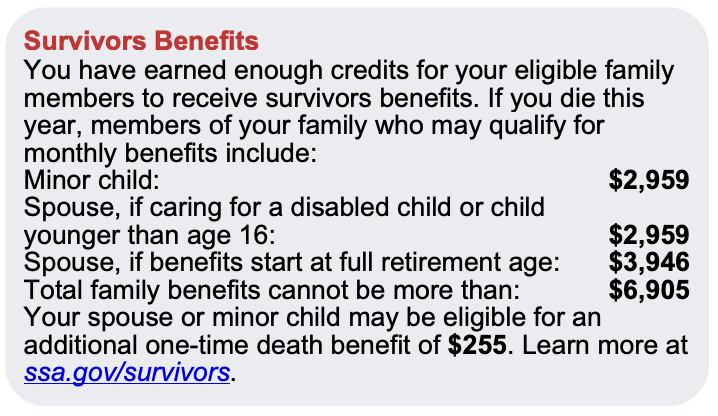
If you’re curious how the math works, $2,959 is 75% of $3,946. If I died today, Katie would get the one-time $255 payment, then her $2,959 and my youngest’s $2,959 ($5,918 total) until my youngest turns 16 in 2031, and then nothing until 2038 when she turns 60. But then she would get $2,821 for 10 years until she claimed her own benefit (now larger than half of mine) at age 70.
How much money would she leave on the table if I died the day I’m writing this and she failed to claim this survivor benefit? Well, $5,918 * 5 * 12 + $2,821 * 120 = $693,600. Even that number isn’t completely accurate since these benefits are indexed to inflation, but it would add up to nearly $700,000 in today’s dollars. That’s a lot of money for anyone, but particularly for the median American who only has $90,000 saved for retirement ($200,00o for those close to retirement).
A Real Marriage Penalty
If you’re getting survivor benefits and remarry before age 60 (50 if disabled), your survivor benefits are terminated. That’s a real marriage penalty. That penalty goes away after age 60 (50 if disabled).
More information here:
- Social Security Is Not Going Away (But You Might Have to Adjust Your Plans)
- The Consequences of Ignoring Social Security
What If You File Later Than Age 60
You don’t have to file a restricted application at 60 (50 if disabled), but the benefits are not retroactive. Forget until age 62? You just lost at least two years of benefits.
Should You Delay Until Full Retirement Age?
Some might wonder if they should delay their survivor benefit until their own FRA. The answer is almost surely not. Claim it at age 60 (50 if disabled) and earlier if you have a child under 16. The higher benefit just isn’t going to make up for the lost years of benefits since you’re probably going to just claim your own benefit at age 70 (it will probably be higher than the survivor benefit). There certainly is no benefit in waiting until later than FRA to get your survivor benefit.
What do you think? Did you know about this survivor benefit? Have you benefited from it?
The post Why Many Young Widows and Widowers Leave Social Security Money on the Table (Restricted Application) appeared first on The White Coat Investor – Investing & Personal Finance for Doctors.
 |
 |
<!–