Economists want Warsh to share more on his view of the economy at Jackson Hole, says CNBC survey

Markets want more info from the Fed Chairman and less intervention from the Treasury Secretary.
That’s the message from the special Jackson Hole edition of the CNBC Fed Survey. Among the 31 respondents, 80% say the Fed chairman should provide more insight into his economic views. But they’re split, 48% to 48%, on whether he should provide his views on the rate outlook.
“Chairman Warsh’s address is poised to be extremely key given the jump in long-term interest rates and high uncertainty over the path of inflation and Fed’s reaction function going forward,” said Kathy Bostjancic, chief U.S. economist at Nationwide.
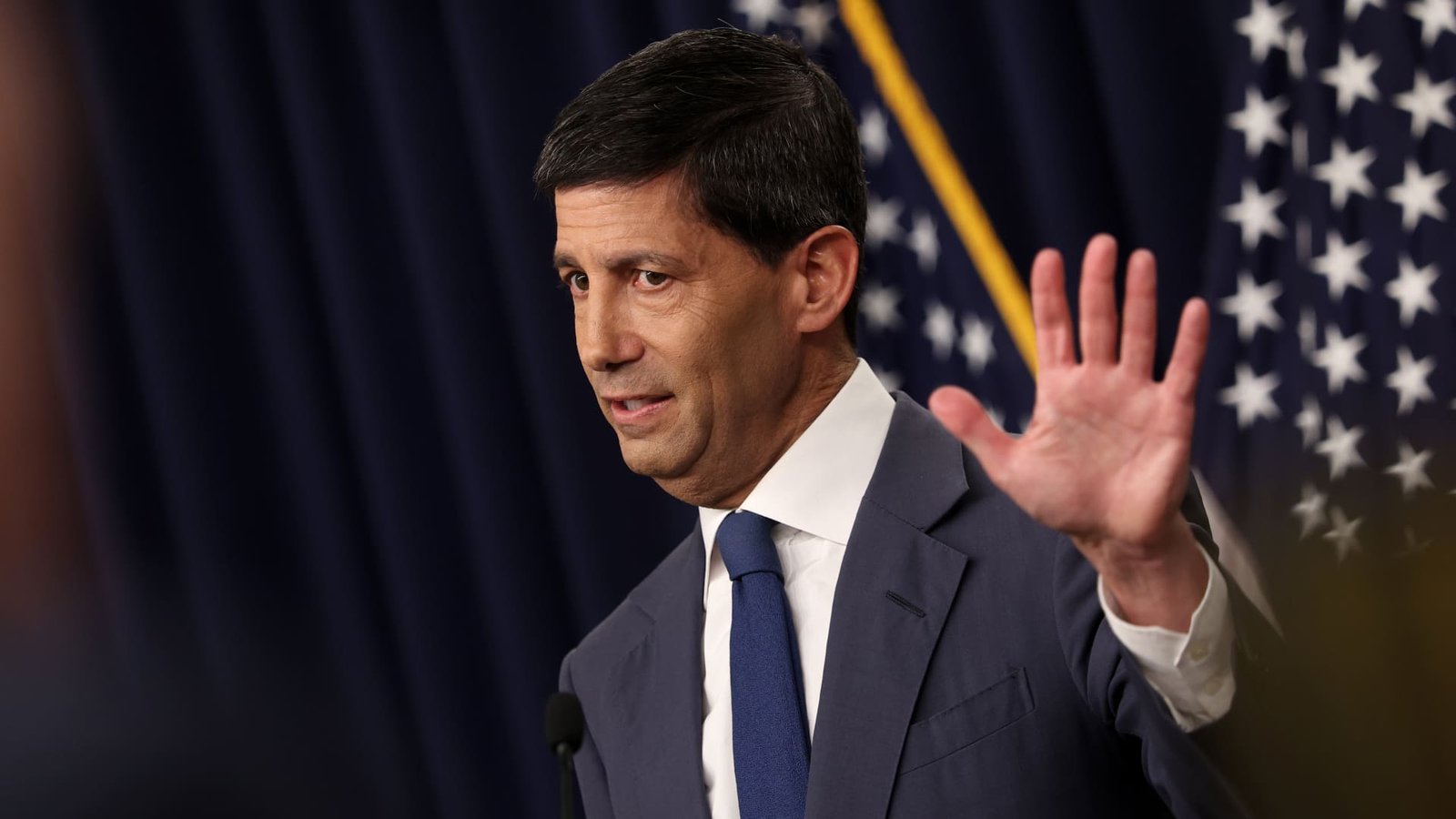
Warsh is scheduled to deliver his first keynote speech at the Fed’s marquee annual conference in Jackson Hole on Friday. Since taking office, he has launched a new regime of communications in which he has declined to offer much in the way of his views on the economy or his outlook for policy, breaking with his predecessors.
Warsh has said he’s holding back because he wants a cleaner view of market pricing unfiltered by Fed guidance.
A plurality of respondents think he’ll continue that practice, with 45% expecting he won’t offer any guidance on the rate outlook at his Friday speech. But 32% think he’ll be somewhat hawkish, and 19% believe he will be neutral.
“In eschewing forward guidance, Mr. Warsh has thrown the baby out with the bathwater,” said Constance Hunter, chief economist and head of research, Economist Enterprise. “He has abdicated his role in communicating about the reaction function and now, that communication comes from the minutes and the speeches of other members of the FOMC.”
Bessent effort seen failing
Ironically, it appears as if Treasury Secretary Scott Bessent has made it harder for Warsh to get that clearer market view. Treasury announced last week a surprise increase in purchases of long-dated off-the-run securities, a move that most saw as an effort to tamp down bond yields. But 77% believe the effort will not be successful.
“By further front-loading T-bill issuance, I believe the U.S. Treasury is complicating the Fed’s job,” said Peter Boockvar, chief investment officer, One Point BFG Wealth Partners.
Mark Zandi, Moody’s Analytics Chief Economist, wrote in, “The Administration’s efforts to bring down long-term interest rates are spitting into the wind created by the Iran War, massive budget deficits, and confusion over how the Fed will manage monetary policy.”
“Treasury’s actions are at best a band-aid and at worst a sign of panic,” said Gregory Daco, chief economist at Parthenon EY.
The widespread belief in the ineffectiveness of the Treasury’s actions can be seen in the survey’s prediction for the 10-year yield, which is forecast to remain between 4.60 and 4.70 through the end of next year.
Asked why bond yields have marched higher, the average respondent said 37% can be attributed to increased global supply of debt, 28% to higher expected inflation, 21% to higher Fed rate expectations and 19% to an improved growth outlook.
Rate outlook
On the eve of the Jackson Hole symposium, respondents are more divided than usual on the outlook for rates. Over the next year, 53% look for rate hikes, 30% see rate cuts and 16% forecast no change.
Inflation is forecast to decline next year to 2.6% year-on-year from 3.4% this year, the unemployment rate should remain stable at around 4.3% through 2027 while GDP hovers just above 2%. But for some, that decline in inflation comes because of Fed rate hikes.
The disagreement about the outlook for rate policy in the survey is reflected in the rate-setting Federal Open Market Committee. In July, the committee voted 9-3 to keep rates unchanged, with 3 voting for a quarter-point hike. Fed funds futures show a 40% probability of a September rate hike, rising to 70% by December.
By contrast, 46% of respondents have at least one rate hike in their outlook between now and December.
As top policy makers gather in Jackson Hole, Warsh may have the family fight he has said he wanted when it comes to the “regime change” he has promised to bring to the Fed. Respondents are split 40% to 40% on whether a majority of the FOMC supports Warsh’s views on the need to reform the Fed’s inflation framework; 38% think Warsh has majority support on the need for balance sheet reform while 31% say he doesn’t. And 47% think Warsh has majority support on communications reform, with 30% believing he does not. Still, Fed officials have not been shy about providing their economic and rate outlook in speeches and interviews with the press since Warsh took office.
Yet, 65% of respondents agree with Warsh that the Fed would benefit from talking less and getting a more unfiltered view of market signals on where rate policy should be.
“We do support the chairman’s goals of improving and modernizing the Fed’s operations,” said John Donaldson, director of fixed income, Haverford Trust Co. “That process will be evolutionary rather than revolutionary. It will not be overnight but will take some time to get everything up to date.”