Nvidia unleashes 70% growth bombshell and defends against ‘circular financing’ doomsayers
Nvidia jolted investors on Wednesday with a projection that its revenue would skyrocket by 70% next fiscal year and said demand for its AI chips is growing at 100%, prompting an after-hours stock rally.
The 70% preliminary expectation wildly exceeded projections for fiscal 2028 revenue of roughly $570 billion, or 44% growth from fiscal 2027 (the current year). Nvidia’s projected growth, applied to fiscal 2027 revenue and expected revenue, would imply fiscal 2028 revenue in the range of $690 billion to $700 billion, more than $100 billion over the $570 billion analysts had been modeling.
“We wanted to make sure that everybody has the same set of information,” CEO Jensen Huang said on a conference call Wednesday. “We’ve got a huge year coming up next year, and it’s going to be pretty extraordinary.”
“It is the case that we’ve never forecasted, never guided to a year in advance,” Huang noted later in the call.
Melissa Otto, global head of Visible Alpha research at S&P Global, said the magnitude of growth on the top line “blew away expectations” especially given that Nvidia doesn’t normally provide such guidance.
“I think what wowed the market was that 70% fiscal year 2028 number that they gave that was way ahead of Visible Alpha consensus,” said Otto. “I think the whole market was like, ‘Whoa, 70%.’”
Chief financial officer Colette Kress said customers’ forecasts pointed to Nvidia’s growth doubling next year. She delivered the news to investors after the market closed and her comments sent Nvidia’s stock rallying more than 4% in after-hours trading.
However, Nvidia is also battling with significant supply constraints, much like all the other mega-cap tech companies. “Our entire supply chain is challenged, and it’s everybody; everybody is really running flat out,” Huang said.
Huang said that if not for these constraints, revenue growth next year would be even greater.
“Even though our demand is much greater than 70%, our supply allows us to confidently deliver 70%,” Huang said in response to an analyst question.
The never-before-seen growth forecast came after the company disclosed quarterly earnings results that crushed across the board. Revenue for Q2 came in at $96.2 billion, up 106% from a year ago and sailing past projections of $92.2 billion from analysts. The company earned $2.22 per share on a non-GAAP basis, above the $2.06 to $2.09 expected. Kress guided next quarter to $108 billion in revenue, matching the so-called buyside whisper range of $105 billion to $108 billion.
Nvidia
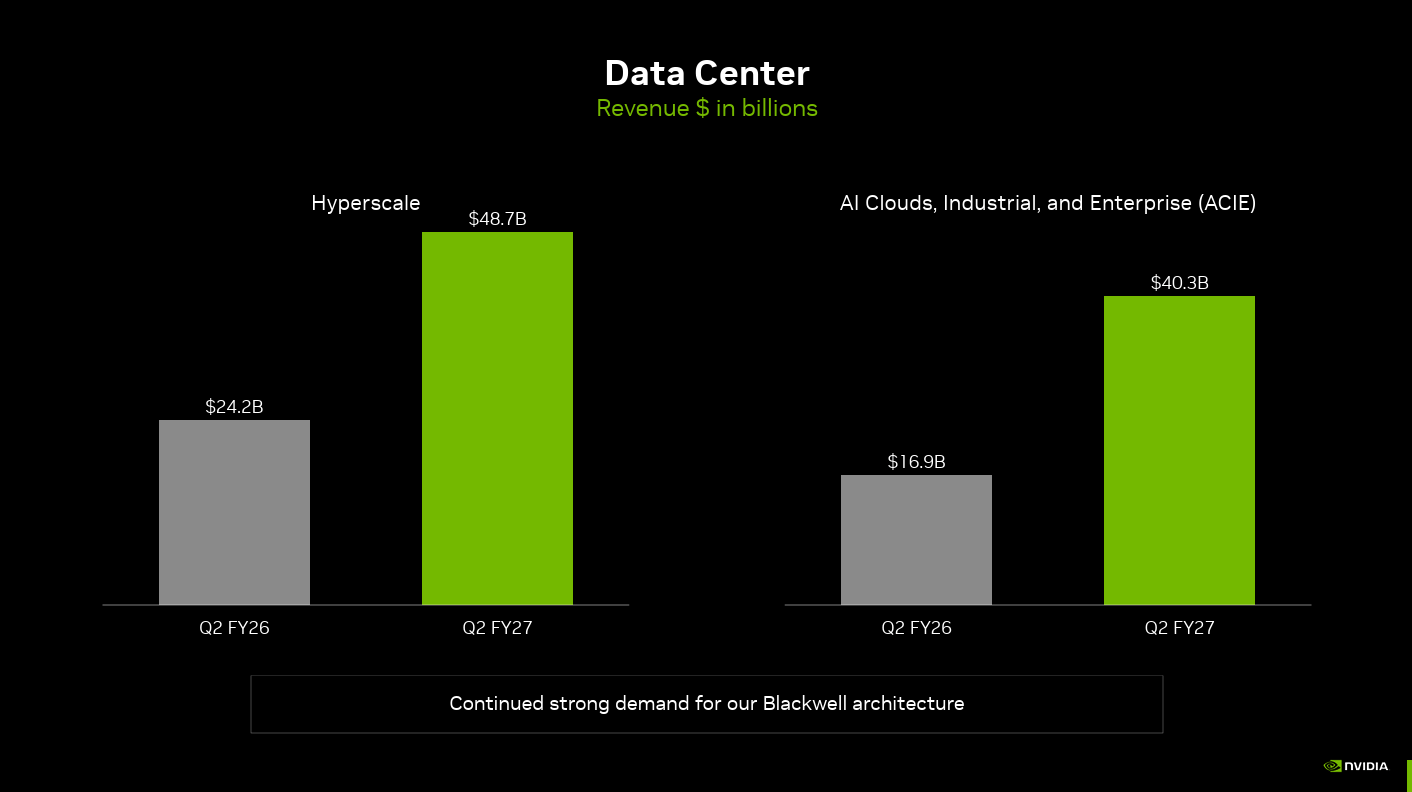
Huang said massive demand was coming from both hyperscale cloud providers as well as non-hyperscalers including sovereign AI, neoclouds, AI startups, and enterprises. The non-hyperscale crowd “represents about half our business, and that’s growing 100% a year,” said Huang.
Much of rising demand reflects a shift in the way AI systems are consuming AI compute, particularly as the use of agentic AI becomes more widespread, Huang explained. The amount of compute an AI agent gobbles up versus a human user is about 15 to 100 times greater, depending on the type of task or problem being solved, he said. And the number of agents within businesses is only going to grow.
“We have 40,000 employees, roughly,” he said. “In the future, we’ll have 400,000 agents, 4 million agents, and those agents are running continuously.”
‘We see it differently’
While the booming demand for AI chips has made Nvidia the world’s most valuable company, with a market cap of more than $5 trillion, critics have warned about the company’s spate of investments in other companies within the AI industry, from data center operators to frontier model makers like Anthropic. Many view the deals, which Nvidia is financing from its massive cash pile, as creating dangerous interdependencies with the AI business.
Kress offered up a defense against critics during the call: “We recognize the scale of this support, and we know some will call this circular financing,” the Nvidia finance chief said. “We see it differently.”
She said the frontier AI labs have proven technology leaders, traction from customers, and “skyrocketing” usage.
“We expect them to become the largest technology companies in history,” said Kress. Their growth “isn’t limited by their technology or customer demand. It’s limited by compute.”
Still, Nvidia’s involvement has been critical and substantial and, moreover, has led to a drag on the stock price. The company disclosed maximum gross guarantee exposure of $108.5 billion, which mostly stems from credit support for SB Energy’s Ohio tech campus, which will host Nvidia compute leased to OpenAI. The rest is due to $3.5 billion backing lease obligations for AI cloud partners. Nvidia has also publicized investments of nearly $50 billion in frontier AI labs and has partnered with private equity giants Apollo, BlackRock, Blackstone, Goldman Sachs, and KKR to raise more than $500 billion in third-party capital for AI infrastructure.
Kress said the investments in partners were low-risk, high-reward for Nvidia.
“We believe these investments, measured against the strength of their demand, the business they create for us, the ecosystem they build on Nvidia’s platform, and the equity returns on our invested capital will be excellent, and our risk is limited,” said Kress.
Secondly, Kress said demand from the AI labs will contribute to about a quarter of Nvidia’s business next year. She added that Nvidia’s platform is “fungible and durable” and can be used for other business if a partner alters their forward-looking projections.
For smaller, AI-native cloud providers known as neoclouds, Kress said Nvidia offers a deal structure where Nvidia guarantees it will pay for a minimum portion of a data center’s capacity, which satisfies the banks. In exchange, Nvidia takes a cut of the provider’s rental revenue above that threshold.
“Independent capital still underwrites every deal on its own merits. We’re not making loans,” said Kress. “In this model, we get paid twice—once on the hardware sale, and again through the share of rental revenue.”
Markets haven’t exactly loved the circular nature of all of these deals. Bill Birmingham, managing director at Rex Financial, said that when reports surfaced in July that Nvidia was in talks to guarantee as much as $250 billion in capacity for OpenAI in Ohio, the credit-default swap market repriced Nvidia’s five-year risk from 40 basis points to 82 basis points.
“The equity shed $250 (billion) in turn,” wrote Birmingham in a pre-earnings note seen by Fortune. “Even though the final number came in at $105B, the market read this as less demand and not less risk.”
Margin squeeze
One point that was slightly less than sterling was Nvidia’s third-quarter gross margin guidance of 74%, down from 75% it delivered in the second quarter, noted S&P Global’s Otto. Still, based on consensus estimates, the market “was already there,” she said.
“The market was expecting 72.6% for Q3, and the fact that they guided to 74% suggests that their gross margin is actually more resilient than the market was expecting,” said Otto.
Kress, in her CFO commentary, said supply and capacity commitments surged from $119 billion to $279 billion, driven by rising memory costs, a persistent boogeyman that has been behind rising prices all around the tech sector. During the call, Kress clarified further that the magnitude of memory prices led Nvidia to reset expectations, given the higher prices expected next year, said Kress.
John Belton, a portfolio manager at Gabelli Funds, said Nvidia had likely gotten a jump on the memory price issue by engaging early on with suppliers to strike long-term agreements with locked-in prices. During Wednesday’s call, Huang confirmed he had worked with suppliers about visibility into pricing well in advance.
“A long time ago, people asked me why it is that we’re working with memory suppliers when we’re a chip company,” he said. “Today, people understand it’s really quite genius that we were working on our supply chain so far upstream.
Birmingham wrote that Nvidia has been raising prices to customers by about 15% to pass through the inflation related to memory costs, which he said was a risk.
“It’s dangerous to raise prices when ROI for AI at the customer level is still unknown,” he wrote.
Kress said margins will bottom at 71% to 72% in the fourth quarter, and settle around 72% to 73% next fiscal as price increases take effect.