After Surging 3,110%, Has Sandisk Already Had Its “Nvidia Moment”?
After Western Digital spun off Sandisk (SNDK -0.96%) last February, the company returned to being a stand-alone specialist selling NAND flash storage accompanying solid-state drives (SSDs) into three end markets: data centers, edge devices like PCs, phones, cars, and gaming consoles, and branded consumer storage solutions.
This all sounds quite boring… that is, until the workloads leveraging Sandisk’s products changed. Training and running large language models does not stop at consuming GPUs. Generative AI also consumes high-speed storage for data lakes, model weights, and cache as inference deployments scale.
AI hyperscalers are increasingly expanding their capital expenditure (capex) budgets downstream (beyond chips), creating something of a supercycle in the memory market. Here’s the thing: Most investors following the AI trade already know these industry dynamics. What they may not know, however, is how to price the scale of this move.
Over the past year, Sandisk stock has risen roughly thirtyfold. In 2026 alone, shares are up more than 500%, and that’s after sliding about one-third from its peak back in June. The question is whether Sandisk’s rally is finished. The case that it is not hinges on one number: $93.9 billion. Read on to learn why this figure is key to Sandisk’s future.
Image source: The Motley Fool.
Sandisk’s growth looks familiar
For the fiscal year ended July 3, Sandisk generated $20.2 billion in revenue, up 175% year over year. The company earned $73.76 GAAP earnings per share (EPS) after posting a loss in the year prior. On the surface, these figures don’t reveal much other than that Sandisk is booming. But why? It’s the company’s revenue mix that tells the real story.
Edge remains Sandisk’s largest business at $12.2 billion, up 195% year over year. This makes sense as AI-enabled PCs and phones are absorbing more flash. Sales from the company’s Consumer division grew by a modest 29% to $2.9 billion. Meanwhile, Sandisk’s data center business jumped 437% to $5.2 billion. During the fourth quarter alone, data center revenue nearly doubled sequentially to $2.9 billion and was up more than twelvefold from a year ago.
The rate of this growth is not merely a pedestrian imitation of Nvidia‘s (NVDA +8.74%) first surge during earlier phases of the AI revolution. During Nvidia’s fiscal 2024, the company’s data center revenue rose 217% to $47.5 billion. In the following year, Nvidia’s data center business grew 142% to about $115 billion.
It makes sense that Sandisk’s data center operation is smaller than Nvidia’s in absolute dollars. A couple of years ago, the hyperscalers prioritized GPU procurement above anything else in the chip value chain. However, smart investors are starting to realize that initial waves of GPU demand fueled the current tailwinds supporting the AI memory landscape. Underneath the surface, investors can see that the percentage climb in Sandisk’s data center business is already in the same neighborhood as Nvidia’s early breakout.

Today’s Change
(-0.96%) $-14.42
Current Price
$1,484.95
Key Data Points
Market Cap
Day’s Range
$1456.00 – $1557.89
52wk Range
$48.56 – $2354.39
Volume
8.9M
Avg Vol
13.7M
Gross Margin
71.47%
Sandisk’s new contracts are like Nvidia’s chip architecture launches
The $93.9 billion figure referenced above is Sandisk’s floor, not a lofty forecast. The company has signed New Business Model (NBM) agreements with eight data center and edge customers. These deals lock in committed bit volumes and mix fixed and variable pricing with floors and ceilings.
According to management, the NBMs run as long as five years and have a weighted average term of more than four years. At the end of the fourth quarter, Sandisk boasted $59.8 billion in remaining performance obligations (RPO), a figure that climbed to $91.1 billion after accounting for two post-quarter agreements.
The structure of these deals does for Sandisk what a new chip architecture used to do for Nvidia. When Nvidia first announced Hopper or Blackwell, the hyperscalers lined up almost immediately, providing the company with years of visible data center demand. Sandisk’s new business contracts perform the same job without a product codename attached. In other words, these agreements convert Sandisk’s historically cyclical price swings into a more defined backlog.
Sandisk stock is cheap relative to Nvidia’s early breakout
Despite a stock price of nearly $1,500, the market is treating Sandisk stock like a cyclical memory name. Sandisk’s price-to-earnings (P/E) ratio is around 20, while its forward earnings multiple hovers around 7.
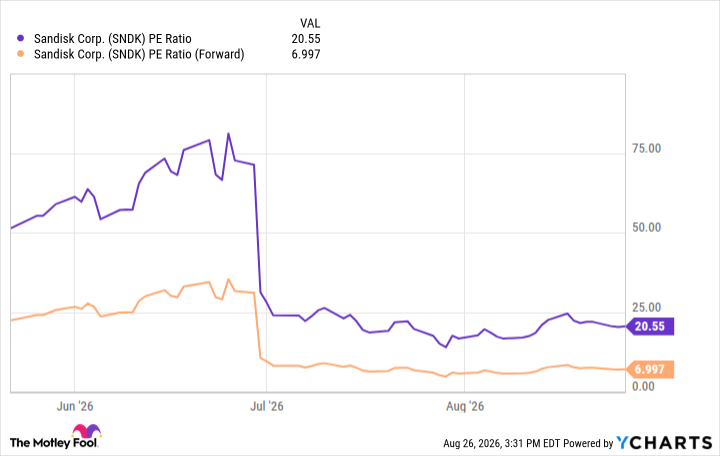
SNDK PE Ratio data by YCharts.
In comparison, Nvidia was never this inexpensive on a forward basis in fiscal 2024 and 2025. Back then, Nvidia’s forward P/E initially popped to around 30, but eventually sustained above 50 as the company captured the bulk of the initial AI infrastructure build-out.
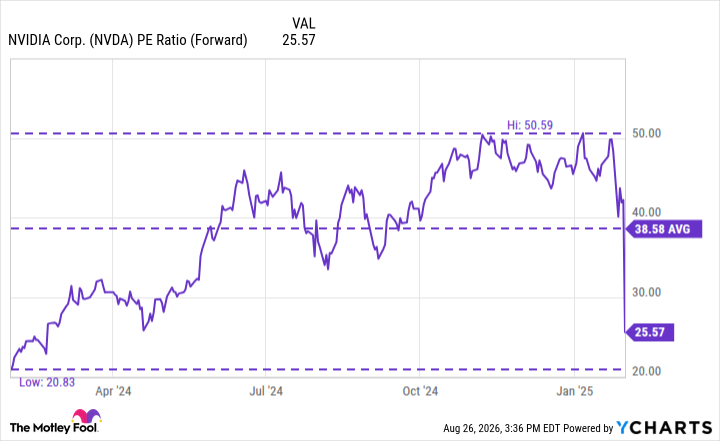
NVDA PE Ratio (Forward) data by YCharts.
Sandisk is unquestionably the cheaper stock in this comparison, and by a wide margin. A company whose data center business is compounding at Nvidia-like rates, and that has nearly $94 billion of minimum contracted revenue, is being priced as if a downcycle is the base case. To me, this is the tell.
Sure, Sandisk’s stock price has had a spectacular year so far, but its underlying valuation hasn’t had its “Nvidia moment” yet. If the company’s revenue mix continues shifting toward the data center segment, expansion in Sandisk’s multiples should be inevitable.