Data Centers Escape to Orbit, Nimbys Follow | American Enterprise Institute
A reasonable assumption: if artificial intelligence delivers the productivity gains implied by today’s massive AI infrastructure spending, investment will continue and lots more data centers will get built. A second reasonable assumption: ongoing pushback will raise costs and extend timelines.
Both those assumptions are strong ones for me and feed into my baseline expectations. But from there on, things get fuzzy. Where, exactly, will all those future data centers get built? That’s a spicy question that leads to many others. Will they get built pretty much everywhere across America as companies do a better job of meeting community concerns? Might anti–data center opinion subside when white-collar jobs don’t evaporate? Will builders turn to unexpected locations—such as Alaska, with its cold climate, abundant water, and vast land—or perhaps federal property?
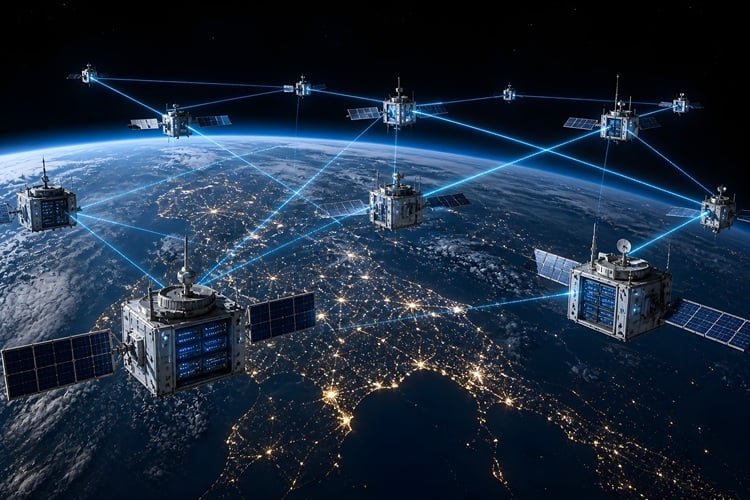
Or how about data centers in orbit? The idea now seems central to Elon Musk’s medium- to long-term business case for SpaceX, although other AI bosses have mentioned it as well. This is a world of thousands of rocket launches a year enabled by a rapidly reusable SpaceX Starship. Recent reports from Goldman Sachs and JPMorgan envision roughly five thousand Starship launches annually by 2031, with the buildout of orbital compute accounting for the overwhelming majority of them. (Helps explain the company’s decision to build a massive launch site in Louisiana.)
Anyway, that’s obviously a lot of rocket launches, especially when you consider that SpaceX’s workhorse Falcon 9 is considered a high-cadence rocket and will do fewer than two hundred launches this year, and under seven hundred lifetime launches so far. And Starship is still a work in progress, with just thirteen test launches.
It’s not hard to imagine a different kind of NIMBY pushback against data centers, one focused on the rocket launches putting the satellite-based servers in orbit. (I am sure there will be complaints about all those satellites creating “space junk” that obscures our view of the heavens.)
On that point, my recent Faster, Please! podcast offers some illumination. I chatted with Phil Metzger, a former longtime NASA researcher who is now a professor of planetary science at the University of Central Florida and director of its Stephen W. Hawking Center for Microgravity Research and Education. During our conversation, Metzger said there would be an “atmospheric protection issue” from the sort of quantity and pace of launches being imagined. He continued:
If you start launching too fast, then it does cause some cumulative damage to the atmosphere. The atmosphere will heal pretty quickly, so it’s not long-term damage from rocket launch. But I believe there will be political pushback when people see gigantic rockets launching every hour, hour after hour, 365 days a year, from 50 launch sites around the world. So Elon’s idea was we’re gonna have to build these AI systems on the moon using lunar resources, and we don’t need to launch them off the moon with rockets because the moon doesn’t have an atmosphere. We can just shoot them off the moon with a railgun. They call it a mass driver in that context.
Now you understand why AI—orbital compute specifically—may turn out to be the “killer app” for the space industry, including a permanent, industrial lunar presence. Metzger, again:
We were hoping that Mars settlement would drag up the entire in-space industry. I ran models on Mars settlement, and I believe it’s very doable. But the new thing now is AI. AI swept in like a storm two, three years ago. Suddenly everybody woke up and realized, “No, this is the killer app for space.”
Age of AI, meet the New Space Age.