
Nvidia Just Delivered Bad News for AMD and Intel
Nvidia (NVDA -4.58%) recently delivered blowout second-quarter earnings that the market couldn’t ignore, even if long-term questions about artificial intelligence (AI) remain.
The company easily beat Wall Street consensus estimates and raised third-quarter guidance beyond Street expectations. But the real kicker came when Nvidia CFO Colette Kress said that Nvidia is expecting 70% annual revenue growth in fiscal 2028, when the Street had only modeled 44%.
During the earnings call, management also discussed a newer, fast-growing business. It’s bad news for Advanced Micro Devices (AMD -2.33%) and Intel (INTC -2.85%).

Image source: Getty Images.
Nvidia taking full advantage of agentic AI
Agentic AI continues to gain momentum. People can now use AI to deploy autonomous agents that can complete tasks with very little human interaction.
While graphics processing units (GPUs) have always been at the center of the AI story because they power the inference that trains large language models (LLMs), there’s been a resurgence of central processing units (CPUs), the chips used to power legacy technology like cellphones and computers.
GPUs still handle most AI inference, but CPUs are now seen as the better option for orchestrating agentic workflows, such as calling tools and coordinating steps between model calls. This has led to CPU companies, such as AMD and Intel, to perform incredibly well, as demand for CPUs goes through the roof.
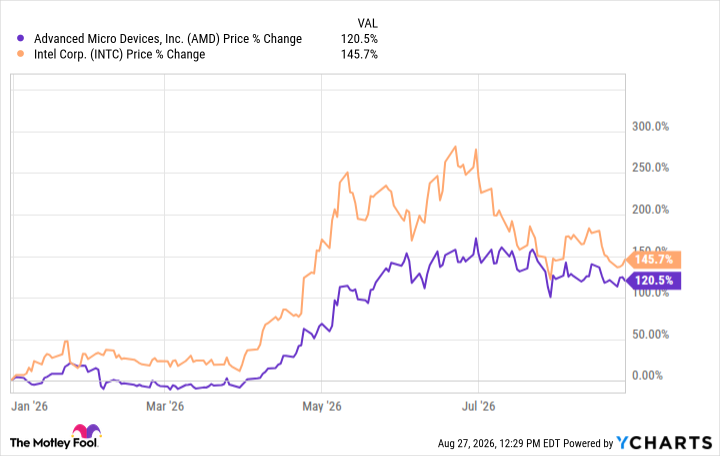
Data by YCharts.
Unfortunately for Intel and AMD, this is also a business that was not hard for Nvidia to move into. Last quarter, the company surprised the market by introducing its stand-alone Vera CPU, specifically for running AI agents. Nvidia says its CPUs can complete agentic tasks 1.8 times faster than industry standards and provide fivefold the bandwidth per watt than any other data center CPU.
Additionally, Kress said last quarter that they were projecting $20 billion in CPU sales for fiscal year 2027, which ends in late January. That instantly made Nvidia competitive with other CPU leaders, such as AMD and Intel. In the second quarter, Intel reported $6.3 billion of data center and AI revenue, which is where CPU sales are categorized, although not broken out. AMD reported roughly $6.7 billion in data center revenue in the second quarter. It also does not break out CPU revenue individually.
The bad news for AMD and Intel is that Kress said Nvidia not only still expects $20 billion in CPU revenue in its fiscal 2027, but expects that number to more than double in fiscal 2028.
The good news is that agentic AI is likely to keep growing
If there’s a silver lining for AMD and Intel, it’s that agentic AI is likely to keep growing exponentially.
“Today, the vast majority of AI is prompted by people. I believe that this last month it has crossed. Most AI are now agentic,” Nvidia’s CEO Jensen Huang said on the company’s earnings call. “But in the future, every company will have a whole bunch of agents. We have 40,000 employees, roughly. In the future, we’ll have 400,000 agents, 4 million agents. Those agents are running continuously. They’re running in the background.”
If the market keeps growing, there should be plenty of room for AMD and Intel to get their piece of the pie.
In a research report earlier this month, Bank of America analyst Vivek Arya once again raised his estimates for the total addressable market (TAM) for server CPUs. A few months ago, Arya expected the TAM to grow by fivefold to $170 billion by 2030.
Now, his new estimate is $210 billion, due to the rise of AI agents.