When Buyouts and PE Hub launched our first list of Women in PE in 2020, studies found that women represented less than 20 percent of all staff, and only 12 percent of those were in senior roles.
The list was meant to highlight the professionals most likely to change the face of the industry, and in many ways, capture private equity’s first generation of female leaders.
Unfortunately, progress has been glacial. A 2025 Columbia Business School Study found that out of 661 US private equity firms, only 5 percent were led by women, and roughly 350 firms have no women in senior roles.
Every year, Fairview Capital Partners issues a report on the state of women and minority-owned private equity firms. In its latest report, it found 212 firms owned by women in 2025, although buyout only represented 13 percent of that total. These stats also represent an 11 percent decline from the peak reported in 2024.
The numbers may be disheartening, but there have been bright spots in the last few years, including a $600 million debut fund from Grafine Partners, led by Elizabeth Weymouth, and a $900 million debut fund from Coalesce Capital, led by Stephanie Geveda. They may be outliers, but they represent a silver lining, as do many of the professionals we highlighted in that 2020 list, which ran just as the pandemic began shutting down the world.
The problem with any such list is it’s rooted in a particular moment or accomplishment, and that can obscure so much about a career trajectory, and how women navigate their career over the long term. So, we decided to speak with some professionals we recognized in that first list to see where they were, and what advice they’d give the next generation.
What we found is that they’ve grown exponentially in the past few years, into new strategies and larger funds, with an eye on what AI means for their portfolios. Yet, when they spoke about how young women professionals can build a career, they didn’t suggest an app, but an apprenticeship with an actual human. They stressed the need to cultivate relationships, both with senior leaders and peers, which is easier said than done during the Zoom era.
And perhaps the most consistent theme is placing a priority on a career path that feels tailored to their own values and needs.
In short, the good news is that these women are still thriving; the bad news is they’re still rarities.
Michelle Noon: Accelerating performance
When Buyouts and PE Hub spoke to Michelle Noon for the list, she had just founded Clearhaven Partners in 2019 to focus on software buyout opportunities in the lower mid-market. Today, she serves as founder and managing partner, and with their recent seventh anniversary, her team has managed to raise about $1 billion over two funds, and acquire sixteen companies, of which seven were add-on acquisitions.
As a software investor, AI has loomed large for Noon and her firm. “In 2022 through 2024, AI was all about experimentation, but in 2026, it’s about the application of AI to deliver real gains in productivity, revenue, cost and efficiencies,” she says.
In short, it’s time to gauge AI by its results, and she’s touted in-house talent at Clearhaven that serves as “river guides” on how to accelerate real-world wins and then share those learnings across the firm and its portfolio. Clearhaven itself has invested meaningfully in AI-driven insights into portfolio performance monitoring and target investment sourcing.
Michelle Noon, Clearhaven Partners
Clearhaven might seem uniquely fragile to AI disruption, but Noon invests in enterprise software, where portfolio companies’ relationships with clients are built on delivering value at scale, often in regulated environments, and affords companies the time and trust to evolve its offerings as the tech evolves, putting them in a pole position to make the most of it. Software companies are natural consumers of technology and often the first to adopt new techniques, such as mobile, cloud computing and now AI.
When asked about her advice for the next generation, Noon suggests a buffet approach. “Get exposed to as many facets of the deal process, with as many senior people as possible,” she says. “That’ll teach the multi-faceted nature of the work, the context switching, the enormous detail orientation, and that’s where you can develop pattern recognition. There’s no one right way to create returns, so it’s important to find the path that best fits you.”
But she also admits that the industry can be incredibly demanding on women. “I have two children, now 13 and 15, and there were some dark days when it was hard to do everything it took to stay in this career and still be effective at home,” Noon says. But she also argues that her love of problem-solving, and her willingness to “get comfortable being uncomfortable,” has made the journey a fulfilling one for her.
Ashley Evans: Security through specialization
In 2020, Ashley Evans was a principal in Carlyle Group’s tech team and was investing out of the firm’s flagship fund, having joined back in 2006 as an associate. Since then, she’s left Carlyle to join Francisco Partners as a partner.
The move grew out of her view of the market. “In 2022, volatility increased and with that came a real breakdown between what was fundamentally true about businesses and their valuations in the market,” Evans says. And in that context, she felt the need to be at a shop committed to specialization. She noted that Francisco was founded in 1999 as a technology-focused firm and has since invested in more than 500 businesses.
Ashley Evans, Francisco Partners
That specialization runs right into the questions about AI. Evans sees it as technology changing how people work, and the durability of companies in light of generative AI. “We see it through both an operating lens and an investing lens,” she says. “And that’s creating some interesting dislocation opportunities for folks that are specialized and focused.”
For the next generation, Evans stresses the need for authenticity. “The funny thing about being a woman in this industry, is you have to be yourself. There’s not really another option,” she says. “So, I was forced to be myself and encouraged to do so by my mentor at Carlyle, Patrick McCarter.”
McCarter did two things Evans found crucial to her developing her own authentic path. “First, he always told me the truth,” she says. “People always say they want feedback, but they don’t really want it.” But McCarter was always direct about her limitations or how she might improve, but with an important caveat.
“He was always himself and was never trying to make me anybody but me,” she says. And that helped develop her own sense of authenticity in how she handled her work and her career.
Michelle Riley: New tricks, same values
Michelle Riley may have been with Bregal Investments since 2007, but that doesn’t mean her career hasn’t radically changed, with the last few years offering a slew of new challenges for her. After the 2020 list, she moved up from general counsel to chief legal officer of Bregal globally, and joined the firm’s four-person management committee, while maintaining her GC duties for their US funds.
Like so many firms, Bregal moved into new strategies including credit and secondaries and continued to swell in size, with Bregal Sagemount’s fifth flagship fund closing oversubscribed at its $3.5 billion hard-cap this past March, only four months after launch. She managed all these changes by hiring well and collaborating closely with the firm’s new internal experts.
Michelle Riley, Bregal Investments
That devotion to collaboration was true of Riley since the earliest days of her career. “Back then, everyone was in the office together, and I learned so much,” she says. “And as much as I enjoy working from home at times, young people do need to find ways to stay connected with their peers and senior people to learn the business because it is an apprenticeship.”
Riley believes there are two flavors of mentors, and both are crucial. “There are those that give you wonderful life and career advice,” she says. “And then there are those that won’t give you any of that but will give you a window into why they’re handling that intense negotiation in a particular way or making a given decision.” While every professional needs to be challenged, Riley clarifies they also need to be reminded why they’re excited to show up at the office.
She does note that great mentors don’t have to be women. “When I was a young lawyer, I hardly ever worked with a woman partner or client,” Riley says. “Now there are more [female professionals] and they should make those connections, but they shouldn’t feel afraid to find mentors who are successful men. Many of them might care about advancing women, but most of them will certainly care about having great people work for them.”
Patti Melcher: Sticking to the knitting
Patti Melcher founded EIV Capital in 2009, and this past April, EIV closed two funds with a cumulative total of $1.1 billion, raising its total committed capital under management to about $3 billion. When she first launched the shop, it was focused on lower mid-market midstream energy opportunities, and she credits its success both to the team and their commitment to their strategy.
“A few years ago, there was a feeling that no one was ever going to use oil and gas again, and there was a lot of encouragement to raise a transition-only fund,” Melcher says. “Now we did our first renewable deal in 2010 because it looked like a midstream energy deal, since it just used natural gas from landfills.” She didn’t believe there was enough downside protection in a renewables-only fund, so they continued investing in them selectively through EIV’s infrastructure funds.
Patti Melcher, EIV Capital
Fast forward to the latest fundraising trek, where Melcher found LPs grateful for the distributions from traditional energy investments. “Some investors explained that while oil and gas is less than five percent of their allocations, it’s delivering 40 percent of their distributions,” she says. Even as the market made exits harder in the last few years, EIV has managed to turn many of its investments into “cash machines” for their LPs.
For Melcher, EIV’s performance is due to three simple rules. One, stick to your knitting, that is, staying in the energy industry. Two, don’t pay too much. And three, don’t use too much leverage. They were lessons she learned from her mentor, LE Simmons of energy investor SCF Partners.
“The only reason I left SCF was that I had a special needs child, and at the time, didn’t feel like I’d find something that fit me unless I built it myself,” Melcher says. Necessity might have driven that gamble, but she notes it gave her a rich career, although she wouldn’t suggest her particular career path as a model to follow.
The UK student finance framework is facing unprecedented scrutiny. In a landmark report titled “Student loans: Broken and unfair?”, the cross-party Treasury Select Committee has concluded that the government has a moral obligation to overturn its planned repayment threshold freeze for Plan 2 student loans. The policy, originally announced by Chancellor Rachel Reeves to freeze…
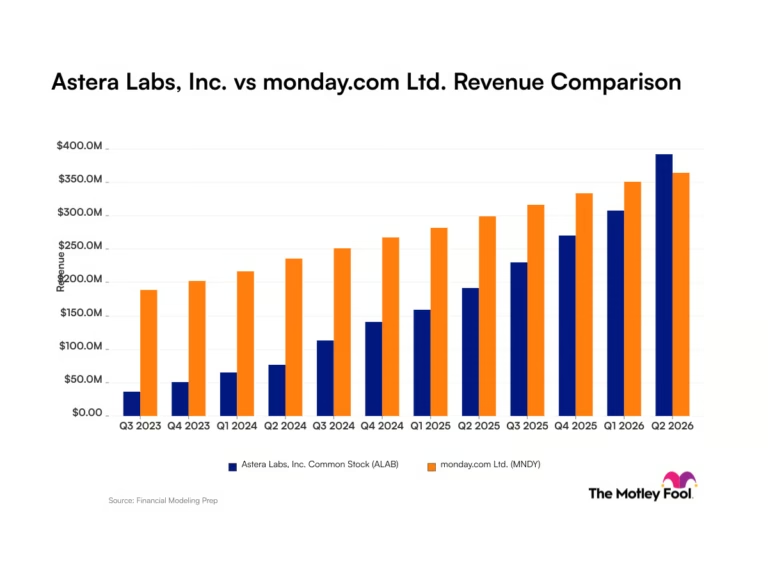
Astera Labs: Rapidly Accelerating Quarterly Revenue Growth Astera Labs (ALAB -4.75%) primarily generates revenue by providing semiconductor-based connectivity solutions for cloud and computing infrastructure. While corporate directors liquidated substantial personal equity holdings, the company advanced the volume production schedule for its fabric switch equipment and recorded a net income margin of 39% for the quarter…
Between tariffs, trade disputes, and the closure and reopening of the Strait of Hormuz, “disruption” has moved from being a buzzword to a permanent fixture in the CEO lexicon. Asia is one of the world’s most dynamic regions in the world. Its demographic scale, industrial depth, and technological capabilities puts it at the centre of…
Soyla Reyna stood outside Calvary Temple Church, taking a momentary respite from hours of manning the flood displacement shelter at her home church in Kerrville on Thursday. “A lot of it was unbelievable,” she said as the rain outside the church patio began to let up. “People are devastated by the reoccurrence.” Over the course…
Remember those 1990s infomercials for the Ronco slow-cooking rotisserie oven? “Set It and Forget It” became a popular catchphrase and a game-changing convenience for working families. But when “set it and forget it” is applied to estate planning, it’s easy to get burned. How many of your clients finally get around to creating a will…
An increasing number of small businesses are offering retirement plans to their employees, according to a new report. Processing Content The report, released Tuesday by the payroll and benefits provider Gusto, found a 64% increase in the number of small businesses offering retirement plans since 2019. While only about 19% of small businesses offered a…