A Huge Loss in Philadelphia | American Enterprise Institute
When my son was three, we packed the car on a cold fall day and drove to Philadelphia from New York. It was the first time I had a chance to take him to my hometown and show him a bit of my life.
As we approached our hotel, we passed the Academy of Natural Sciences, and my son saw the dinosaur outside. He shrieked with delight and before we even parked said, “Let’s go see the dinosaur.” It was the first thing he wanted to do in Philadelphia, so we went.
I will never forget walking him up the same stairs I had walked up with my mother nearly 40 years earlier. We entered Dinosaur Hall, where he found a giant T. rex staring at him. He smiled and looked up in awe. It was the same reaction I had at his age. Watching him experience the Academy for the first time reminded me of the thrill of visiting the museum when I was a little boy.
That is why the news that the Academy will close its public museum at the end of September hit me so hard. The research institution and its collection of more than 19 million specimens will survive, and I am grateful for that. But the museum, open to the public since 1828, will be gone.
The Academy meant the world to me as a child. I learned about dinosaurs, birds, animals, the environment, and the natural world there. Its people and programs were cemented into my mind, and the Academy helped supervise quite a bit of my journey toward Eagle Scout. I can tell you what the museum did for me. From its bison to its minerals, it sparked curiosity about the world and met me with both questions and answers.
What is so upsetting is the realization that children will no longer experience the joy of the physical museum.
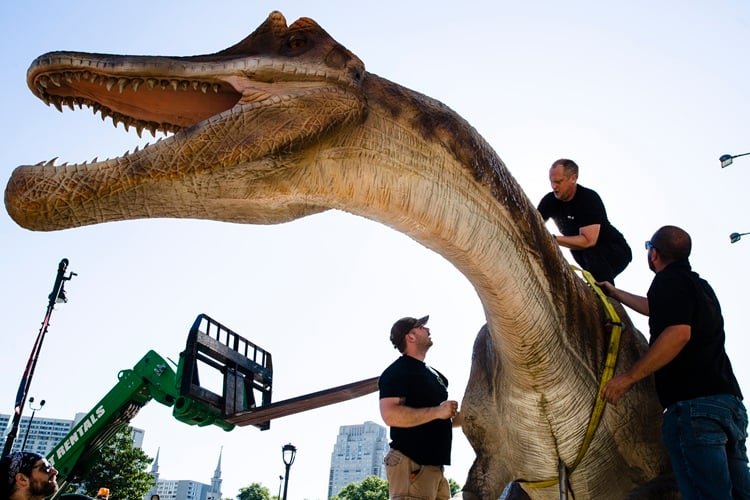
Think about it this way: Almost anyone can put an image of a Tyrannosaurus rex on a screen, but the T. rex in Dinosaur Hall towers over all visitors. Seeing it in person is simply awesome and cannot be replicated even on an IMAX screen. I have a wonderful picture of my son during his first visit leaning way back to see the whole T. rex—his smile is huge. Standing beneath a real dino is something no website or video can replicate.
The same is true of the Academy’s famous dioramas. These natural scenes used real animals and were created under practices that museums would not use today; that history deserves an honest discussion. But these scenes exist, and the scores of actual animals on display give a window into the natural world that many children may never experience in the wild. A child could walk up to the glass, see a tiger or musk ox, and notice something new every time. A digital version can be useful, certainly, but it gives a child a far narrower and less exciting experience.
Perhaps, most importantly, children will lose the chance to actively learn and engage with others around dinosaurs and the natural world. The shared excitement and euphoria of seeing a triceratops in real scale or a tiger up close can last well beyond a museum visit. And visitors will no longer have the chance to learn from talented educators and naturalists—the same dedicated staffers who helped me as a Scout—who bring the museum to life, answer questions, and connect with visitors.
Philadelphia is extraordinarily lucky to have a place like the Academy of Natural Sciences. As the natural science museum has been around for almost two centuries, it seemed like a permanent fixture that anchored the city’s identity. I mistakenly assumed the Academy would always remain because it had always been there for me.
However, Academy leaders noted that pressures from rising costs and attendance declines prompted the closure. While I’m sure that those pressures are real, a public museum that educates children cannot be judged as though it were a traditional store expected to support itself through sales. Its full value will never show up in attendance or even memberships—this is why philanthropy and civic leadership matter so much. I really hope that both step in here now, for the institutions we preserve and support signal what we value and the Academy is priceless.
My son is now eight. We’ve been back multiple times since his first visit, and I had assumed that I would take his siblings and possibly his own children years from now. For close to 200 years, Philadelphia families have been able to do exactly that. It would be tragic if my son and I turned out to be part of the last generation that could.