The Diamond Podcast for Advisors: OnePoint BFG Wealth Partners
What separates a successful advisory practice from an enterprise with the ability to grow well beyond its founders?
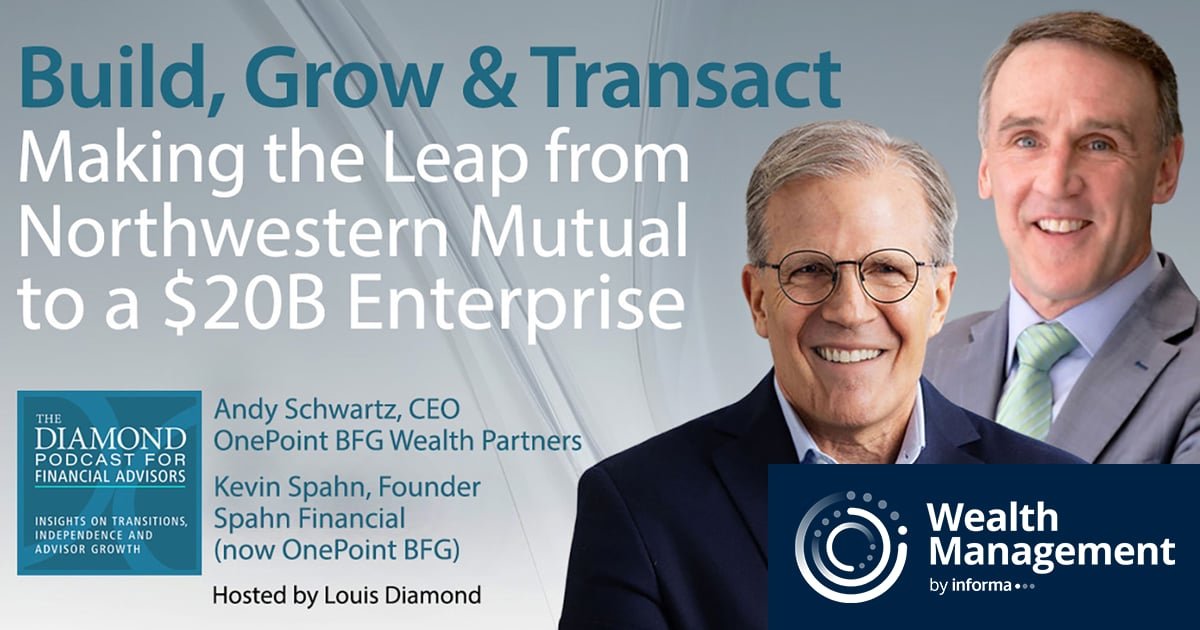
Andy Schwartz and Kevin Spahn offer two different perspectives on that question. Both spent decades at Northwestern Mutual, but their paths eventually diverged. Andy left to help build what is now OnePoint BFG Wealth Partners, an $18B+ firm expected to surpass $20B by year-end. Kevin built one of Northwestern Mutual’s top practices before deciding to merge his business into OnePoint and become an equity partner.
Louis talks with Andy and Kevin about the decisions behind both journeys: creating a true firm rather than an aggregation of practices, transitioning advisors from 1099 to W-2, using outside capital without relinquishing control, rethinking succession, and determining when equity in a larger enterprise can offer greater opportunity than continuing to build alone.
Underlying it all is a factor that’s much harder to quantify: trust.
The Storyline
Andy Schwartz and Kevin Spahn have known each other for roughly 30 years. They met while both were building careers at Northwestern Mutual, where Andy became an important mentor to Kevin as Kevin transitioned from practicing law and estate planning into wealth management.
After roughly 30 years at Northwestern Mutual, Andy and his partners left in 2015 with approximately $3B in assets to launch independently. What began as Bleakley Financial eventually became OnePoint BFG Wealth Partners, an $18B+ enterprise that Andy expects will surpass $20B by the end of 2026.
That kind of growth required more than attracting assets. Andy describes the evolution from a predominantly 1099 structure into a firm where more than 85% of advisors and AUM are now W-2. The shift created a more cohesive enterprise, gave advisors access to equity, and ultimately positioned OnePoint to bring in minority capital from Joe Duran’s Rise Growth Partners.
Andy makes an important distinction about that relationship: OnePoint is “private equity invested,” not “private equity owned.” The structure gave the firm capital and expertise while allowing its partners to retain control.
Kevin faced a different decision. After more than 30 years at Northwestern Mutual, his practice had grown to 18 people and approximately $2B in assets. He was happy at the firm, but his clients had evolved, his business had become increasingly complex, and the internal succession plan he once envisioned carried risks he could no longer ignore.
He could have built an independent firm himself. Instead, he chose to merge with OnePoint.
The decision wasn’t driven by the largest possible check. Kevin saw the opportunity to become an equity partner in a larger enterprise, give his team and clients a more durable future, and leverage infrastructure he didn’t want to recreate himself.
For both men, the story ultimately comes back to the same principle: The right economics matter, but sustainable partnerships require trust, shared philosophy, and the belief that everyone involved can create more value together than separately.
Topics Covered
-
Building an enterprise versus building a practice
-
Northwestern Mutual and the path to independence
-
OnePoint BFG Wealth Partners’ growth from ~$3B to $18B+
-
Organic growth versus M&A
-
Creating a growth-oriented advisor culture
-
Moving from a 1099 model to a predominantly W-2 structure
-
Equity ownership and advisor alignment
-
Minority private equity investment
-
Rise Growth Partners and Joe Duran
-
Internal succession versus an external merger
-
Selling versus merging an advisory business
-
Merging versus teaming versus going it alone
-
Evaluating equity versus cash in a transaction
-
The economics of leaving a captive firm
-
Centralization versus advisor autonomy
-
Trust as a factor in partnerships and transactions