Why Governments are Struggling to Borrow
The last two weeks I spent in the US on holiday. I tend to take a break from economics and the news. Though, eating in a classic US diner, they have to show the news on tv screens (a very bad habit of US restaurants). Anyway, what was on TV but bond yields going up and talk of a global debt sell off. I must say it was very inconsiderate to have a global bond crisis, when I’m away on holiday. But, actually, it isn’t really a crisis, more a continuation of a long-term trend, which really began with the end of QE in late 2021 and the new inflation surge.
In August, the US Treasury doubled its buybacks of long-dated government debt, from $2 billion to $4 billion. Against a national debt of $40 trillion, that is a rounding error. But Treasury Secretary Scott Bessent was telling markets that the government would rather intervene and buy its own debt rather than watch yields keep rising.

Yields fell on the announcement, then drifted back up. So what does it tell you when the seller of US government debt has to start buying his own product? And this is not new. Bond yields have been rising since 2022. US 30 year bond yields are now close to a 19 year-high. In fact, the widening gap between 10 year and longer 30 year bond suggests this is more than just concerns about temporary inflation, but also longer term sustainability.

The story in the US is reflected across the globe. Bond yields are soaring in all major economies. This rise in bond yields means investors are demanding higher price to buy government debt. Government debt is less attractive and more expensive than it was five years ago.

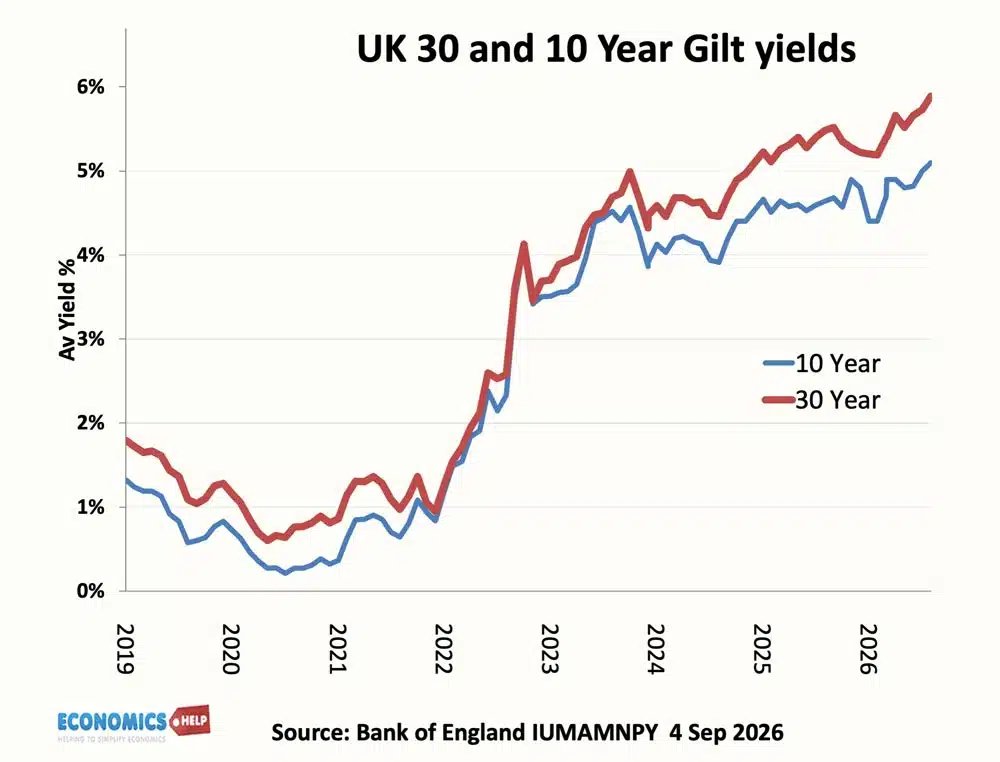
The UK has one of the highest bond yields, with 30 year bond yields rising close to 6%, the highest level since the late 1990s The most dramatic change is Japan, which has seen 40 year bond yields rise from 0.5 to 4%. The 30 year period of near zero interest rates is over. The same story is playing out across the globe. Last week, this rise in bond yields became breaking news. But this sell-off actually started in 2022 and has engulfed most economies apart from low-debt havens like Switzerland and Sweden.

The exception of two low-debt countries suggests debt itself is central to the story. Investors are moving away from bonds leaving the government to increasingly fund its own buybacks.
Inflation
But, in the short-term it is the inflation shock that is the trigger for rising bond yields. Inflation reduces the real value of a government bond, so when inflation increases, investors demand higher yields and lower prices to make it attractive. US inflation is 3.4%, Eurozone inflation 3.3%, but energy inflation is running at 14.3%. The ongoing conflict in the middle east has caused rising oil prices, but diesel prices have increased substantially more, and it is this that will feed through into higher food and transport prices. You can see the link between oil prices and inflation here. Despite rise in renewable energy, oil is still a driving force behind inflation.

As a result, there is also a link between oil prices and 10 year yields. Because of sticky inflation, markets have moved from expecting Central Bank rate cuts, to rate rises, and this pushes up all interest rates including bonds.
More than inflation
However, for all the fears about renewed inflation. There are two things to point out. Inflation of 3.4% is much less than the 10% of 2022. If we look at breakeven inflation rate, markets don’t really expect much inflation in 10 year’s time. Now admittedly, markets are not very good at predicting inflation, but the point is, this story is not just about a modest inflation rate of 3%. Another story is that everyone is borrowing more at the same time.

The US deficit is at 6% of GDP – a record level outside recession or war-time. US debt has increased from $35 trillion to $40 trillion in two years and is forecast to keep growing, and as a result, US debt interest payments as a share of GDP are forecast to grow. It is a similar story in other countries be it Japan, France or the UK. French debt servicing is forecast to rise from 3% of government revenue in 2019 to 6% by 2028. At the same time as governments borrowing more, AI Tech giants are now selling bonds to fund the datacentre boom. Goldman Sachs predict $400billion by 2027 and $5 trillion datacentre spend by 2025-30.
Less safe Haven
Another big change is that government debt and US debt in particular was seen as a safe haven, permanently safe asset. But this belief in the credit worthiness of US debt is being eroded. After the buyback announcement, gold rose and the dollar fell. And Markets fear that if deficits continue to rise and bond yields rise, governments will respond with some form of financial repression. This could be inflating away debt by creating money.
Another trend is that the demand side for government bonds is changing. Central Banks are no longer buying. China is slowly reducing its Treasury holdings and buying gold instead. There are other countries like Norway, Gulf States and Japan all winding down their purchase of US Treasuries. At the same time, the UK Central Bank has aggressively reversed quantitative easing, selling bonds back on the market. The ECB is running down its holdings €1.2 trillion since 2022. The US were reversing QE until recently holdings went back up. At the same time, pension funds are shifting from defined benefit which needs long-term bonds to defined contribution, which means more likely to chase returns from buying equities. It means the structural buyer of 30 year bonds are disappearing. Hedge funds are now buying a higher share of government bonds, but they drive a harder bargain and are more likely to be volatile owners.
Long-term fiscal pressure

Also, into the mix is the demographic change all countries are facing. With a fall in global fertility rates, the dependency ratio is rising in Europe, Asia and the US. This means slower economic growth and higher government spending on health and pensions. Recently Scott Bessent said the US could grow its way out of debt, like countries did in the post-war period. But this is getting harder. Growth is slowing down, at a time of rising debt. This is the dynamic which is understated.
If you believe that the bond crisis is increasingly due to fiscal concerns, the data suggests that long-term yields are rising faster than short-term yields. What this means is that markets are less willing to buy long-term bonds because they have greater concerns about long-term fiscal strength in 30 year’s time. So lenders are not refusing to lend to governments for a period of 2 years, they are refusing to lend for periods of 30 years. What this means is that in the short-term, the government is funding debt by swapping 30 year bonds for three month bills. Ironically, the government is doing what the market is doing.
AI bubble pushing up rates
An alternative explanation for rising government bond yields is basically, a reflection of the AI bubble. Interest rates across the economy rise when demand for credit outstrips supply. This happened in the late 1990s dotcom bubble. Bond yields fell when the bubble burst. If markets feared default, you would see credit default swaps and breakeven inflation rates rise. Both are flat. And as mainstream economists would often point out, if you borrow in your own currency, you cannot go bust, as you can always create your own currency to buy debt.

However, there is divergence in global bond yields, widening spreads suggest country-specific fiscal risks or country specific inflation fears. Also, the rise in Japanese bond yields from 0.5 to 4% suggests that even if you have your own currency and borrow almost exclusively in Yen, it doesn’t stop the price of borrowing tripling. The truth is there is no imminent solvency crisis, but what has happened is the price of borrowing has increased.
Debt Cycle
Also, there is concern that rising bond yields create its own vicious circle. More than half the US deficit is now interest on past borrowing. Higher yields lead to bigger deficit, requiring more issuance and higher yields.
Can anything stop debt sell-off?
So can anything stop the global bond sell-off. Well, the easiest way to reduce bond yields is to push economy into recession. This would reduce inflation and interest rates, but at huge cost nobody wants. Fiscal consolidation, higher taxes and spending cuts would reduce fiscal element, but politically unlikely. Could Central Banks start buying bonds again? Kevin Warsh has disavowed QE, and with high inflation, it would be very risky to resort to creating more money. But it is always a temptation when interest rate costs rise. More likely is efforts to cap yields through intervention through Treasury buy backs. An interesting question is where would yields be without intervention, certainly in Japan you would expect higher rates.
The problem is rising bond yields put pressure on governments and households. It makes the upcoming UK budget more difficult, less room for fiscal giveaways. It has also squeezed mortgage rates and car loans higher, creating a new cost of living pressure at times of inflation. What could change the outlook, an end to oil crisis, and precipitous fall inflation. That would cause a very different market.
Sources
- Politico, Bessent, bonds and the US financial market, 26 August 2026
- CNBC, Treasury doubles debt buybacks as Bessent moves to steady bond market, 19 August 2026 — buyback raised from $2bn to at least $4bn, targeting 10–20 and 20–30 year maturities; buyers’ strike since late June
- CNBC, Bessent says Treasury buyback operation could be more than $4 billion, 20 August 2026 — 30-year liquidity described as very poor
- CNBC, Bessent moves to curb Treasury yields, putting new pressure on the Fed, 19 August 2026
- Financial Times, Global bond sell-off deepens as UK borrowing costs hit highest since 2008, 1 September 2026 — 10-year gilt 5.26%, 30-year gilt 5.9%, Japan 10-year at 3%, Brent at $94.65, eurozone inflation 3.3%
- Fortune, Scott Bessent and the bond market: a pointless intervention, 24 August 2026
- The Economist, Why European government bond yields keep climbing, September 2026 — ECB balance sheet run-down of €1.2tn since 2022, French and Italian debt-servicing forecasts (Fitch), hyperscaler bond issuance, pension fund shift from defined benefit to defined contribution
- The Economist, America’s top bond salesman is buying his own wares, August 2026 — US deficit at 6% of GDP, interest as a share of the deficit, financial repression
- Paul Krugman, Substack — the case that rising yields reflect credit demand from the AI build-out rather than fiscal risk; flat breakevens and credit default swaps
- Trading Economics, Switzerland 10-Year Government Bond Yield — 0.43% on 2 September 2026
- Goldman Sachs, via The Economist — hyperscaler bond issuance of $250bn in 2026 and a projected $400bn in 2027; $5tn of datacentre spending between 2025 and 2030
- FRED, St. Louis Fed — long-term government bond yields, 10-year (IRLTLT01 series) for the UK, US, Germany, Japan, France and Italy; DGS10 and DGS30 for US Treasury yields
About The Author