Despite The Ukraine War, The Sports Community Is Inviting Russia Back

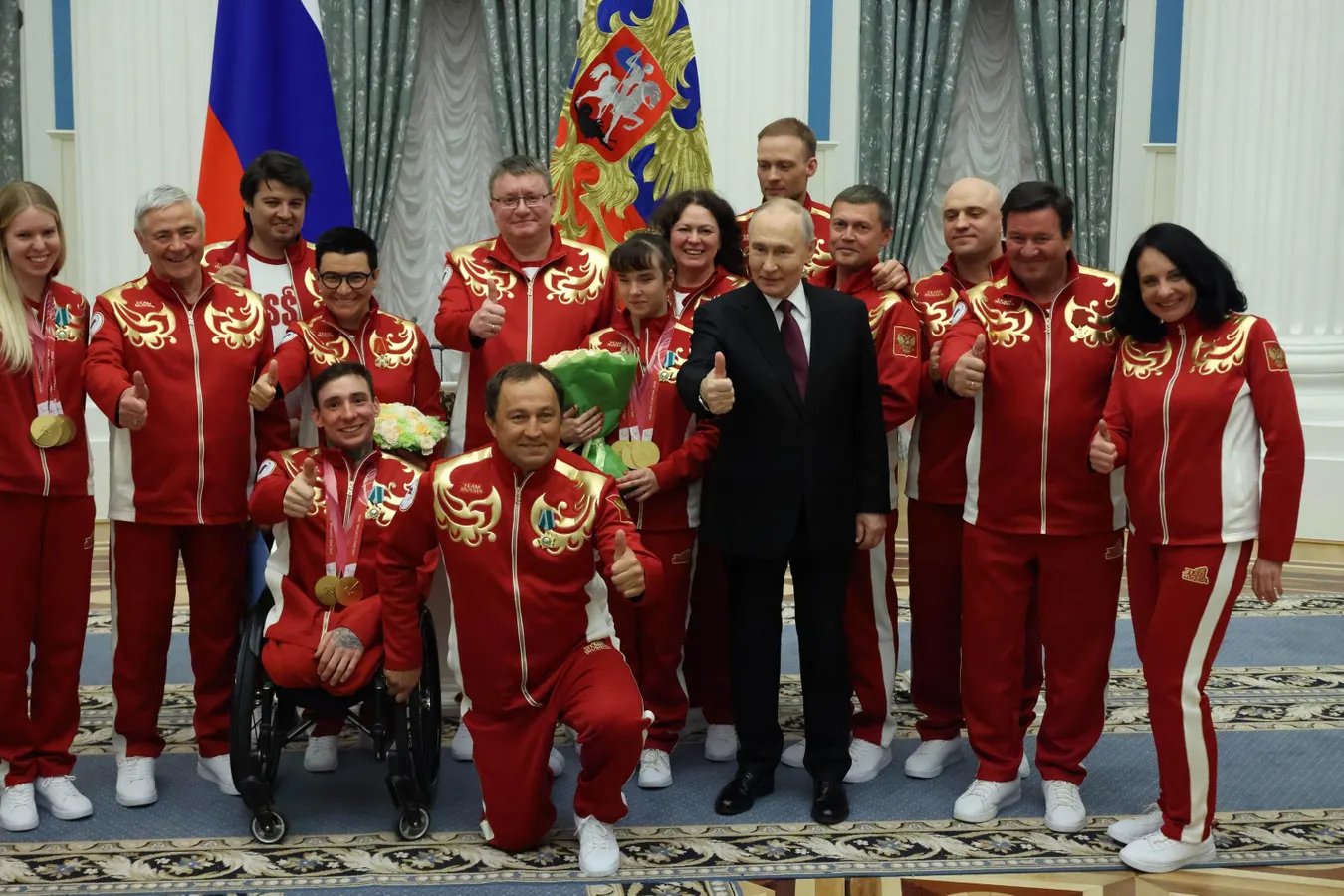
MOSCOW, RUSSIA – MARCH 19: Russian President Vladimir Putin poses for a joint photo with para athlets during an awards ceremony at the Kremlin, on March 19, 2026 in Moscow, Russia. Vladimir Putin receives national paralympic team who participaned in Milano Cortina 2026 Winter Paralympic Games. (Photo by Contributor/Getty Images)
Getty Images
On August 13, the United Nations published a report stating that civilian casualties in Ukraine in July hit their “highest level since March 2022.” The report added that “child casualties [in July] also reached their highest level since April 2022.” A similar UN report, published on July 6, noted that Russian missile and drone attacks “damaged apartment buildings and other civilian infrastructure” in Ukraine.
Despite these documented events, international organizations have begun to ease their restrictions on the Russian Federation. When Russia’s full-scale military incursion into Ukraine began in February 2022, the international community came together to impose stiff penalties on Russia to punish it for launching its unprovoked invasion.
Numerous Russian banks were removed from SWIFT, the international financial messaging system. Additionally, hundreds of Russian politicians, oligarchs, business owners, and companies were sanctioned, and billions of dollars in Russian assets were frozen and seized. The Russian Federation was also suspended from the United Nations Human Rights Council, the Financial Action Task Force, and the Organization for Economic Co-operation and Development, and Russia was expelled from the Council of Europe.
Beyond these economic, political, and institutional penalties, numerous international sports organizations announced bans on Russian athletes. Restrictions were also imposed on Belarusian athletes due to Belarus’s involvement in Russia’s invasion of Ukraine. The sports sanctions against Belarus, however, are not as severe as those against the Russian Federation.
Initially, these punishments were created to try to force Russia to end its full-scale military incursion into Ukraine. But as the war enters its fifth year, some international organizations have begun easing their restrictions on the Russian Federation. This has been most notable in the sports community.
The easing of sports-related penalties first began in March 2023, roughly a year after the Russia-Ukraine War began. At the time, the International Olympic Committee and the International Paralympic Committee proposed that Russian and Belarusian athletes could be reinstated in their competitions on an individual basis.
Nine months later, in December 2023, both organizations confirmed that Russian and Belarusian athletes could compete as neutral athletes at the 2024 Summer Olympics and the 2024 Summer Paralympics. This meant that Russian and Belarusian men and women could participate in the 2024 Summer Olympics and Paralympics, but they would not be able to display their countries’ flags, colors, or emblems.
Then, in September 2025, the IPC announced that it had lifted its ban on Russian athletes entirely, meaning Russian men and women would be able to fully participate at the 2026 Winter Paralympic Games. Belarusians were also allowed to participate fully in the 2026 Winter Paralympics, meaning Russians and Belarusians no longer needed to compete as neutral athletes at IPC events.
Following the IPC’s decision to ease restrictions on Russian and Belarusian athletes, other international sports organizations began to take similar measures. In November 2025, the International Judo Federation and the International Sambo Federation announced that they had lifted their bans on Russian athletes, allowing them to fully participate in their sporting events and competitions. A few weeks later, the European Gymnastics General Assembly also lifted its ban on Russian athletes.
The trend of international sports organizations easing penalties on Russian and Belarusian athletes has continued into 2026. In May, the IOC opted to join the IPC in lifting all restrictions on Belarusian athletes, thus allowing them to fully participate in all Olympic events. Then, in July, the IOC stated that it would provisionally lift its ban on Russian athletes, thus clearing the way for Russian men and women to participate at the upcoming 2028 Summer Olympics.
Other international sports organizations this year have adopted decisions similar to those of the IOC and IPC to lift neutral restrictions or bans on Russian and Belarusian athletes. This means that men and women from those countries can now fully participate in a variety of sports.
According to a report published by The Moscow Times on August 27, World Archery, the World Aquatics Bureau, World Boxing, the International Fencing Federation, the International Handball Federation, the International Union of Modern Pentathlon, the World Taekwondo Council, the International Volleyball Federation, the International Weightlifting Federation, and United World Wrestling all fully reinstated Russian and Belarusian athletes in their respective sports in 2026. The Moscow Times found that several of the aforementioned sports organizations lifted their restrictions on Russian and Belarusian athletes this summer, shortly after the IOC announced it had provisionally lifted its ban on Russian athletes.
The International Automobile Federation and FIBA, the International Basketball Federation, became the latest organizations to ease restrictions on Russia and Belarus. In mid-August, the FIA lifted restrictions on Russian and Belarusian drivers, allowing them to use their national flags, symbols, and anthems. Then, FIBA announced on September 1 that it would allow individual Russian and Belarusian athletes, coaches, referees, and officials to participate.
Even FIFA is re-evaluating its ban on Russia, citing the IOC’s ruling. UEFA, however, extended its suspension of all Russian national teams and clubs through the 2026/2027 season.
Ukrainian authorities have condemned these developments. When asked about the easing of restrictions on Russian and Belarusian athletes in the sports community, Ukrainian Minister of Youth and Sports Matviy Bidnyi said that relaxing penalties on Russia and Belarus is “undermining the collective pressure that the international community has been building against” the Russian Federation. Ukraine has also taken legal action against the IOC and the FIA by submitting appeals after these organizations eased restrictions on the Russian Federation.
Other government officials from countries in Europe and North America have also condemned international sports organizations, such as the IOC, for easing restrictions on Russia. Estonian Prime Minister Kirsten Michal told POLITICO that a “return to business as usual [in sport] would send the wrong message: It would disregard the suffering of the Ukrainian people and risk normalizing Russia’s aggression.” Similarly, Canadian Secretary of Sport Adam van Koeverden, a former Olympian, argued that the “countries of Russia and Belarus should not be represented in international sports competitions while Russia’s illegal and unjustifiable full-scale invasion against Ukraine continues.” Meanwhile, European Commissioner for Sport Glenn Micallef said that “sport cannot become a back door for normalizing aggression” after the IOC lifted restrictions on Russia. Additionally, Republicans and Democrats in both the United States House of Representatives and the Senate have condemned these events. Sixteen countries even boycotted the opening ceremonies of the 2026 Winter Paralympics in protest of the IPC’s decision to allow Russian men and women to fully participate in the competition.
The justification for lifting bans on Russian athletes from these international sports organizations has remained consistent. Representatives from these groups argue that the ban is hindering the development of Russian and Belarusian athletes, as they are unable to compete against athletes from other countries, which would provide them with exposure and experience. Others state that politics and sports should be separated, as the athletes are not responsible for the actions of the Russian government or Belarusian government. Finally, they argue that the sports ban has not achieved anything, as the Russian Federation is still waging its war in Ukraine. As a result, they conclude that the consequences of bans on Russian and Belarusian athletes have outweighed the initial goal of punishing Russia to try and force an end to the war.
Supporters of maintaining the ban, however, state that allowing Russian and Belarusian athletes to participate in international sports competitions risks normalizing Russia’s full-scale invasion of Ukraine. They highlight that the bylaws of numerous sports organizations call for the respect and sovereignty of fellow participants. They argue that Russia and Belarus have violated these norms due to the war in Ukraine. They add that allowing Russia back into the sports community violates the integrity of these sports organizations. They conclude that the leaders of these international sports organizations should evaluate what additional pressures can be imposed on the Russian Federation to end the war in Ukraine.
In other words, the relationship with the international sporting community and Russia has been complex and controversial amid the full-scale invasion of Ukraine since February 2022. When the Russian Federation’s full-scale military incursion began, organizations around the world attempted to punish Russia to try and force an end to the war. Belarus was also punished due to its involvement in the war.
But with Russia’s ongoing full-scale invasion of Ukraine now in its fifth year, some international sports organizations are re-evaluating these penalties and their relationship with Russia and Belarus. Now, as these developments continue to unfold, supporters of Ukraine, observers of the Russia-Ukraine War, and sports enthusiasts will monitor how the international sports community evaluates its relationship with Russia and Belarus, given the backlash they have received from Ukraine and its allies in Europe, North America, and Oceania.