
BNY Mellon Oversees $62 Trillion in Client Assets. Custody Is the Quietest Fee Machine in Finance.
There are several different types of banks that handle various functions for their customers and often perform differently, depending on the market.
There are commercial banks that manage assets for consumers and businesses, investment banks that help institutions get access to capital from other investors, and custody banks that simply hold and service assets for large institutional customers. Some of the larger banks do all three, but typically have a specialty.
Probably the least considered, but perhaps best investment of the three in recent years are custody banks. There are only a handful of major custody banks that can handle and are trusted with the trillions of dollars they oversee, so they are protected by a competitive moat, and they have a simple fee-based business model that generates reliable earnings through various market cycles.
The world’s largest custody bank is Bank of New York Mellon (BNY +0.31%), which has been the best bank stock over the past five years.

Image source: Getty Images.
BNY Mellon’s fee machine is humming
BNY Mellon has a massive $62.6 trillion in assets under custody, which means it holds, services, and safeguards $62.6 trillion in assets from pension funds, mutual funds, hedge funds, investment managers, corporations, governments, municipalities, and other organizations.
While the bank also offers its own separate accounts, mutual funds, and exchange-traded funds (ETFs), and earns interest income from sweeping uninvested cash into high-yield investments, the bulk of its revenue comes from fees.

Today’s Change
(0.31%) $0.51
Current Price
$164.84
Key Data Points
Market Cap
Day’s Range
$163.58 – $165.84
52wk Range
$102.63 – $165.84
Volume
2.4M
Avg Vol
3.5M
Dividend Yield
1.35%
BNY Mellon generated $5.7 billion in revenue in the second quarter, up 13% year over year. Of that amount, $4 billion, or 70%, comes from fees for holding and servicing the assets. The fees are tied to asset levels, so when the asset levels rise, whether through appreciation or net inflows, BNY Mellon’s fees rise. It also generates fees for securities lending and certain issuer services.
The rest of the revenue is from two different buckets, investment management fees from its own funds and interest income from sweep accounts. With sweep accounts, it invests unused, idle client cash into high-yielding investments and earns a portion of the interest.
But it is the asset servicing fee engine that drives BNY Mellon. As one of a handful of major custody banks, it will attract assets in any type of market. In fact, it tends to see more customers during market downturns as there is a flight to safety, and customers want to protect their assets. So, that helps offset the capital depreciation of its assets during downturns.
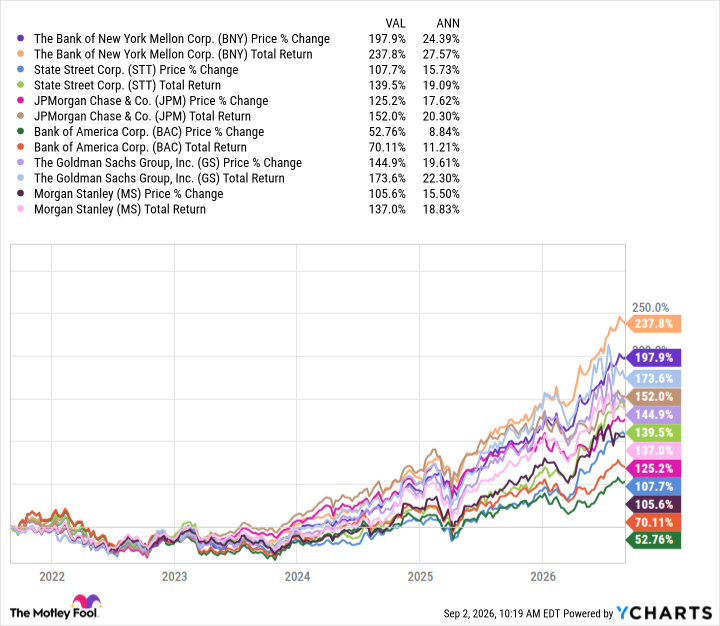
But when markets are strong, like they have been for the past four years, assets under custody keep appreciating, which leads to more revenue for BNY Mellon.
It’s a good business if you can get it — it only takes 242 years of trust and experience built up from the roots planted by the founder of Bank of New York, Alexander Hamilton, back in 1784.
BNY Mellon stock is up 39% year to date, and it has been the best-performing bank stock in recent years. It has posted an average annualized return of 56% over the past three years and 28% over the past five years. And it is still reasonably valued, trading at 18 times earnings. It remains one of the best, most reliable bank stocks you can buy.