Prediction: Taiwan Semiconductor’s Market Value Passes $3 Trillion Before 2029
Taiwan Semiconductor Manufacturing (TSM +2.85%) is already worth about $2.2 trillion, with shares of the chip foundry trading at about $427 as of this writing.
My prediction: The company’s market value passes the $3 trillion mark before 2029. To be specific, that means sometime before the end of 2028, about two years and four months away.
That may sound like a bold call. The stock would need to reach about $580 per share, about 21% above its 52-week high of $479.
But the yearly return the milestone requires is more ordinary than it sounds. And it’s a fraction of the pace TSMC’s business is growing at today.

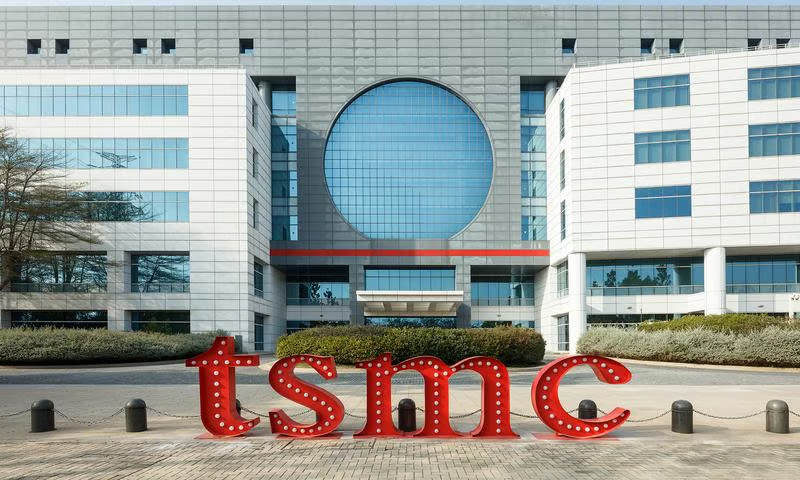
Image source: TSMC.
TSMC needs about 14% a year to get there
Going from about $2.2 trillion to $3 trillion is a gain of about 35%. Spread over that stretch, it works out to about 14% compounded annually.
For a business growing the way TSMC is right now, that isn’t a high bar.
I’m not assuming investors pay more for each dollar of TSMC’s earnings than they do today, either. If the stock’s price-to-earnings multiple simply holds steady, the share price should track earnings growth over time. In other words, earnings compounding at about 14% a year through 2028 could arguably get the company there on its own.
A 40% year
Highlighting how far ahead of that bar the business is running, TSMC’s second-quarter revenue rose 36% year over year to NT$1.27 trillion ($40.2 billion in U.S. dollars), while net income surged 77%. Gross margin was 67.7%, a big step up from 58.6% a year before. And the momentum has carried into the second half of the year. July revenue rose about 45% year over year, putting revenue through the first seven months of 2026 up 37%.
Management expects more of the same. Guidance calls for third-quarter revenue of $44.6 billion to $45.8 billion. Against the year-ago quarter’s $33.1 billion, the midpoint represents about 37% growth — an acceleration from the second quarter’s pace in dollar terms.
In July, management also raised its full-year outlook to revenue growth slightly above 40% in U.S. dollar terms.
“Moving into third quarter 2026, we expect our business to be supported by continued strong demand for our leading-edge process technologies, including the steep ramp-up of our 2-nanometer technology,” said Wendell Huang, TSMC’s chief financial officer, in the company’s second-quarter earnings release.
The company is spending like it expects the demand to last, too. Management now plans $60 billion to $64 billion of capital spending in 2026, up from its earlier budget, and it announced an additional $100 billion investment in Arizona to build several more leading-edge chip fabs and advanced packaging plants.
What could go wrong?
The main risk is concentration.
High-performance computing accounted for 66% of TSMC’s revenue in the second quarter, tying the company’s growth closely to the artificial intelligence (AI) build-out. If the biggest spenders on AI infrastructure pull back, growth could slow quickly.
Of course, margins could give back some ground, too. Gross margin guidance of 65% to 67% for the third quarter sits below the 67.7% the company just posted. If profitability drifts lower from here, earnings could grow more slowly than revenue does — and it’s earnings growth, not revenue growth, that has to average about 14%.

Taiwan Semiconductor Manufacturing
Today’s Change
(2.85%) $11.90
Current Price
$428.91
Key Data Points
Market Cap
Day’s Range
$419.42 – $429.82
52wk Range
$241.62 – $479.00
Volume
12.3M
Avg Vol
13.1M
Gross Margin
63.08%
Dividend Yield
0.82%
But the prediction can absorb a lot of deceleration. Say revenue growth halves to 20% in 2027, then halves again to 10% in 2028.
Even that path compounds at about 15% a year over those two years, still above the requirement, assuming profit margins hold near current guidance and the price-to-earnings multiple stays put. And it leaves out the rest of 2026, when growth is running at about three times that pace.
The scenario I take more seriously, however, is a market that changes its mind. If investors sour on AI infrastructure spending, they could pay less for each dollar of TSMC’s earnings even while those earnings keep growing. A compressing price-to-earnings multiple would likely raise the bar on the business — possibly well past 14% a year.
Ultimately, though, a business guiding for revenue growth slightly above 40% this year clears a 14% hurdle with plenty of room to spare, even if growth fades hard through 2027 and 2028. I expect Taiwan Semiconductor’s market value to top $3 trillion before the end of 2028.