This Strange Growth Between Your Houseplant’s Leaves Isn’t a New Leaf

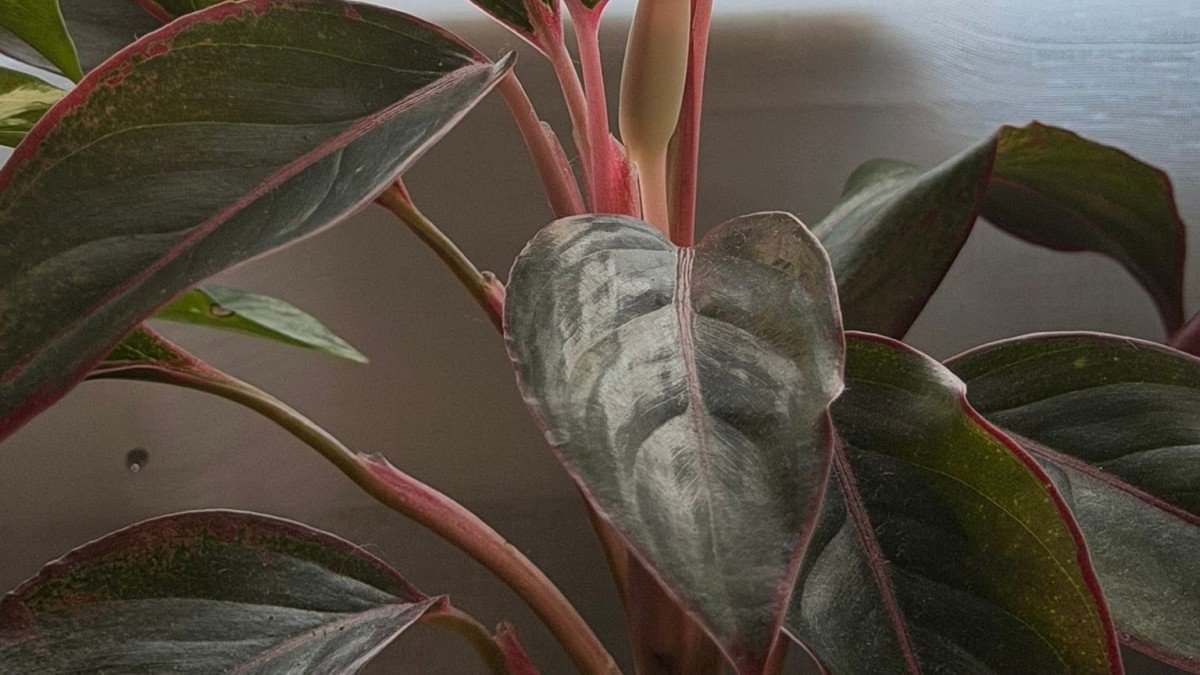
After caring for the same houseplant for about a year, Facebook user April Harbinson spotted something she hadn’t seen before. A pale, pointed growth was pushing up between the stems, but it didn’t look like the colorful leaves the plant had been producing.

“What is this growing from my child?! I have never seen this before,” Harbinson wrote when she shared photos with other plant owners.
Her plant is an Aglaonema, or Chinese evergreen, and the strange growth isn’t a new leaf. It’s a flower, and its appearance can tell you something about where the plant is in its growth cycle.
That Pale Pod Is an Aglaonema Flower

The difference becomes clearer beside the existing foliage. Broad green leaves have pink-red margins and veins, while the new growth is pale, narrow, smooth, and pointed at the top.
Aglaonemas belong to the Araceae family, along with peace lilies. Their blooms consist of a central spadix surrounded by a spathe. Before the spathe opens, it can resemble a pod or tightly rolled leaf emerging between the stems.
Flowering Can Be a Sign the Plant Is Growing Well

Aglaonemas are kept for their patterned foliage, so an owner may grow one for years without paying much attention to its flowers. Producing a bloom generally means the plant has reached sufficient maturity and has the resources needed for reproduction.
For a houseplant, that’s an encouraging development. Suitable light, stable temperatures, water, and established growth can support flowering. A bloom doesn’t prove every growing condition is perfect, but the unusual growth itself isn’t a warning that the plant is in trouble.
Other plant owners recognized it in Harbinson’s photos. One identified it as an Aglaonema flower and called it “a good sign of a happy plant,” while several others said their plants had produced similar blooms.
Some Growers Remove the Flowers
Not everyone keeps an Aglaonema bloom. Several people in the discussion said they cut theirs because flowering uses resources that could otherwise support the foliage.

Removing it isn’t required. Owners who want to see the unfamiliar bloom develop can leave it in place, while those growing the plant for its leaves may choose to cut it. Once the flower fades, it can also be removed rather than left on the plant.
For someone accustomed to watching new leaves emerge, that pale growth can look completely out of place. In this case, though, finding something unfamiliar between the leaves means the plant is doing something many owners never expect to see.
Would you leave the flower and watch it open, or remove it to keep the plant focused on its foliage?