The Economics of Going Home on Time

 |
 |
<!–
You’re a physician. You get paid $250 per hour to work a nine-hour shift. That’s $2,250. At the end of the workday, you still have a handful of charts left, maybe a few loose ends to clean up that you don’t want to pass along to the oncoming doc or defer until tomorrow. You stay another hour to finish everything. No one is surprised. It feels normal and responsible.
Something changed, though. That $250 per hour job just became a $225 per hour job. Same shift. Same patients. Same pay but spread over more time. You just worked more for the same money.
Most physicians don’t think about their time this way. Staying late gets framed as professionalism, thoroughness, or just part of the job, but step back and look at it through a financial lens. Every minute you stay after your shift lowers your true hourly rate. The painful part? Most of the time, you’re choosing to do it.
Earning Is One of the Core Money Activities
Physicians make a high income. Despite that, it’s easy to feel pessimistic and unappreciated in a world of declining reimbursement, especially in specialties heavily reliant on government payors. Many physicians see their inflation-adjusted income drift downward year after year while the workload related to caring for an aging and increasingly medically complex population continues to increase. It starts to feel like there is nothing you can do about it.
Reframing your earnings as an hourly rate and enforcing a boundary around your shift can be a powerful mindset tool to combat this pessimism. You may not have a lot of control over what you’re paid, but you do control how much time you give away for free. If you routinely stay late finishing charts, cleaning up tasks, and doing work that spills outside your shift, you are lowering your hourly rate.
What Is Your True Hourly Rate?
Physicians are paid in a variety of ways: salary, production, hourly. It doesn’t really matter, because it can always be reduced to the same equation:
Total pay ÷ total hours worked
The mistake most people make is using the wrong denominator. If you look at your pay stub, it shows your income and the number of hours you were scheduled to work. (If you’re salaried, you can also use your FTE to estimate the number of hours you’re expected to work for that pay.) Divide those two numbers, and you get what looks like your hourly rate. It’s not. This is your scheduled hourly rate. It only accounts for the hours you were scheduled to work—not the total time you actually spent working.
Your true hourly rate includes all of your worked hours, like staying late after your shift or finishing tasks at home. Once you account for that, the equation changes. The numerator (your pay) stays the same, but the denominator (actual hours worked) grows. That’s how you end up quietly taking an hourly-rate pay cut without ever seeing it on a paycheck.
The opposite is also true. Protecting your time by going home when your shift ends is one of the few levers in your work life that you can control, and it’s how you can increase your true hourly rate even in an environment where your inflation-adjusted income may be falling.
More information here:
- What’s a Night Shift Worth?
- Who Really Has Work-Life Balance in Medicine? A Data-Driven Look Across Specialties
Scale It Up
The impact of this is easy to underestimate until you zoom out. Think about how much time, on average, you stay late after your work is scheduled to end. Assuming a $250 per hour scheduled hourly rate for a nine-hour shift, here’s what that does to your true hourly rate:
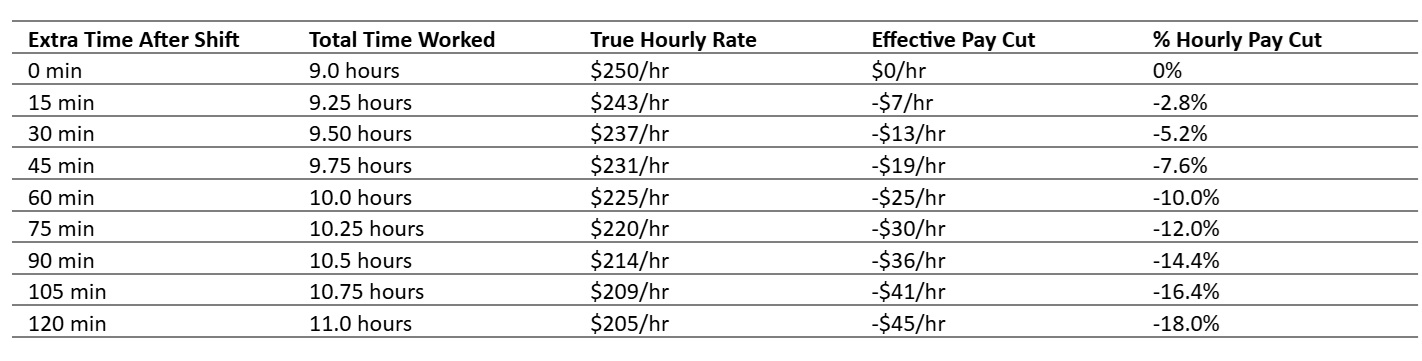
At first, those numbers don’t feel catastrophic. Losing $7 per hour or $13 per hour hurts, but maybe it doesn’t trigger alarm bells. But zoom out even further, and think about this in terms of your time, assuming a modest 12 shifts per month:
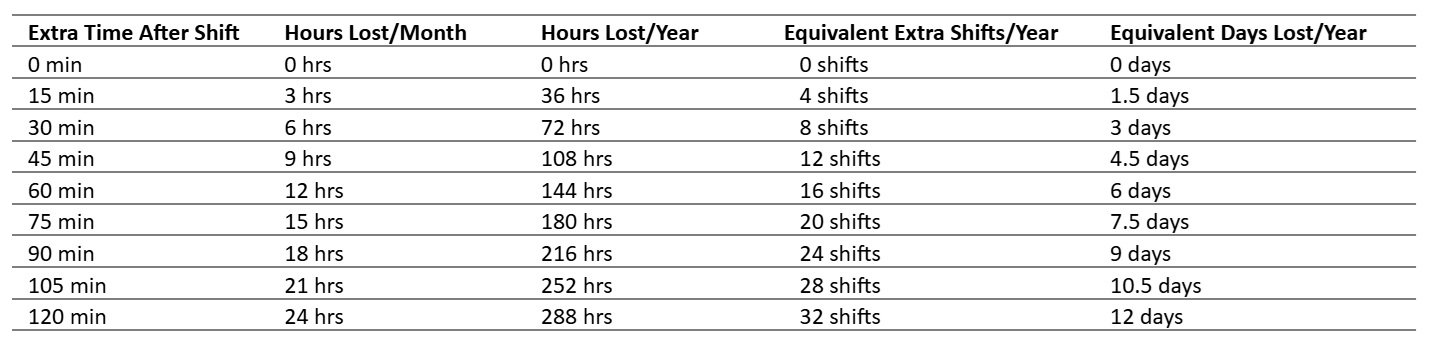
To hammer home the point:
- If you routinely stay 30 minutes after your shift doing free work, you’ve given away 72 hours per year. Now you’ve just traded away a long weekend that you could have spent fishing, skiing, traveling, or doing literally anything else that you want.
- Sixty minutes after each shift? That’s the same time commitment as working 16 additional shifts every year. You’re working one month each year for free. No bonus. No thank-yous. No recognition. Just more work.
- Ninety minutes after each shift? That’s nine full days of your life every year. Not theoretical days. Real full days. Go take a trip to Europe instead. Or stay home and do nothing. I bet you can find something better to do with that time than volunteering at the hospital.
Zoom out even further and extend this over a career. Assume you normalize staying 60 minutes late after every shift, work 14 shifts per month, and do this for a 30-year career. By the time you retire, you will look back and realize you effectively spent over three years working for free. If you’re working more shifts than this each month, the effect is even more pronounced.
Once you understand the concept of your true hourly rate, it becomes harder to ignore the trade you’re making, and you can start to make decisions that will help you bring your true hourly rate closer to your scheduled hourly rate.
Time Is the Real Currency
We spend plenty of time in personal finance talking about building enough wealth to eventually control your time, but what if you’re already giving that time away, a little bit at a time at the end of every shift? The goal shouldn’t be to maximize dollars at the expense of living life. The goal should be to use your resources (money and time) to live in a way which maximizes purpose and joy.
Staying late doesn’t reduce your annual salary or total career earnings. You’re still seeing the same number of patients, generating the same RVUs, and working the same shifts. In other words, you’re still going to make the same amount of money. What changes is your efficiency. You are spreading the same income over more worked hours.
Money is renewable. Time isn’t. Every extra hour you spend finishing work after your shift is time away from your family, your hobbies, your health, and your rest. It’s time that could have been spent doing something that you consider to be personally meaningful or time spent doing nothing at all. Stop donating your time to a system that is perfectly happy to take it.
More information here:
- There Was No Golden Age of Medicine (at Least for Physician Incomes)
- The Truth About Physician Compensation Structures
 |
 |
<!–
Why Do We Stay Late?
If the economic tradeoff is so clear, why does this happen so consistently? Medicine has a long history of self-sacrifice baked into its culture. It started as a vocation, not just a job, and that mindset shapes culture today. Physicians also tend to be a proud bunch, and there is pride in cleaning up your work, not handing things off, and seeing everything through. Residency reinforces grind culture in our formative years with long hours and the expectation that the work gets done no matter what, regardless of what the clock says. “Good doctors stay late” is trained, and it becomes self-reinforcing. Everyone else in your group stays late, so you stay, too. Over time, it stops feeling like a choice and starts feeling like that’s just how it is.
Systems can either reinforce or counteract this. Inefficient EMRs, poor templating, frequent interruptions forcing constant task switching, and clunky workflows can make it harder to finish work on time. Individual habits are important, too. Consider simple procrastination and task deferral. Your job is hard, and when decision fatigue sets in, it is easy to defer small tasks. When you are juggling multiple patients, conversations, and decisions, your brain defaults to triaging what feels urgent in the moment and pushing everything else aside, with the intention of getting to it later. The reality is that, in practice, “later” usually means after your shift ends. Each small task deferral feels insignificant in the moment, but by the end of the shift, you realize you are carrying a backlog of busy work that has yet to be dealt with when you ought to be punching out and going home (where you hopefully won’t be doing even more work).
There is also the social piece, which people are often reluctant to acknowledge. The most collegial physicians—you know, the ones always chatting at the desk and fully engaged with staff—often seem to be the same ones staying the latest to finish their work. That is not a character flaw. Camaraderie matters, and it makes your job better. We all love those people!
But it’s also not a coincidence. Let’s say the quiet part out loud: socializing at work is trading time during your shift for time after your shift. You can be more social during your busy shift and stay late, or you can be more focused during your busy shift and go home on time. I’m not suggesting that you completely disengage at work. Being hardline antisocial doesn’t work in a team sport like medicine, but don’t pretend there isn’t a tradeoff. How much you prioritize being the likable socialite on shift at the expense of your on-shift efficiency is a choice, and you are fully in control of it.
Work Efficiently, Earn Time Back
Efficiency is not a new concept in medicine, but it often feels like a dirty word because we hear it from administration regarding throughput, RVUs, and other ways in which your efficiency benefits the system. That is not the kind of efficiency I’m talking about. The focus here is personal: increasing your efficiency for the purpose of increasing your true hourly rate and reclaiming personal time.
A full breakdown of efficiency strategies could easily fill a book, so that’s not a realistic goal for a blog post. The core principle, though, is simple: do the work when you are at work. Not later. Not “when things slow down.” Not after your shift. Do work in real time during your shift.
To the extent that you have control over systems factors, use tools that reduce friction. Consider scribes, AI, templates, macros, and voice dictation. Environmental changes can help, such as having a workstation physically near your examination rooms or using a workstation on wheels to reduce wasted steps. Create a culture of reducing avoidable interruptions, and if you are implementing changes to protect cognitive work in your department, be transparent about it with staff who may be at risk of perceiving it as isolation or antisocialism. Transparency is the antidote to awkwardness.
Regarding personal habits, this is easier said than done when you are deep into a shift and decision fatigue has set in. A few ideas:
- Brute-force anti-procrastination mindset. Avoid letting small tasks accumulate into a backlog that must be cleaned up at the end of the shift.
- Chart in real time. Document as you think. Sign the note when the patient leaves.
- Defer nonurgent interruptions. Finish your current task before switching to a new one. Fun fact: emergency physicians are interrupted, on average, 7-19 times per hour. Greater than 50% of the time, they do not return to the original task once the interruption has been addressed. This is an inefficient way to navigate a shift, and it probably increases medical errors.
- Limit social time until you are caught up.
- Redefine what “good” looks like. Complete and defensible documentation is good enough. Perfect documentation takes time, and you are the one paying for it. Not your hospital. Not your group. You.
- If staying late has become routine, predefine a boundary. Decide ahead of time that you are leaving within 10-15 minutes of the end of your shift. A simple sticky note at your workstation reflecting this commitment can change how you pace your work and force periodic recommitment.
Whatever strategy you choose, the theme is to be structured and deliberate in how you move through your shift and to do your work during the time for which you are being paid.
More information here:
- 5 Financial Lessons That Boomers Taught This Millennial That Gen Z Needs to Hear
- Help, I’m a Doctor in a Cubicle
- Should I Feel Bad About Taking Time Off?
Tradeoffs and Reality Acknowledgement
You’ll have tradeoffs to working this way. For example, in the emergency department, lower-acuity patients may wait a little longer to be seen. Critical illness aside, that is fine. The patient with six days of URI symptoms can wait a while longer while you finish a note. Seeing the worried-well immediately should not take priority over you leaving on time.
We all know this to be true, but reading that last sentence probably made you feel a little uneasy, didn’t it? That reaction isn’t accidental. You’ve been trained to feel that way. Years of chasing customer service metrics like “door-to-doc” time have conditioned you to prioritize arbitrary metrics over your own well-being. You don’t have to keep playing that game.
It’s also worth acknowledging that some of this is simply out of your control. Even if you have dialed in your efficiency habits, not every shift is going to be clean. Sometimes the department becomes a mess, patients stack up, and timing works against you. Sick, unstable patients roll through the ambulance doors 20 minutes before your shift ends. When it’s a dumpster fire, help your partners out. That’s part of being on a good team, and one of the things that makes a job satisfying. Staying late is simply unavoidable in some situations. It’s worth acknowledging that reality. It just shouldn’t be the norm.
From personal experience, I am not perfect at this. I have improved on-shift habits over the years, but I still fall into the trap. I stay late sometimes and occasionally have charts to finish after my shift ends. In fact, while in the process of writing this article, I noted the irony of writing about going home on time while signing out to my buddy in the ED about 45 minutes after my scheduled shift end time. It was just one of those days.
Interruption deferral still feels uncomfortable. Like when the well-meaning ED tech tries to interrupt you to read the EKG on the college kid who apparently said “chest pain” in triage when describing the burning sensation he was feeling while in between hungover scromiting episodes. The tech then awkwardly hovers over your shoulder for another 45 seconds while you finish putting in orders and an HPI on the other patient you just saw. The discomfort in real time is tough to push through. I’m not sure that’s ever going to go away. But I have learned that it is also brief, and the discomfort starts to disappear more and more quickly when you’re consistently walking out of the department on time.
The discomfort that I worry about more does not occur on shift but in the idea of changing group culture. I care about how my partners view me, because those are the relationships that matter most to me over the course of my career. Proposing a shift in culture, especially in a group of dozens of physicians who have practiced a certain way for years, comes with some natural hesitation and expected resistance. If there is a shared understanding of an “out on time” culture, though, the concern about being seen as a team player largely goes away, as it benefits everyone equally. As long as you don’t routinely hand off unkempt signouts, you make a good-faith effort to get your partners out on time, and you can “read the room” as far as when the dumpster is on fire in the rare instance that you really ought to stay late and help your buddy out, you’ll still be seen as a strong team player.
Final Thought
Most physicians don’t have an income problem. They have a time leakage problem. Staying late doesn’t feel like a financial decision. It feels responsible. It feels like part of the job. When it happens so regularly, it’s tough to realize that every extra hour you spend after your shift is an hour you gave away for free.
Staying late is a financial decision. That trade has a cost. You lowered your true hourly rate and gave up time you will never get back. But unlike so many things in medicine, this one is a choice. You have some control over this.
Time at home matters. Relationships matter. Your health matters. The life you are building outside of medicine matters. Time is the currency behind all of that.
You are not going to be perfect. Some shifts will run over, and some days you will stay late. It just shouldn’t be the default. So, do your work during your shift, go home when your shift ends, and protect your time like it matters, because it does. Your life and identity are bigger than your job, and both are too important to keep giving away for free.
Do you stay late at work? Do you resent it, or is it just part of the job? Do you feel you can make changes to help prevent that? What else can somebody do to get home on time?
The post The Economics of Going Home on Time appeared first on The White Coat Investor – Investing & Personal Finance for Doctors.
 |
 |
<!–