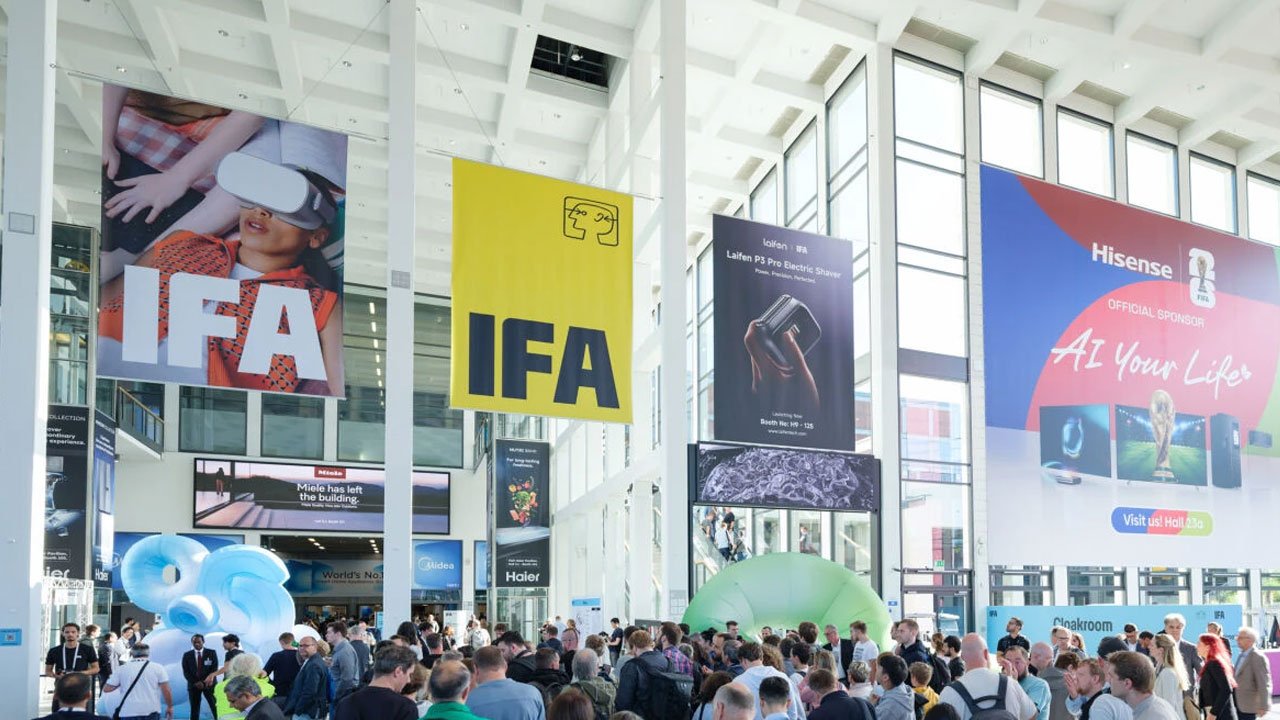
What to Expect From IFA 2026: Trends and Sneak Peeks
While there are many similarities between CES and IFA, the fine line that separates the two events is product readiness. Unlike CES, which largely features futuristic concepts and visionary prototypes, IFA focuses on market-ready innovations and practical consumer appliances. As a matter of fact, much of the hardware exhibited at IFA is discounted shortly after in Black Friday sales, which is not the case with CES. That makes IFA an event not to be missed by tech lovers, shoppers, retailers, and journalists alike.
The Samsung-Shaped Hole
This year’s edition runs from September 4 through September 8. The biggest headline going into the show is the absence of Samsung’s booth from the show. Outside of the pandemic-hit 2020 edition, it’s the first time in over three decades that the South Korean company won’t stage a proper exhibition on the show floor, choosing instead to host retail and media meetings across town at Humboldt Carré, while still sponsoring IFA’s Creator Hub. Whatever the reason, Samsung leaves a noticeable gap for everyone else to fill.

Despite losing one of its anchor exhibitors, the conversation around Europe’s largest consumer tech show sounds different from the one we’ve been having for the past decade. IFA has carried a reputation as the place where appliance makers came to display washing machines and coffee makers, a show that could never quite compete with the spectacle of CES in Las Vegas. That reputation is changing fast, and 2026 might be the year it finally breaks.
To find out what to expect from IFA 2026, I reached out to the IFA Directors, TCL, Morphy Richards, tech pundits, PR honchos, and a few CEOs exhibiting at the event. Here’s what they had to say:
Embodied AI Takes Center Stage
I asked IFA CEO Leif Lindner what’s actually going to surprise people this year. Leif’s answer wasn’t a product name but a term, ’embodied AI.’ “For several years, the public conversation around AI was largely about software, smartphones, and screens. Now AI is beginning to acquire a physical presence, and much of it will be on display at IFA 2026,” he states.
Before IFA, in August this year, Leif Lindner sat for an exclusive interview with me. When asked about the comparison, he described CES as the trailer for IFA. “CES opens the technology year, creates excitement, and gives the industry an early indication of the ideas and trends that will shape the months ahead,” he said. “By September, the story has developed; CES provides the trailer, while IFA brings the full story to life.”

TCL Steps Into the Spotlight
If Lindner’s read is right, we’re going to see that trailer-to-feature-film jump play out across a few very different booths, and TCL is a good place to start because it’s the least subtle about what it’s trying to prove. “We will use the platform to present ‘AI Inspired Life’ through our Inspiration Habitat in Hall 21A at Messe Berlin,” Stefan Streit, TCL Europe’s CMO, tells me.

Making the most of Samsung’s absence, TCL will showcase a dozen products at IFA 2026, including NXTPAPER phones and tablets, the newest RayNeo glasses, new washing machines, and AC units built for the European market. Streit stayed cagey about the actual tech under the hood, though, teasing only that “the showcase brings together our latest innovations in entertainment, connected living and home technology, offering visitors a first-hand look at how AI is shaping the way people watch, live and connect.”
The Rise of The Underdogs
Francis Bea, co-founder of International 11 PR Agency, doesn’t hedge on how this year’s IFA compares to past ones. “IFA has in the past been a place for brands to showcase utilitarian hardware like appliances, which would find it tough to compete with cutting-edge technologies at CES,” he says. That makes sense, considering CES has so many exhibitors that it’s hard to stand out, while IFA has about half as many, making it easier to get noticed. But Bea says 2026 could be different, “with brands like Vention, Laifen, iKairos, and XPENG launching EVs, AI wearables, kids’ devices, and battery gadgets at IFA for the first time.”

Morphy Richards and Its Legacy
Interestingly enough, the appliance reputation Francis describes as IFA’s old skin hasn’t gone anywhere. It’s just wearing better clothes this year, and nobody makes that case better than Morphy Richards. The British brand renowned for electrical appliances turns 90 in 2026 and has picked Berlin to make a thing of it, building its whole booth around the “Forged by Time. Inspired by Tomorrow” tagline.

Martin Guo, the company’s global director, tells me, “Ninety years represents both a significant milestone and a responsibility to continue evolving.” Adding, “The philosophy that inspired Morphy Richards in 1936 remains relevant today: creating products that address real household needs and make daily life easier. As lifestyles continue to change, we remain focused on developing practical and meaningful solutions for modern living.”
What the company actually has in store is still under embargo, but from the little I’ve been shown, it’s going to give Conway, Dyson, Dreame, and SwitchBot something to think about. Read between the lines there.
Kickstarter is the Ultimate Shark Tank
Then there’s Morpho, doing something equally interesting on the content-creation side. Mingyu Wang, aka Brett, who used to run R&D at DJI, founded the desktop UV printing company and took it to a seven-million-dollar Kickstarter in sixteen hours earlier this year, apparently making it one of the highest-grossing campaigns of 2026 on Kickstarter.

When I asked him where he sees the category heading at IFA 2026, his answer was more reflective than promotional. “I see content creation technology as a reflection of our innate need to make things we love,” he said. “Realizing that vision, however, means overcoming real hurdles: cost, compatibility, and software-hardware usability. That’s exactly what drives us, whether in UV, 3D, or laser: building tools that make better work accessible to every creator. We intend to take this to the next stage at IFA this year.”
Another gadget with a banger Kickstarter run is TDM. Having pulled in $154,113 in revenue during its campaign, the company is now exhibiting at IFA 2026. “Whilst I’m sure AI will have its moment at IFA this year, I’m really looking forward to seeing technology that encourages human connection in real life,” Hannah Brailsford, TDM co-founder, tells me.
“I also think we’ll see more technology that moves with the way people are actually living, rather than forcing them to choose between different experiences,” she adds. “Consumers increasingly expect fewer devices to do more without compromising the experience, and I think we’ll see more products breaking traditional category boundaries and combining functionality in genuinely useful ways, something we’re incredibly passionate about at TDM.”

Another exhibitor I was lucky to get hold of, though some of his backers might argue luck ran out for them, was Paolo Ganis, CEO of Vitesy, who described the trade fair as a “fixed stop on their calendar.” “This year’s edition puts smart, sustainable home tech front and center, and we’re excited to join the conversation with Vitesy’s smart and sustainable solutions, empowering people to build more conscious food consumption and housekeeping habits,” Ganis says. But not everyone’s convinced by the pitch: his Kickstarter campaign is still trailed by comments from backers who say they’re still waiting on their units.
Everything Else, Everywhere, Powered by AI
Plenty is happening outside these headline stories too, so keep your eyes open once you’re walking the halls. Honor, for instance, is bringing its gimbal-camera Robot Phone West for the first time, as reported by Tom’s Guide and confirmed by my own sources. Meanwhile, Xiaomi looks set to fill some of the space Samsung left behind. The company is showing up at IFA for the first time in its 102-year history, bringing its full ecosystem along. What exactly it’s showing off remains under wraps, but don’t be surprised if it ends up stealing the show with its vacuum cleaners, TVs, air purifiers, and smart home devices.

There’s also chatter about a foldable and rollable, though expectations should stay modest unless Lenovo delivers something jaw-dropping. Acer will host its own event on September 2 ahead of the main show; DJI is spotlighting its Romo 2 vacuum series, and LG and Hisense bring their usual TV muscle. Smart ring brands like RingConn, Circular, and Ultrahuman will use IFA as a launchpad, since Oura’s absence means less competition for attention.
Exoskeletons are another notable category, with Hypershell and Ascentiz likely returning with slimmer hardware than last year. And if you miss cassette decks, We Are Rewind, JLab, EarFun, and Edifier have you covered, while Sony and Bose battle to prove who’s the grown-up in the room. The only question: are they AI-powered, or AI themselves?
Chris Perera, CEO of Impact and a longtime tech commentator, thinks the show’s tone is shifting. “I expect exhibitors at IFA 2026 will shift away from promoting AI itself and begin emphasizing the real applications that new technology enables,” he says. “Robotics will be a major theme, spanning home and business use,” he predicts. Humanoids were already a major trend at CES 2026, and with China’s World Humanoid Robot Games in Beijing pitting thousands of robots against each other in everything from sprints to factory tasks, this is a space well worth watching.
The Bottomline
None of these stories is really about the individual gadget, though. It’s about an industry that finally seems tired of bolting AI onto things just to say it did, and a show floor reshuffling itself now that its biggest, longest-tenured name has stepped back. Whether that shows up in a robot vacuum, a necklace with two cameras, a flying car concept, or a coffee maker built to honor ninety years of a British kitchen brand, Berlin over these five days should tell us more about where consumer tech is actually going than most other shows will manage all year.