Tesla Stopped Reporting Solar Numbers 10 Quarters Ago. Now the Solar Roof Is Gone, Too.
Tesla (TSLA -3.22%) has ended the Solar Roof, according to reporting from Electrek. The company stopped taking orders for the glass solar tiles as of Aug. 20, told its network of certified installers it will no longer supply the product, and redirected the Solar Roof page on its website to conventional solar panels.
The product Tesla unveiled in October 2016 was pitched as the reinvention of the roof — shingles that generate power while looking better than ordinary tiles. CEO Elon Musk put a number on the ambition. “I’m confident that, let’s say, within the next, I don’t know, year or — maybe even by end of year, we should be installing at a rate of 1,000 a week,” Musk said on Tesla’s first-quarter 2020 earnings call.
For a company that rarely retreats in public, the shutdown is unusual. So what does it say about the energy business that investors in the growth stock actually own?

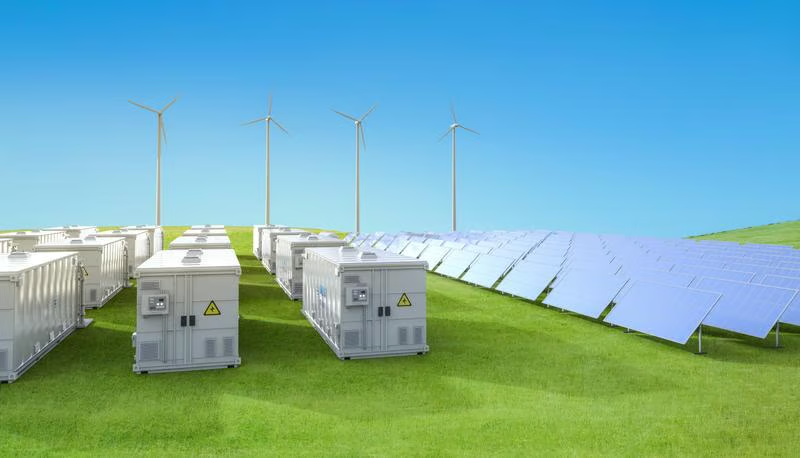
Image source: Getty Images.
The economics never worked
The Solar Roof’s problem seems to have been less about demand for the idea than about the economics of the product. Tesla marketed the tiles as costing less than a new roof plus traditional solar panels, but real quotes ran far higher. TechCrunch reported quotes reaching $200,000 for a single installation. And in 2021, Tesla sharply raised prices, in some cases on customers who had already signed contracts. The tiles were unique to the Solar Roof system, too, requiring custom manufacturing equipment whose cost per unit climbed as volumes disappointed.
Those volumes showed up in Tesla’s own quarterly updates, which reported the solar business as one combined line (megawatts of solar deployed, panels and tiles together). By the fourth quarter of 2023, that figure had shrunk to 41 megawatts, down 59% year over year and lower for a fourth straight quarter.
Even more telling: Electrek reported, citing a source close to the program, that Tesla internally concluded the product is not financially viable. Tesla itself hasn’t publicly explained the decision, and the company could say more when it next reports results, likely in October.
The energy business never needed it
For shareholders, the Solar Roof’s death says very little about the electric vehicle maker’s energy segment, because the segment’s growth was never coming from it.
In the second quarter of 2026, Tesla’s energy generation and storage revenue rose 13% year over year to about $3.1 billion, or about 11% of the company’s total revenue. In its quarterly filing, the company attributed the increase to higher Megapack deployments (the utility-scale batteries), partially offset by lower Megapack prices and a decline in Powerwall deployments.
Whatever the mix, the volumes keep building. Tesla deployed 13.5 gigawatt-hours of energy storage in the second quarter, its second-best quarter ever on that measure.
Solar, meanwhile, has disappeared from Tesla’s reporting altogether. The 41 megawatts deployed in the fourth quarter of 2023 turned out to be the last solar deployment figure the company has disclosed to date. The line item vanished from Tesla’s first-quarter 2024 update, and 10 straight quarterly updates have now gone by without one.
Storage gets a deployment figure every quarter. Solar gets none.
That doesn’t mean Tesla is done with solar. The company began manufacturing a new retrofit solar panel in 2025, according to its quarterly filing. And in July it applied for Texas tax incentives on a proposed $10.1 billion solar cell factory, with commercial operations targeted for 2029. The energy pitch still centers on storage, though, with Megapack, the newer Megablock, and a new Megafactory under construction near Houston.

Today’s Change
(-3.22%) $-11.86
Current Price
$356.09
Key Data Points
Market Cap
Day’s Range
$352.96 – $362.70
52wk Range
$297.38 – $498.83
Volume
36.2M
Avg Vol
41.5M
Gross Margin
18.85%
The shutdown looks like discipline
The decision looks like discipline to me, and arguably overdue discipline. Tesla kept the Solar Roof alive for nearly a decade after unveiling it, through pricing resets and production experiments, while the product that actually scaled (the Megapack) drove the segment’s most recent growth and helped push its revenue to about $3.1 billion a quarter.
Killing a product this publicly associated with the company’s image, and with Musk’s own promises for it, is not a small step. But it could free up resources for the parts of the energy business that have proven they can grow.
There is a risk worth acknowledging, though. The energy segment’s growth rate has cooled to 13%, Powerwall deployments are falling, and Megapack prices are coming down. Storage is a competitive business, and it now carries the whole segment — for a company whose stock still costs more than 150 times next year’s expected earnings.
The Solar Roof was supposed to make every rooftop a Tesla product. More than six years after Musk said Tesla should be installing 1,000 a week, the company is moving on. Judged by where the energy segment’s money comes from, it arguably should have moved on sooner.