
Belgium Digital Tax Proposal: Details & Analysis
Note: The following is the written testimony of Cristina Enache, Economist, submitted to the Belgian Finance and Budget Committee on 31 August, 2026.
The Belgian law proposal of May 2026 seeks to adapt the Belgian corporate income taxA corporate income tax (CIT) is levied by federal and state governments on business profits. Many companies are not subject to the CIT because they are taxed as pass-through businesses, with income reportable under the individual income tax. system to the digital economy through the creation of a Digital Permanent Establishment (DPE), the attribution of taxable revenues to Belgium based on users and digital participation, deemed profit allocation rules, and a digital withholdingWithholding is the income an employer takes out of an employee’s paycheck and remits to the federal, state, and/or local government. It is calculated based on the amount of income earned, the taxpayer’s filing status, the number of allowances claimed, and any additional amount the employee requests. taxA tax is a mandatory payment or charge collected by local, state, and national governments from individuals or businesses to cover the costs of general government services, goods, and activities. functioning as a minimum tax mechanism.
Although the proposal is presented as an income tax reform rather than a digital services tax (DST), its economic substance closely resembles the DSTs adopted across Europe over the last decade. The proposal taxes revenues indirectly rather than actual net profits, relies on user-based allocation rules, targets a defined group of digital business models, creates unilateral nexus standards, and substantially increases the risk of double taxationDouble taxation is when taxes are paid twice on the same dollar of income, regardless of whether that’s corporate or individual income.. The proposal departs significantly from sound tax policy principles and risks generating substantial economic distortions, legal uncertainty, and trade frictions while raising relatively little revenue.
Taxing Digital Services
The rapid growth of the digital economy has sparked debates over how and where digital businesses should be taxed. Many companies, including social media platforms, e-commerce marketplaces, cloud service providers, and online platforms, can operate and generate revenue in countries without a physical presence. This has led governments to adapt consumption taxA consumption tax is typically levied on the purchase of goods or services and is paid directly or indirectly by the consumer in the form of retail sales taxes, excise taxes, tariffs, value-added taxes (VAT), or income taxes where all savings are tax-deductible. rules to account for the growth of products and services delivered through digital means and, in some cases, introduce targeted taxes for digital activities.[1]
Digital firms have often benefited from preferential tax regimes, such as research and development (R&D) incentives, patent boxes, and favorable treatment of intangible assets. While these measures aim to encourage innovation and investment, they can result in lower effective tax rates for digital businesses compared to other sectors. As a result, policymakers have sought new tax measures to address these disparities.
Because most major digital companies operate across multiple countries, digital taxation has become a key topic at the OECD, UN, and EU. Without coordinated international rules, differing national tax policies could overlap or conflict, increasing the risk of double taxation and creating challenges for businesses operating globally.
In response, many governments have introduced measures such as DSTs, significant economic presence and digital permanent establishment rules, and withholding taxes. Belgium’s proposal belongs to this broader family of unilateral responses.
These efforts to reform digital taxation could significantly affect where and how much tax digital companies pay. A key area of debate is whether the value created by users of digital platforms, through data generation, engagement, and network effects, should influence where profits are taxed. While supporters argue that users contribute to the value of digital businesses, measuring and valuing this contribution is challenging because many digital services are provided free of charge. In addition, network effects are not unique to the digital sector. They are also present in industries such as telecommunications, shopping malls, and payment networks. Similarly, medical and pharmaceutical companies derive value from patient participation and data, raising questions about whether digital businesses should be subject to special tax rules.
A DST in Disguise, Despite Its Corporate Tax Label
The proposal is formally drafted as a modification to Belgium’s corporate income tax. However, economic substance matters more than legal form.
A classic DST attributes revenue to users located in a jurisdiction, applies special rules to digital business models, and, most importantly, taxes gross revenue rather than actual profits.
Belgium’s proposal follows a similar approach. It unilaterally attributes revenue to Belgian users, allocates taxable incomeTaxable income is the amount of income subject to tax, after deductions and exemptions. Taxable income differs from—and is less than—gross income. through formula-based apportionmentApportionment is the determination of the percentage of a business’s profits subject to a given jurisdiction’s corporate income tax or other business tax. US states apportion business profits based on some combination of the percentage of company property, payroll, and sales located within their borders. coupled with deemed profitability assumptions, and establishes nexus through digital activity thresholds.
Instead of directly imposing a percentage tax on revenue, Belgium would first assign deemed profit margins and then tax those deemed profits. This intermediate step changes the legal appearance but not the economic substance.
The proposal should therefore be viewed as a DST-like measure integrated into the corporate tax system.
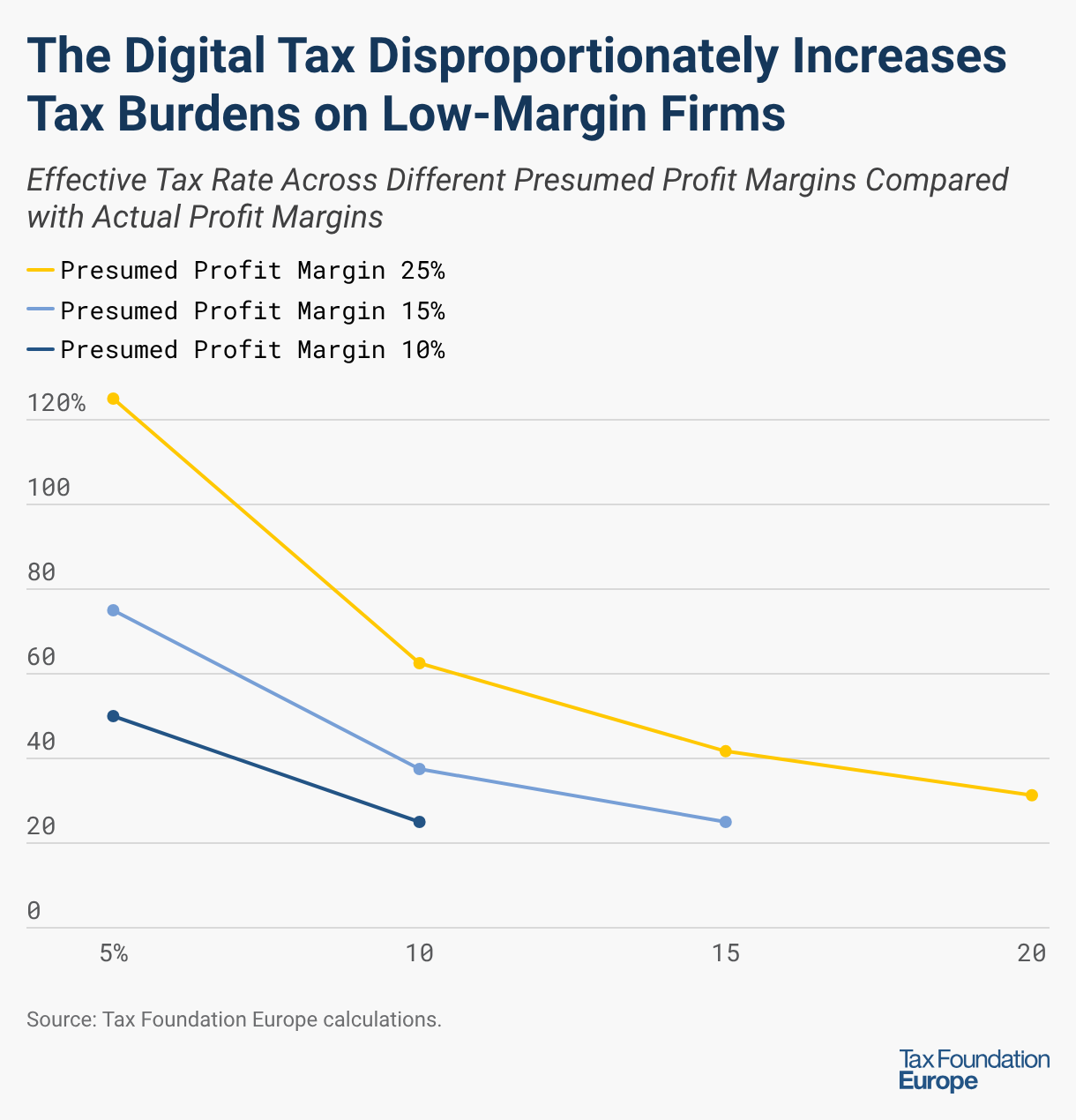
Under the proposal, each business model is assigned a presumed profit margin:
- 10 percent for standardized paid digital services
- 15 percent for free digital services
- 25 percent for selling goods via digital activities and devices with an internet connection
- 25 percent for platforms, marketplaces, and personalized services
With a 25 percent corporate income tax rate, profit margins of 25 percent, 15 percent, and 10 percent translate into DST rates of 6.25 percent, 3.75 percent, and 2.5 percent of revenues, respectively.
While these profit margins may appear low, marketplace platforms typically operate with margins below 15 percent. Under the proposal, this would result in effective tax rates well above 40 percent, reaching as high as 125 percent for a firm with an actual profit margin of 5 percent, compared with the deemed profit margin of 25 percent established by the proposal.
This could create significant distortions: it penalizes low-margin firms, discourages investment and growth, and distorts business decisions.
While companies may rebut the presumptions by demonstrating that the revenue attributable to Belgium is lower than presumed, doing so would impose additional compliance and administrative costs on both the company and the tax administration.
The Proposal Creates Tax PyramidingTax pyramiding occurs when the same final good or service is taxed multiple times along the production process. This yields vastly different effective tax rates depending on the length of the supply chain and disproportionately harms low-margin firms. Gross receipts taxes are a prime example of tax pyramiding in action. and Discourages Specialization
One of the most important criticisms of taxing digital services concerns tax pyramiding. A 2026 Tax Foundation study shows how digital value chains often involve multiple specialized providers: search platforms, advertising networks, marketplaces, analytics providers, social media services, or booking intermediaries.[2] The tax can apply repeatedly across these chains. Consequently, a single commercial transaction may create taxable revenue allocations at several different levels of the value chain. Unlike value-added tax (VAT) systems, the proposal contains no equivalent credit mechanism that eliminates cascading taxation. The result is tax pyramiding similar to turnover taxes.
Modern economies depend on specialization. A marketplace specializes in matching buyers and sellers, a search engine specializes in discovery, an advertising platform specializes in customer acquisition, and payment providers specialize in transaction processing. The 2026 study highlights that DSTs effectively penalize these specialized activities because each layer of specialization may introduce another taxable transaction. As a result, DST-type taxes discourage outsourcing and innovation, encourage vertical integration, and reduce economic efficiency.
The Belgian proposal is likely to induce these same effects since its tax baseThe tax base is the total amount of income, property, assets, consumption, transactions, or other economic activity subject to taxation by a tax authority. A narrow tax base is non-neutral and inefficient. A broad tax base reduces tax administration costs and allows more revenue to be raised at lower rates. concentrates heavily on specialized digital intermediaries.
The Digital Permanent Establishment Does Not Solve Profit Attribution Problems
The proposal introduces a DPE through reinterpretation of international tax rules. A DPE is deemed to exist when a foreign company exceeds any of the following thresholds in Belgium during a tax year:
- 60,000 users
- 3,000,000 digital connections
- 2,400 digitally concluded or performed contracts
However, under the OECD Model Tax Convention, a permanent establishment traditionally requires a degree of physical presence in the jurisdiction, either through a fixed place of business or a dependent agent acting on behalf of the enterprise.
According to an International Monetary Fund (IMF) paper, even if Belgium were to establish nexus through a DPE rule, the attribution of profits would remain challenging because, under the arm’s-length principle and traditional permanent establishment profit attribution rules, little or no profit may be allocable to a jurisdiction where significant functions, assets, and risks are absent.[3]
The Belgian proposal implicitly acknowledges this problem by replacing actual profit attribution with formulaic deemed margins. However, this is not a solution. The proposal confirms rather than resolves the IMF’s criticism.
Double Taxation Risks
When a country expands its tax base by redefining what constitutes a permanent establishment, this can result in double taxation or a redistribution of taxing rights. This proposal significantly increases the likelihood of double taxation.
Belgium may recognize a DPE while treaty partners do not, reject Belgian profit allocation calculations, or continue taxing the same income (revenue) in the residence jurisdiction. A 2020 Tax Foundation report provides a comprehensive example of how expanding the definition of permanent establishment to include not only businesses with a physical presence in a jurisdiction, but also those that exceed certain sales or contract thresholds in a country, could result in more than 100 percent of a company’s income being subject to taxation.[4] This risk is even greater when the tax is imposed on deemed profits derived from revenue, rather than on actual profits.
Article 24(3) of the OECD Model Tax Convention requires contracting states to treat permanent establishments in the same way they tax resident companies.[5] In this case, DPEs would be taxed on their revenues using a deemed profit margin, which differs significantly from the ordinary corporate income tax that resident companies pay.
A recent IMF paper also notes that both expanded nexus regimes and DSTs create overlapping tax claims because they operate outside traditional treaty frameworks.[6] This could lead to disputes over mutual agreement procedures, increased litigation, taxpayer uncertainty, and unresolved double-taxation situations. Such outcomes undermine both investment and international tax cooperation.
Additionally, the proposal explicitly acknowledges this risk of double taxation and the taxation of deemed profits rather than actual profits. It argues that “if the combined taxes from two jurisdictions limit the company’s profit margin too much, the company will have to increase prices.” According to the proposal, this is an intended effect, as it would counteract prices that are considered artificially low due to tax optimization. If such effects arise when only two jurisdictions are involved, they would likely be amplified where multiple jurisdictions seek to tax the same revenues or deemed profits of a single company.
The Digital Withholding Tax Creates Additional Distortions
The digital withholding tax mechanism raises additional concerns. As a non-refundable levy, it effectively functions both as a minimum tax and as an additional gross-basis charge, contributing to a highly complex system.
Where digital corporate income tax is due for a particular fiscal year, a digital withholding tax is imposed in the subsequent tax year at a rate equal to 80 percent of the digital corporate income tax liability. The proposal further provides that digital withholding tax is generally non-refundable unless the amount paid exceeds 80 percent of the taxpayer’s final digital corporate income tax liability. This provision is particularly problematic for loss-making companies, as it may result in a cash-flow burden even where little or no digital corporate income tax is ultimately due.
The Limits of Treaty Reinterpretation
The legislative proposal to adapt the Belgian corporate income tax system to the digital economy is largely based on a reinterpretation of existing international tax treaties. The central question, however, is the extent to which treaty provisions may be adapted through interpretation to address economic realities that were not envisaged when those treaties were drafted.
Article 31 of the Vienna Convention on the Law of Treaties (VCLT) sets out the general rule of treaty interpretation, beginning with the ordinary meaning of the treaty terms in their context and in light of the treaty’s object and purpose. Only where the application of Article 31 leaves the meaning ambiguous or obscure, or leads to a result that is manifestly absurd or unreasonable, may recourse be had to supplementary means of interpretation under Article 32, including the preparatory work of the treaty and the circumstances of its conclusion.
The notion of supplementary means of interpretation does not, however, open the door to an evolutionary reinterpretation of treaty provisions. On the contrary, the examples expressly mentioned in Article 32 refer to historical materials, namely the preparatory work and the circumstances surrounding the conclusion of the treaty. Their purpose is to assist in identifying the intention of the treaty negotiators at the time the agreement was concluded.
In this respect, the reasoning advanced by proponents of reform appears circular. They argue that applying Article 31 produces an absurd result and therefore justifies recourse to Article 32. Yet, instead of relying on the supplementary means expressly envisaged by Article 32, they effectively return to the teleological reasoning of Article 31, using it to overcome the very result that they claim Article 31 produced in the first place. In other words, Article 32 is invoked not to clarify the parties’ original intent, but to facilitate a broader interpretation that Article 31 alone could not sustain.
Whether treaty terms should be interpreted dynamically (evolutionarily) or statically remains an open question. Courts have at times found that a static interpretation better serves the object and purpose of a treaty, while in other cases they have preferred a dynamic approach. There is no clear rule favoring one method over the other, as each has advantages and disadvantages. A key criticism of dynamic interpretation is that it may depart from the intentions of both the treaty negotiators and the national legislatures that approved the treaty, by attributing to its terms a meaning different from that understood at the time of conclusion. Another concern is reciprocity: an evolutionary interpretation may undermine the legitimate expectations of the other contracting state regarding the scope and meaning of the treaty obligations it accepted.
Moreover, given the ongoing debates at the OECD on a new framework for taxing the digitalized economy, the proposals developed at EU level, and the discussions taking place at the UN, all of which stem from the recognition that the traditional concept of permanent establishment is unable to capture businesses operating without a physical presence, it would be contrary to the principle of good faith simply to disregard this reality and expand the interpretation of the permanent establishment concept. Put differently, if existing treaty provisions could be so easily reinterpreted to encompass digital businesses without violating their terms, what was the purpose of pursuing years of international negotiations and reform initiatives?
Legal Disputes, Trade, and Retaliation Risks
Another major issue with a digital tax is international conflict. DSTs, which function like tariffs on certain services, are widely seen as targeting US-based technology companies, which has led to tensions with the United States.[7]
The US government has voiced opposition to DSTs over the last decade, with President Trump using Section 301 investigations in his first term, and, more recently, the US Congress threatening the Section 899 retaliatory tax. While Section 899 was removed from the One Big Beautiful Bill Act, the issue of DSTs remains contentious.[8]
Because the Belgian proposal would continue to place a disproportionate burden on large multinational digital companies, many of which are headquartered in the United States, it risks reigniting the same transatlantic tensions seen in previous digital tax disputes.
The United States is Belgium’s fourth-largest export market. Although Belgium runs an overall trade deficit with the United States, it still exports approximately €31.9 billion in goods and services while importing around €35.1 billion. In Information and Communication Technology (ICT) services, Belgium is a net importer, purchasing roughly €0.7 billion from the United States compared with exports of only €0.34 billion. While trade in digitally deliverable services is broadly balanced, with imports of approximately €3.21 billion and exports of €3.2 billion,[9] unilateral measures targeting predominantly US-based digital firms risk undermining a significant economic relationship.
Such measures create legal uncertainty, strain international trade relations, and increase the likelihood of retaliatory action. In the absence of a globally agreed framework for taxing the digital economy, further escalation would ultimately be detrimental to all parties involved.
Evidence Suggests the Burden Will Fall on Belgian Consumers and SMEs
The economic incidence of a digital tax is closer in nature to an excise taxAn excise tax is a tax imposed on a specific good or activity. Excise taxes are commonly levied on cigarettes, alcoholic beverages, soda, gasoline, insurance premiums, amusement activities, and betting, and typically make up a relatively small and volatile portion of state and local and, to a lesser extent, federal tax collections. than to a corporate income tax. While the economic literature shows that the corporate income tax is largely borne by shareholders—with shareholder income disproportionately concentrated among higher-income households—excise taxes are usually borne by consumers through higher prices. As lower-income individuals consume a larger share of their income, excise taxes tend to be regressive.
The exact equity effects of a digital tax, however, depend on the ability to pass the tax on to consumers, the type of goods and services sold, and consumers’ responsiveness to the tax. Evidence shows that some companies targeted by DSTs have passed the tax on to users. Apple, Amazon, and Google (now Alphabet) passed on the UK’s 2 percent DST tax.[10] Google has a page explaining that a charge for the DST is added on in countries where ads are accessed.[11] Additionally, a recent research paper by economists Dominika Langenmayr and Rohit Reddy Muddasani shows that the attempt to target big digital platforms misses the mark, as the cost mostly falls on European consumers.[12] An IMF paper also finds that DST adoption is associated with lower imports of digital services.[13]
Furthermore, these measures may place a disproportionate burden on European and Belgian businesses, especially small firms that rely heavily on digital platforms. As a result, instead of effectively targeting foreign tech giants, DSTs often end up harming domestic economies. The actual burden often falls on local advertisers, marketplace sellers, small and medium-sized enterprises (SMEs), and consumers. Belgium should expect similar effects.
Significant Administrative Complexity
The Belgian proposal would also impose extensive compliance and reporting obligations on affected companies. Firms would be required to track global revenues, user numbers, and connection counts, allocate users at the country level, perform GDP-weighting calculations, and comply with detailed reporting requirements. In addition, companies seeking to challenge the default allocation methodology would need to provide evidence supporting alternative profit determinations. These requirements would necessitate the collection, verification, and continuous monitoring of large amounts of operational and financial data across multiple jurisdictions.
Such complexity reflects one of the principal criticisms of digital services taxes and digital nexus rules.[14] Both businesses and tax administrations face significant challenges in determining user location, attributing revenues to specific jurisdictions, and understanding applicable compliance obligations. The practical difficulties associated with identifying relevant users and revenues often result in substantial administrative burdens and legal uncertainty, particularly when clear guidance is lacking.
The proposal’s reliance on user counts, connection thresholds, global revenue allocation formulas, and GDP adjustments would likely exacerbate these concerns. Companies would need to maintain detailed records not only of Belgian users and connections but also of comparable global metrics, creating substantial compliance costs and increasing the risk of disputes over data accuracy and tax liability. The proposal would therefore go significantly beyond most existing digital tax regimes in terms of the information required from taxpayers.
These concerns are consistent with broader international findings. The IMF has argued that overlapping unilateral digital tax measures can substantially increase administrative burdens and compliance costs for both businesses and tax authorities. In this context, the Belgian proposal would likely rank among the most complex digital tax systems currently under consideration, creating significant compliance challenges while adding further uncertainty to an already fragmented international tax landscape.
Revenue Impact
Regardless of the proposal’s economic incidence, design issues, and retaliatory measures, Belgium, like many other European governments, is seeking to increase revenue. DST revenue in Austria, France, Italy, Spain, Turkey, and the UK ranged from €137 million (Austria) to €1.04 billion (the UK) in the most recent year revenue was reported. Austria’s DST is much narrower than the others in the sample because it applies only to digital advertising. As a share of total government revenue, they are typically below 0.1 percent, and even in the highest case—Turkey—they reach only about 0.24 percent. The UK is around 0.1 percent, and in countries like Italy, France, Austria, and Spain, it is even smaller—between 0.05 and 0.07 percent.
Table 1. Recent Revenue Raised from Selected Digital Services Taxes
Note: These countries have been selected because they report digital services tax revenue separately as a line item.
Source: Tax Foundation Europe analysis of national budget documents and announcements.
According to Tax Foundation’s modeling, a Belgian digital tax would generate relatively modest revenues while imposing broader economic costs. The estimate is based on a 3 percent digital services tax comparable to the April 2026 Belgian proposal and projects annual revenues of approximately €148 million, providing a limited source of additional government revenue relative to the size of the Belgian economy—less than 0.06 percent of Belgium’s total tax revenues.[15]
The tax is projected to reduce Belgian GDP by approximately 0.056 percent, equivalent to about €342 million annually. Investment would decline by 0.073 percent, while wage levels and employment (or hours worked) would each fall by 0.03 percent. As a result, total labor compensation is estimated to decrease by 0.053 percent.[16] These effects reflect the tendency of taxes on digital activity to be passed through the economy, reducing incentives for investment and ultimately affecting workers through lower wages and employment.
But most importantly, the costs of the proposal may exceed its direct revenue gains. The estimated reduction in economic output of roughly €342 million is approximately 2.3 times larger than the projected annual revenue collection of €148 million. This implies that the broader contraction of the tax base could offset a substantial portion of the revenue generated by the measure and may even result in a net negative fiscal effect once lower collections from other taxes are taken into account. These estimates indicate that the economic distortions associated with the proposed digital tax could outweigh its expected budgetary benefits.
VAT Provides a Superior Alternative
If the objective is to raise more money from digital services, then Belgium should continue reforming the value-added tax to effectively tax these services at the point of consumption. A destination-based VAT is the most coherent and least distortionary instrument for taxing cross-border digital services. VAT already allows governments to tax streaming, online advertising, cloud computing, marketplace services, or software subscriptions without creating specialized digital taxes.
Additionally, VAT has already been modified in recent years to account for the digitalization of the economy. The reforms require non-EU businesses to register and remit VAT in the Member State of the consumer, effectively taxing digital services at the point of consumption. The EU VAT revenues collected from these measures increased tenfold, from €3 billion in 2015, €4.5 billion in 2018, and €20 billion in 2022,[17] to more than €33 billion in 2024.[18]
If Belgium were to apply its standard 21 percent VAT rate to all imports from information industries, it would generate approximately $9.5 billion (€8.15 billion) in tax revenue,[19] equivalent to about 3.3 percent of Belgium’s total tax revenues.
Additionally, Belgium’s VAT actionable policy gap—the additional VAT revenue that could realistically be collected by eliminating reduced rates and certain exemptions—was 27.6 percent in 2024, the latest available data.[20]
There is significant untapped potential. Estimates suggest that broadening the VAT base—by eliminating reduced rates and exemptions—could generate up to €26.9 billion in additional national revenue. This represents 10.76 percent of Belgium’s 2023 total tax revenue.[21] Even a small share of this would exceed what any digital tax could ever deliver.
Compared to digital taxes, VAT offers several clear advantages, including neutrality, a broad tax base, the avoidance of tax pyramiding, international consistency, higher revenue generation, and the absence of trade-related risks.
Conclusion
The Belgian 2026 proposal to adapt the income tax code to the digital economy is presented as a modernization of corporate income taxation. Yet, in substance, it closely resembles the DSTs that have generated significant controversy throughout Europe and internationally.
The proposal combines three problematic approaches: DST-style user-based market taxation, unilateral digital nexus rules, and gross-basis withholding and minimum taxation mechanisms.
These instruments have generally generated limited revenues while imposing substantial economic costs, including tax pyramiding, risks of double taxation, increased compliance burdens, trade tensions, greater international tax disputes, reduced tax neutrality, and pass-through of costs to domestic businesses and consumers.
Rather than representing a genuine improvement of the DSTs, the Belgian proposal replicates many of their fundamental shortcomings and, in several aspects, amplifies them by combining multiple distortionary mechanisms within a single tax regime. A more coherent policy approach would focus on strengthening destination-based VAT systems and pursuing coordinated international solutions rather than introducing another unilateral digital tax framework.
Stay informed on the tax policies impacting you.
Subscribe to our free newsletter to get the latest tax data, news and analysis.
References
[1] Directorate-General for Taxation and Customs Union, “Continued growth in revenue and registrations confirms success of reformed EU VAT rules for e-commerce,” Taxation and Customs Union, Jul. 23, 2025, https://taxation-customs.ec.europa.eu/news/continued-growth-revenue-and-registrations-confifirms-success-reformed-eu-vat-rules-e-commerce-2025-07-23_en.
[2] Alan Cole, “Taxing the Matchmakers: How Digital Services Taxes Cascade Through Online Commerce,” Tax Foundation, Jul. 16, 2026, https://taxfoundation.org/research/all/global/digital-services-tax-online-commerce/.
[3] Shafik Hebous, Brendan Crowley, Rasmi Das, Tibor Hanappi, Cory Hillier, Adam Jakubik, Eric Robert, and Christophe J Waerzeggers, “Taxing Cross-Border Services,” IMF Working Paper WP/26/152, Jul. 17, 2026, https://doi.org/10.5089/9798229055048.001.
[4] Daniel Bunn, Elke Asen, Cristina Enache, “Digital Taxation Around the World,” Tax Foundation, May 28, 2020, https://taxfoundation.org/wp-content/uploads/2020/05/Digital-Taxation-Around-the-World.pdf#page=30.
[5] OECD, “The 2025 Update to the OECD Model Tax Convention,” OECD, Nov. 19, 2025, https://doi.org/10.1787/5798080f-en.
[6] Shafik Hebous, Brendan Crowley, Rasmi Das, Tibor Hanappi, Cory Hillier, Adam Jakubik, Eric Robert, and Christophe J Waerzeggers, “Taxing Cross-Border Services.”
[7] Alan Cole, “Tariffs by Another Name: How Discriminatory Taxes on Cross-Border Services Threaten America’s Export Edge,” Tax Foundation, Apr. 15, 2026, https://taxfoundation.org/research/all/global/tariffs-discriminatory-cross-border-services-taxes/.
[8] Alan Cole and Patrick Dunn, “Reviewing the International Tax Provisions in the One Big Beautiful Bill Act,” Tax Foundation, Aug. 6, 2025, https://taxfoundation.org/blog/big-beautiful-bill-international-tax-changes/.
[9] US Bureau of Economic Analysis, “Table 3.3. U.S. Trade in ICT Services and Digitally Deliverable Services, by Country or Affiliation,” accessed Aug. 11, 2026.
[10] Isobel Asher Hamilton, “Apple, Amazon, and Google hike their developer and ad client fees to pass on the costs of paying new digital taxes in Europe,” Business Insider, Sep. 2, 2020, https://www.businessinsider.com/apple-amazon-google-pass-costs-digital-services-taxes-2020-9.
[11] Google Ads, “Jurisdiction-Specific Surcharges,” https://support.google.com/google-ads/answer/9750227.
[12] Dominika Langenmayr and Rohit Reddy Muddasani, “Navigating the Amazon: The Incidence of Digital Service Taxes,” CESifo Working Paper, Jun. 12, 2025, https://storage.e.jimdo.com/fifile/b2f10b20-f37c-4d9b-8d16-d86f91b1b04f/2025_05%20DST.pdf.
[13] Shafik Hebous, Brendan Crowley, Rasmi Das, Tibor Hanappi, Cory Hillier, Adam Jakubik, Eric Robert, and Christophe J Waerzeggers, “Taxing Cross-Border Services.”
[14] Cristina Enache, “Digital Taxation Around the World,” Tax Foundation, Apr. 30, 2024, https://taxfoundation.org/research/all/global/digital-taxation/.
[15] The proposed 3 percent Belgian DST is modeled as a proportional output tax, deductible against corporate income tax on the capital-borne share, with revenue scaled from France’s DST.
[16] Tax Foundation Europe, Belgium 2024 Corporate Tax Model. Author’s calculations.
[17] Directorate-General for Taxation and Customs Union, “EU VAT rules for e-commerce two years on: Updated revenue figures point again to a successful implementation,” Taxation and Customs Union, Jun. 30, 2023, https://taxation-customs.ec.europa.eu/news/eu-vat-rules-e-commerce-two-years-updated-revenue-figures-point-again-successful-implementation-2023-06-30_en.
[18] Directorate-General for Taxation and Customs Union, “Continued growth in revenue and registrations confirms success of reformed EU VAT rules for e-commerce,” Taxation and Customs Union, Jul. 23, 2025, https://taxation-customs.ec.europa.eu/news/continued-growth-revenue-and-registrations-confirms-success-reformed-eu-vat-rules-e-commerce-2025-07-23_en.
[19] Author’s calculation base on OECD, “Trade in Value Added (TiVA) 2025 edition: Principal Indicators, levels,” Jan. 22, 2026, https://data-explorer.oecd.org/vis?lc=en&df[ds]=dsDisseminateFinalDMZ&df[id]=DSD_TIVA_MAINLV%40DF_MAINLV&df[ag]=OECD.STI.PIE&dq=IMGR.BEL.INFO.W..A&pd=2021,2022&to[TIME_PERIOD]=false&vw=tb.
[20] Cristina Enache, “The EU’s Questionable VAT Policy,” Tax Foundation, Feb. 2, 2026, https://taxfoundation.org/blog/eu-vat-revenue-compliance/; Cristina Enache, “How Smart Policy Can Unlock VAT’s Revenue Potential,” Tax Foundation, Apr. 7, 2026, https://taxfoundation.org/blog/eu-vat-policy-government-revenue/.
[21] OECD, “Revenue Statistics 2025: Disentangling Personal Income Tax Revenue in OECD Countries,” OECD Publishing, Dec. 9, 2025, https://www.oecd.org/en/publications/revenue-statistics-2025_3a264267-en/full-report/detailed-country-tables-1965-2023_cc2fef32.html#title-775d911588.