
Moving Asian consumers from retirement angst to action
Asia’s population is aging faster than any other world region. The population-level consequences for GDP growth and productivity are significant and well-documented. Less explored are the individual-level consequences for the millions of people in Asia who remain underprepared for their retirement years, and what the retirement industry can do to support them.
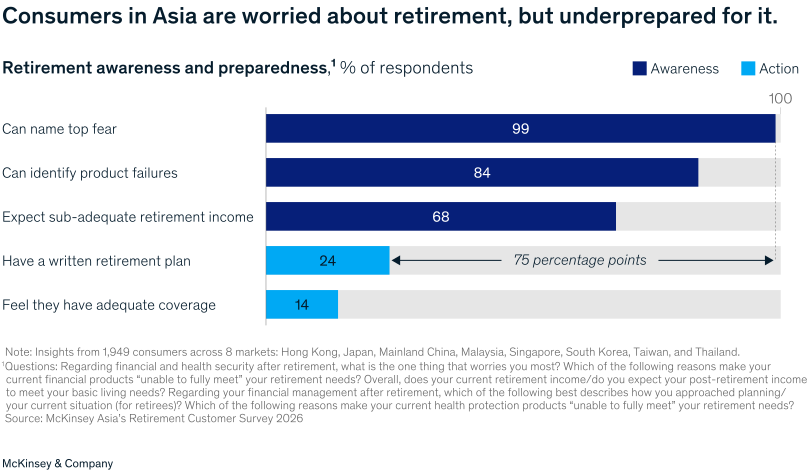
Recent McKinsey research uncovered a stark 75 percentage-point gap between how people in Asia feel about their retirement years and the actions they are taking to prepare for them. Almost universally, people report fears about their future quality of life, health, and financial security, but less than a quarter have a written plan for their retirement.
This 75-point gap between awareness and real action represents a wide-open opportunity for the industry to convert a desire for retirement products into action and suggests a potential misalignment in how the industry designs, prices, and distributes retirement solutions today.
With a fresh perspective on customer needs, insurance companies can rethink traditional retirement solutions and business models to shift more people in Asia from retirement angst into action.
The problem is not demand, but a failure to convert
McKinsey Asia’s Retirement Customer Survey 2026 has found that consumers are both underprepared for retirement and underserved in terms of their retirement needs. Nearly every respondent across eight Asia–Pacific markets admitted to having fears about their retirement, but only 24 percent have a written retirement plan (Exhibit 1). Respondents were critical of the products they currently hold, too, with 84 percent identifying issues such as a lack of inflation-protected returns, flexibility, and embedded care cover. And more than two-thirds (68 percent) admitted they expect to have less income than they’ll need for retirement.
These customers are not the unbanked nor the disengaged. The typical survey respondent holds life insurance, participates in a pension or provident fund, and allocates roughly half their income to living expenses. They are the broad middle class: employed and insured, but unable to find products that match their needs.
Three gaps consumers see
Our survey reveals three systemic gaps between what consumers need and what the industry provides.
Gap 1: Retirement is not just about income—health anxiety exceeds financial anxiety across all markets
The traditional industry lens treats retirement as a financial planning issue: accumulate enough, then draw down. But many consumers see it differently and, when asked about their top retirement worries, respondents prioritized health over finances.
Health-adjacent worries—losing independence, unaffordable medical or long-term care (LTC), becoming a burden to family, and not having anyone to rely on in old age—accounted for 60 percent of responses; 21 percentage points above pure financial concerns, and a gap that holds across all eight markets in the research. “Losing independence due to health decline” edged out “running out of savings” as the most-cited worry.
The responses differ across generations, as one might expect. Younger respondents (aged 35 to 44) are most anxious about financial vulnerability, loss of independence, and isolation. Their top concerns are “running out of savings before end of life” (23 percent), “health decline leading to loss of independence” (18 percent), and “having no one to rely on in the future” (15 percent). This may reflect deep-seated concerns about long-term financial resilience amid economic uncertainty and the strain of smaller families on traditional intergenerational support. Senior respondents aged over 55 fear losing autonomy, with “health decline leading to loss of independence” ranking as their greatest retirement worry.
Retirement readiness means health and wealth, but consumers state they struggle to find products that treat this as a unified challenge. Nearly a third of respondents (30 percent) say they want combined health-and-wealth retirement solutions—a product category that is still in its infancy across the region but well established in the United States. Fidelity, for example, offers US consumers a platform that combines workplace cover, health savings, wealth protection, and retirement income. Few providers in Asia offer truly integrated propositions, and product supply remains siloed: financial planning sits with wealth managers while health coverage sits with insurers.
In our survey, 14 percent of respondents across the eight markets indicated they held an LTC product, with the number ranging between 6 and 23 percent across the individual markets. This is broadly consistent with evidence that private LTC insurance remains a niche market in many Asian economies, with LTC needs still primarily financed through public schemes, family support, and out-of-pocket spending. Even in a more mature LTC market such as Singapore, for example, only around a quarter of citizens over 30 have private LTC to supplement the government LTC CareShield Life scheme.
Regional demand for LTC is robust, however, with 26 percent of respondents saying they want additional LTC coverage and 7 percent stating that they needed LTC services in the last 12 months but were unable to access them. While LTC products are widely available, there are many structural barriers to adoption, including product complexity, high premiums, limited flexibility, and unclear value. And many consumers continue to expect to rely on family support for care in their older age—a tradition that is being disrupted by the social reality of smaller and older families across much of the region.
To better meet consumer needs, the next generation of retirement solutions could be designed around integrated health and wealth outcomes, rather than as separate financial, medical, and care policies.
Gap 2: Inflation and affordability are universal unmet needs
Across our survey, inflation emerges as the most consistent perceived failure of products today. Lack of inflation protection is the top reason for dissatisfaction, selected by 26 percent, while the most desired feature, chosen by 31 percent of respondents, is inflation-linked/consumer price index (CPI)-adjusted payouts.
And, with 15 percent of respondents citing their greatest financial worry as inflation eroding their retirement funds, the industry’s reliance on nominal guarantees in an inflationary environment emerges as the largest source of product-market misfit. With a few exceptions, annual consumer inflation has been around 2 to 6 percent per year in East Asia over the past 20 years. Consumers who pay decades of premiums see their purchasing power eroded, while payouts are worth less each year.
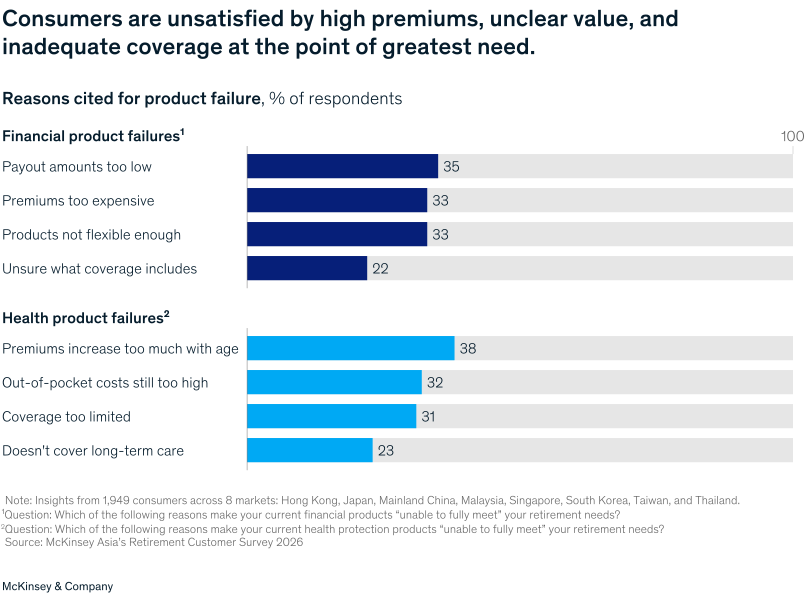
Looking deeper into consumers’ top reasons for perceived financial product failures, an affordability trifecta emerges—payouts too low (35 percent), premiums too expensive (33 percent), and products not flexible enough (33 percent). And with five out of six current product holders identifying specific failures, this is not a satisfaction problem at the margins; it is a fundamental value-engineering challenge.
On the health side, there is an equally concerning dynamic at work. Premiums escalate with age while income declines post-retirement, forcing consumers to reduce or abandon coverage at the point of greatest medical need. Nearly four in ten respondents (38 percent) cite this “scissors effect” as their top health-product failure (Exhibit 2).
Gap 3: The “aware but inactive” majority is blocked by design, not apathy
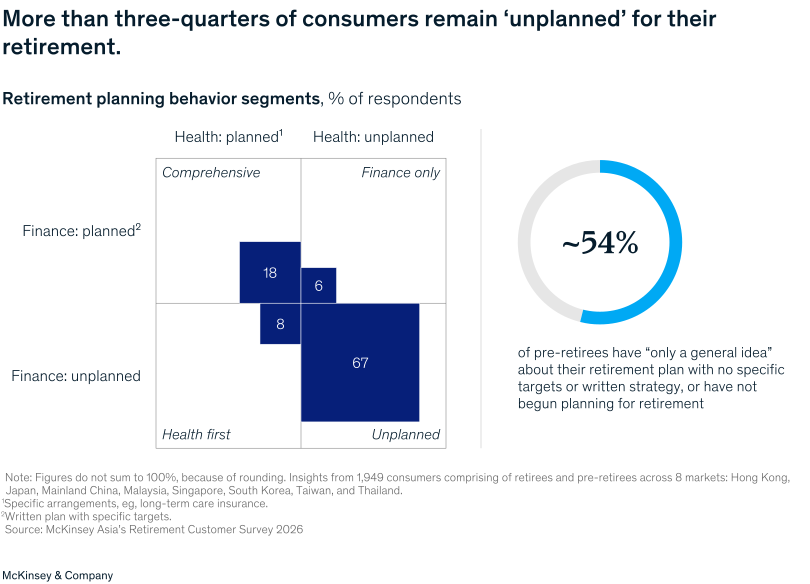
Perhaps the most commercially significant finding in this research is that just over half (54 percent) of pre-retirees have “only a general idea” about their retirement plan, with no specific targets or written strategy, or have not begun their retirement planning. Over two-thirds (67 percent) of all respondents are completely unplanned, with neither a financial plan nor specific health arrangements. Only 18 percent of all respondents have both (Exhibit 3).
When non-holders were asked why they haven’t purchased retirement products, 45 percent said they cannot afford premiums, 24 percent don’t know what products are available, and 21 percent find the products too complex (Exhibit 4). Only 7 percent report structural exclusion (being rejected due to age or health conditions).
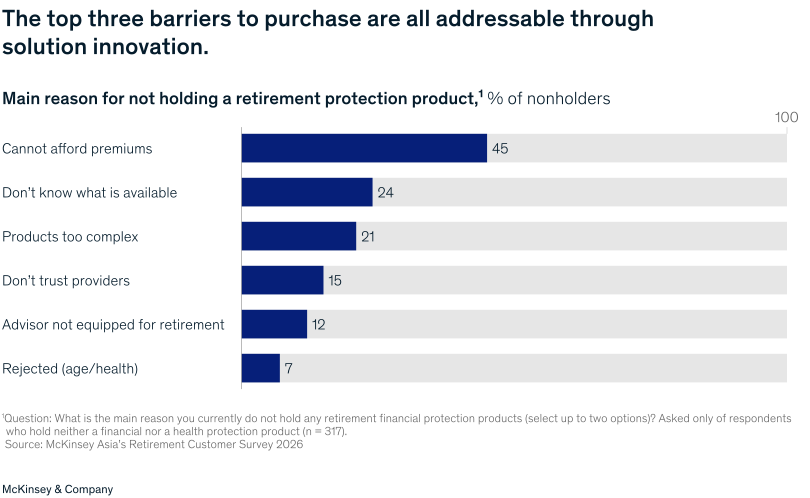
In other words, the vast majority of consumers express a need but cannot find suitable products, cannot understand them, or cannot afford them in their current form. The top three barriers could all be removed by industry through product architecture and new business models.
The gap consumers don’t see: How much is enough?
Consumers themselves systematically underestimate their financial needs in retirement. Across OECD countries, pension replacement rates—the share of pre-retirement earnings replaced by retirement income—are typically around 60 to 70 percent for average earners. Yet in our survey, only 11 percent of pre-retirees expect to need as much as 70 percent. The remainder plan for far less, with 43 percent expecting to get by on just 30 to 50 percent of their current income. This represents a systemic under-planning risk because consumers are unaware of their inadequate preparation.
Younger respondents with less lived experience tend to underestimate what they will need compared to older ones. Only 9 percent of those aged 35 to 44 expect to meet the 70 percent benchmark, versus 17 percent of respondents aged over 55. Regionally, the “super-aged” markets in Asia lead on realism. In Japan, 30 percent of respondents expect to meet the benchmark, followed by South Korea (22 percent), and Taiwan (18 percent), potentially reflecting societies where the true cost of aging is visible in every household.
The unseen gap plays out differently across the markets. South Korea and Taiwan show the classic learning curve, with realism deepening with age; in South Korea, 18 percent of younger respondents felt they would need as much as 70 percent of their pre-retirement earnings, versus 26 percent of senior respondents. In Taiwan, it is 15 percent younger versus 24 percent senior.
Only 3 to 11 percent of younger respondents from China, Malaysia, and Thailand expect to need as much as 70 percent of their current income post retirement, with important implications. China, the country with the largest working-age population in the region, and the fastest-aging major economy, has the shallowest realism of any age-market combination we measured. This may point to entrenched cultural assumptions about frugal old age or reliance on family support that may be more challenging given the demographic reality.
The gaps reflect a structural misalignment between how the industry operates and what consumers need across a 30-year retirement horizon. To break the conversion failure, the industry may need to first break the prevailing “I only need less than half” myth, anchoring every retirement conversation on a personalized replacement-rate target based on an individuals’ needs and aspired retirement lifestyle, benchmarked against the 70 percent OECD norm.
Five shifts to help close the conversion gap
Current business models cannot close these gaps through incremental product improvement alone. Today’s model sees insurance agents distributing products at single moments, whereas consumers indicate needing ongoing relationships triggered by life stages. The current model prices health products on individual age rating, while consumers indicate needing smoothed costs that don’t increase at the point of greatest need. And it sells financial, health, and LTC products separately, despite consumer demand for unified health-wealth solutions.
Failing to close this conversion gap will likely result in aging populations with exhausted savings, and national pension and health systems that were designed for shorter lifespans unable to meet demand.
Five shifts could help providers meet consumer needs and reimagine the industry status quo.
From product manufacturer to retirement platform
Today’s insurers and wealth managers sell standalone products—a life policy here, a health rider there, a pension wrapper elsewhere. But 30 percent of consumers say they want integrated health-and-wealth solutions, and the top three product failures (affordability, flexibility, and inflation protection) all stem from siloed design. Providers could shift to a single platform that orchestrates savings, protection, health coverage, and care access as one unified proposition, where a customer’s financial plan automatically adjusts when their health status changes, and vice versa. One option is enrolling consumers in their 30s and 40s into an integrated longevity platform combining early-age pricing, cohort-level experience adjustments, participating insurance mechanisms, and wellness-linked reserve accumulation where early entrants build reserves that subsidize later-life claims across the cohort (see sidebar, “Building a unified, flexible retirement platform: A thought experiment”). This is a fundamentally different business architecture from designing and distributing discrete policies.
From point-of-sale to lifecycle enrollment
Auto-enrollment at employer onboarding, where workers opt out, rather than opt in, and a system where contributions auto-escalate with salary increases, are two ways to rethink how retirement contributions are structured today. Other approaches include triggering coverage upgrades at major life events such as marriage, childbirth, or a parent’s hospitalization. The United Kingdom’s autoenrollment regime, for example, drove pension participation from 55 percent in 2012, before the introduction of autoenrollment, to 88 percent in 2023 after autoenrollment was introduced. These mechanisms have not yet been applied to insurance and health or LTC products in Asia, but the infrastructure, including employer funds, provident schemes, and social security systems could manage them.
From product complexity to outcome clarity
Nearly half of non-holders (45 percent) are blocked not by cost but by confusion. They don’t know what products are available (24 percent) or find products too complex to understand (21 percent). Building retirement literacy represents a revenue strategy that could operate along three dimensions: 1) employer-embedded engagement where retirement readiness is integrated into workplace benefits programs, leveraging employer trust, recurring attention, and payroll infrastructure to convert awareness into action; 2) outcome-based decision tools, where digital journeys start from the life the customer wants to protect and translates that into the right product combination, hiding complexity behind an outcome interface; and 3) trusted intermediary networks, where retirement education is embedded into mortgage reviews, annual health check-ups, and financial wellness apps. This could help reach the 24 percent of consumers who may never read a product brochure through the channels they already use.
From rational engagement to emotional connection
The industry engages customers through analytical tools such as retirement calculators, gap projections, and risk questionnaires, all framed around “how much do you need?” But our survey reveals that customers’ deepest anxieties are emotional, not mathematical: young people fear isolation in their later years, while seniors fear losing autonomy. And across all ages, becoming a burden to family is a significant worry. Consumer engagement can shift from financial-gap analysis to life-fear understanding—from “your projected shortfall is $X” to “here is how we protect the independence you value most.” Advisors and digital journeys that start with what customers feel, not what actuarial tables project, could convert the 54 percent who have “only a general idea” about their retirement plans or who have not begun planning into active retirement planners.
From commission-driven to outcome-aligned
When advisors earn front-loaded commissions on product sales, incentives are misaligned with 30-year customer journeys. A shift to ongoing fees tied to client outcomes—retirement readiness scores or coverage adequacy milestones, for example—could transform the advisory relationship from transactional to consultative.
The consumers we surveyed are worried about retirement, identify specific product failures, and expect to have sub‑adequate retirement income. The binding constraint to meeting their needs is the mechanisms by which awareness becomes action, and action becomes a product relationship that lasts 30 years.
For insurers and wealth managers who move now—redesigning business models around lifecycle enrollment, pooled risk, and integrated health-wealth platforms—the opportunity is a multi-trillion-dollar market serving the world’s fastest-aging populations with solutions they are actively demanding.