These Rooms Show What a Rug Does That Furniture Alone Can’t

Sofas, tables, beds, and chairs determine how a room functions, but their placement does not always make them feel connected. Rugs fill the floor between those pieces, define where one furniture group ends, and add color or texture where hard flooring would remain exposed.

These rooms show the difference through placement rather than elaborate rug designs. Some rugs stretch beneath every seat, others extend past a bed or dining table, and several use color to connect furniture that would otherwise look separate.
One Rug Connects a Sectional With Two Different Coffee Tables

Blue-gray pile extends beneath the sectional and both overlapping coffee tables, covering the floor between the sofa and tables. Its dark blue tones also contrast with the pale upholstery and pick up the darker sections of the marble tabletop.
A smaller rug centered beneath the tables would leave bare tile between the rug and much of the sectional. Extending it beneath the sofa keeps the coffee tables and seating within the same rectangle.
Dining Furniture Gets Its Own Zone Without Walls

Brown carpeting sits beneath the round dining table and chairs, separating the group from the exposed gray floor around it. All four chair positions remain within the rug instead of straddling its edge.
Dark brown furniture and the rug sit close in color, while the white dimensional wall and pale cabinet surround them with much lighter surfaces. The rug marks the dining area without requiring a screen, cabinet, or change in flooring.
Gray Underfoot Pulls Yellow Chairs and a Sofa Together

Mustard chairs face a gray sofa across a marble coffee table, with each piece bringing a different color and material into the seating area. The gray rug reaches from the sofa to both chairs, so no strip of bare flooring divides them.
Its color also echoes the sofa instead of competing with the mustard upholstery. Yellow remains the strongest accent, while the gray floor covering carries the sofa color across most of the seating arrangement.
Texture on the Wall Meets Texture on the Floor

Dimensional white wall panels create a grid of raised geometric forms behind the long glass-front cabinet. Below, a gray rug covers the seating area and adds texture to a room dominated by glass, dark wood, white walls, and black ceiling elements.
Clear coffee tables leave much of the rug visible from above. Rather than hiding the floor covering beneath a solid tabletop, the glass exposes its woven surface across the center of the room.
Geometric Lines Separate Dark Furniture From Dark Floors

Black lounge chairs sit over dark herringbone flooring, making the black-and-white rug important for contrast. White geometric lines cross beneath the chairs and tables, outlining the furniture against another dark surface.
The rug also reaches from the front chairs toward the shelving unit at the back of the room. Instead of leaving strips of wood floor between each piece, one continuous pattern runs through the seating area.
Rug Extends the Bedroom Past the Bed Frame

Pale carpeting begins beneath the bed and continues beyond its sides and foot, covering the floor beneath the upholstered bench. Bed and bench share similar wood frames, and the rug keeps the space between them from becoming an exposed strip of hard flooring.
Extra width on both sides also gives bare feet a soft landing beside the bed rather than placing the rug where most of it would disappear underneath. The visible border makes the bed area wider than the frame itself.
Transparent Furniture Needs a Defined Floor Beneath It

Glass makes much of this dining table disappear from view, leaving its branching wood base and upholstered chairs as the strongest forms. The gray rug extends well beyond the glass top and beneath the chairs, making the dining area visible even where the tabletop almost disappears.
Its generous size also leaves room behind the chairs. Pulling one away from the table would not place its back legs straight onto the surrounding wood floor.
Teal Connects the Sofa With Smaller Accents

Deep teal carpeting sits beneath the pale sofa and walnut table, repeating the green-blue accent seen in one of the sofa cushions. That color link carries the small cushion accent across a much larger section of the room.
Fringed edges remain exposed beside the furniture, showing exactly where the rug stops and the hard floor begins. The table’s thin black legs also leave most of the teal surface visible instead of covering it.
One Large Rug Fills the Open Floor in Front of the Sofa

Gray carpeting covers most of the floor between the long sofa and low coffee table, leaving a dark border of flooring visible around the arrangement. Its pale tone sits between the light upholstery and much darker tables.
Without another strong color or pattern, attention stays on the furniture shapes and the repeated square lamps. The rug handles the large empty floor area without adding another decorative focal point.
Dark Carpet Separates Pale Upholstery From Pale Wood

Gray lounge seating and a tufted ottoman sit above a charcoal rug that contrasts with the pale wood floor surrounding it. The darker surface makes the chair’s open wood frame and angled legs easier to distinguish.
Raised furniture leaves sections of rug visible beneath the seat, ottoman, and neighboring pieces. Those dark areas fill the gaps between furniture without hiding the pale floor across the rest of the room.
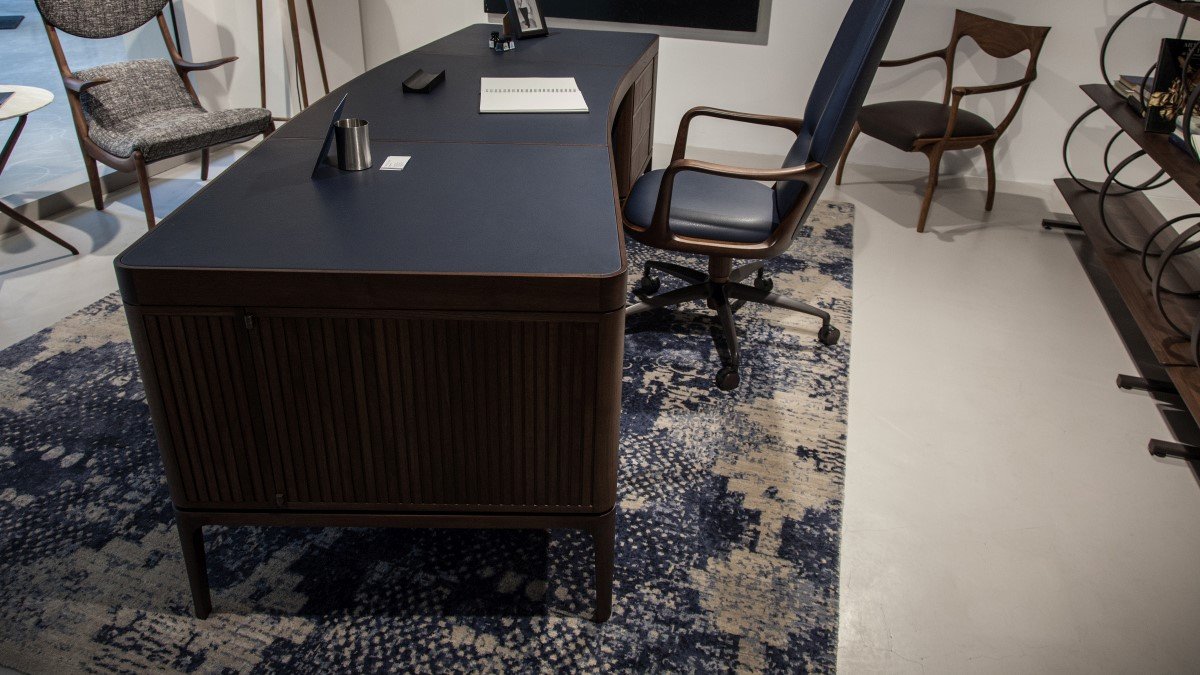
Office Rug Defines the Desk Area

Blue-and-cream pattern runs beneath the large desk and working chair, separating the main workspace from the pale floor around it. Dark blue in the rug also relates to the desk’s navy writing surface and blue leather office chair.
The rug extends beyond the desk on the working side, covering the area where the chair moves in and out. Additional chairs and shelving remain on the bare floor around it, making the desk area distinct without enclosing it.